Liu Mei, Deng Ke, Wang Mingqi, He Qiao, Xu Jiayue, Li Guowei, Zou Kang, Sun Xin, Wang Wen
Institute of Integrated Traditional Chinese and Western Medicine, Chinese Evidence-based Medicine and Cochrane China Center, West China Hospital, Sichuan University, Chengdu, China.
Hospital of Chengdu University of Traditional Chinese Medicine, Chengdu, China.
Integr Med Res. 2025 Mar;14(1):101100. doi: 10.1016/j.imr.2024.101100. Epub 2024 Nov 15.
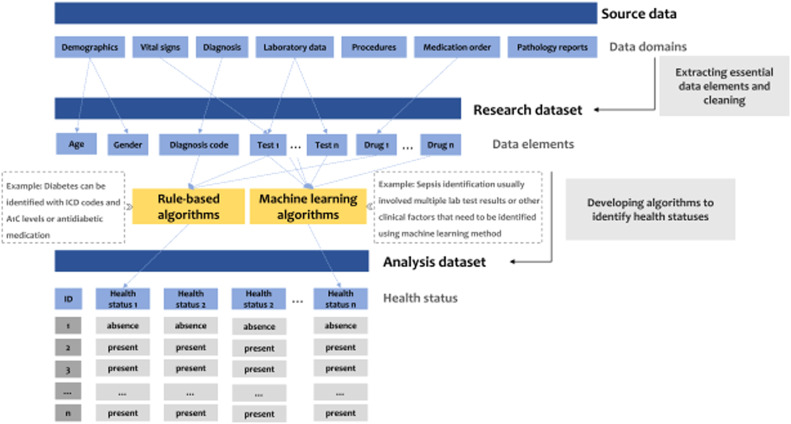
Routinely collected health data (RCD) are currently accelerating publications that evaluate the effectiveness and safety of medicines and medical devices. One of the fundamental steps in using these data is developing algorithms to identify health status that can be used for observational studies. However, the process and methodologies for identifying health status from RCD remain insufficiently understood. While most current methods rely on International Classification of Diseases (ICD) codes, they may not be universally applicable. Although machine learning methods hold promise for more accurately identifying the health status, they remain underutilized in RCD studies. To address these significant methodological gaps, we outline key steps and methodological considerations for identifying health statuses in observational studies using RCD. This review has the potential to boost the credibility of findings from observational studies that use RCD.
常规收集的健康数据(RCD)目前正在加速评估药品和医疗器械有效性与安全性的出版物的发表。使用这些数据的一个基本步骤是开发算法以识别可用于观察性研究的健康状况。然而,从RCD中识别健康状况的过程和方法仍未得到充分理解。虽然当前大多数方法依赖于国际疾病分类(ICD)编码,但它们可能并非普遍适用。尽管机器学习方法有望更准确地识别健康状况,但在RCD研究中仍未得到充分利用。为了弥补这些重大的方法学差距,我们概述了在使用RCD的观察性研究中识别健康状况的关键步骤和方法学考量。本综述有可能提高使用RCD的观察性研究结果的可信度。