Yoon Da-Eun, Moon Heeyoung, Lee In-Seon, Chae Younbyoung
Department of Science in Korean Medicine, College of Korean Medicine, Kyung Hee University, Seoul, Republic of Korea.
Department of Meridian and Acupoints, College of Korean Medicine, Semyung University, Jecheon, Republic of Korea.
Integr Med Res. 2025 Mar;14(1):101115. doi: 10.1016/j.imr.2024.101115. Epub 2024 Dec 12.
Pattern identification is a crucial diagnostic process in Traditional East Asian Medicine, classifying patients with similar symptom patterns. This study aims to identify key symptoms for distinguishing patterns in patients with functional dyspepsia (FD) using explicit (doctor's decision-based) and implicit (computational model-based) approaches.
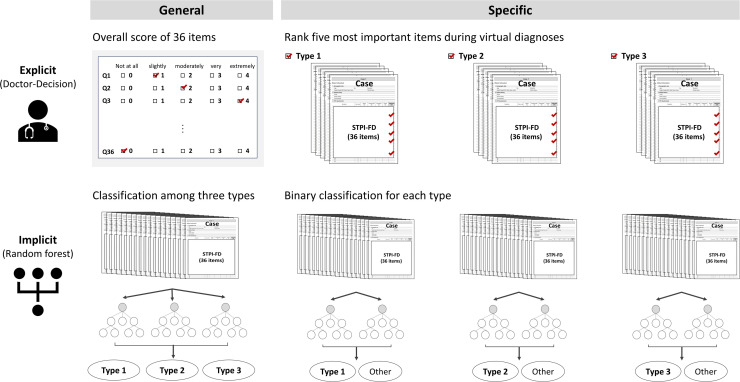
Data from twenty-one FD patients were collected from local clinics of traditional Korean Medicine and provided to three doctors in a standardized format. Each doctor identified patterns among three types: spleen-stomach weakness, spleen deficiency with qi stagnation/liver-stomach disharmony, and food retention. Doctors evaluated the importance of the symptoms indicated by items in the Standard Tool for Pattern Identification of Functional Dyspepsia questionnaire. Explicit importance was determined through doctors' survey by general evaluation and by selecting specific information used for the diagnosis of patient cases. Implicit importance was assessed by feature importance from the random forest classification models, which classify three types for general differentiation and perform binary classification for specific types.
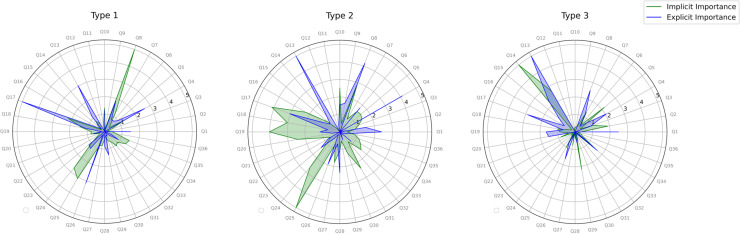
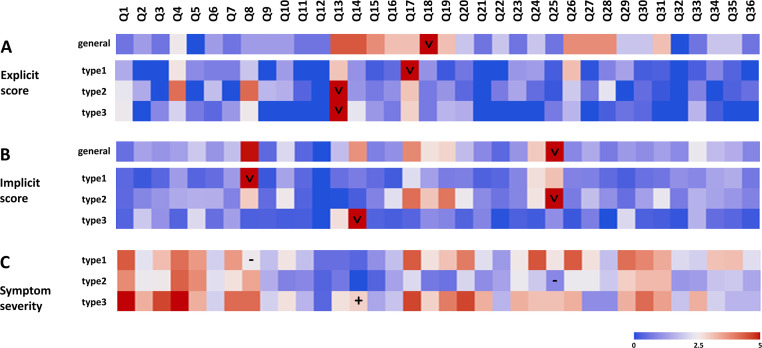
Key symptoms for distinguishing FD patterns were identified using two approaches. Explicit importance highlighted dietary and nausea-related symptoms, while implicit importance identified complexion or chest tightness as generally crucial. Specific symptoms important for particular pattern types were also identified, and significant correlation between implicit and explicit importance scores was observed for types 1 and 3.
This study showed important clinical information for differentiating FD patients using real patient data. Our findings suggest that these approaches can contribute to developing tools for pattern identification with enhanced accuracy and reliability.
证型辨别是东亚传统医学中至关重要的诊断过程,用于对具有相似症状模式的患者进行分类。本研究旨在使用明确(基于医生判断)和隐式(基于计算模型)方法,识别功能性消化不良(FD)患者证型辨别的关键症状。
从韩国当地的传统中医诊所收集了21名FD患者的数据,并以标准化格式提供给三名医生。每位医生在三种证型中进行辨别:脾胃虚弱、脾虚气滞/肝胃不和、食积。医生评估了《功能性消化不良证型辨别标准工具》问卷中各项所指示症状的重要性。通过医生的综合评估调查以及选择用于诊断患者病例的具体信息来确定明确重要性。通过随机森林分类模型的特征重要性来评估隐式重要性,该模型对三种证型进行总体区分,并对特定证型进行二元分类。
使用两种方法确定了区分FD证型的关键症状。明确重要性突出了饮食和恶心相关症状,而隐式重要性则确定面色或胸闷通常至关重要。还确定了对特定证型类型重要的具体症状,并且在第1型和第3型中观察到隐式和明确重要性得分之间存在显著相关性。
本研究展示了使用真实患者数据区分FD患者的重要临床信息。我们的研究结果表明,这些方法有助于开发具有更高准确性和可靠性的证型辨别工具。