Yang Yunpeng, Lu Yong, Gao Changshan, Nie Yanhong, Wang Hongfei, Huang Yufei, Dong Haiyan, Sun Qiang
Jiangsu Co-innovation Center for Prevention and Control of Important Animal Infectious Diseases and Zoonoses, College of Veterinary Medicine, Yangzhou University, Yangzhou, 225009, China.
Institute of Comparative Medicine, Yangzhou University, Yangzhou, 225009, China.
Heliyon. 2025 Jan 12;11(2):e41912. doi: 10.1016/j.heliyon.2025.e41912. eCollection 2025 Jan 30.
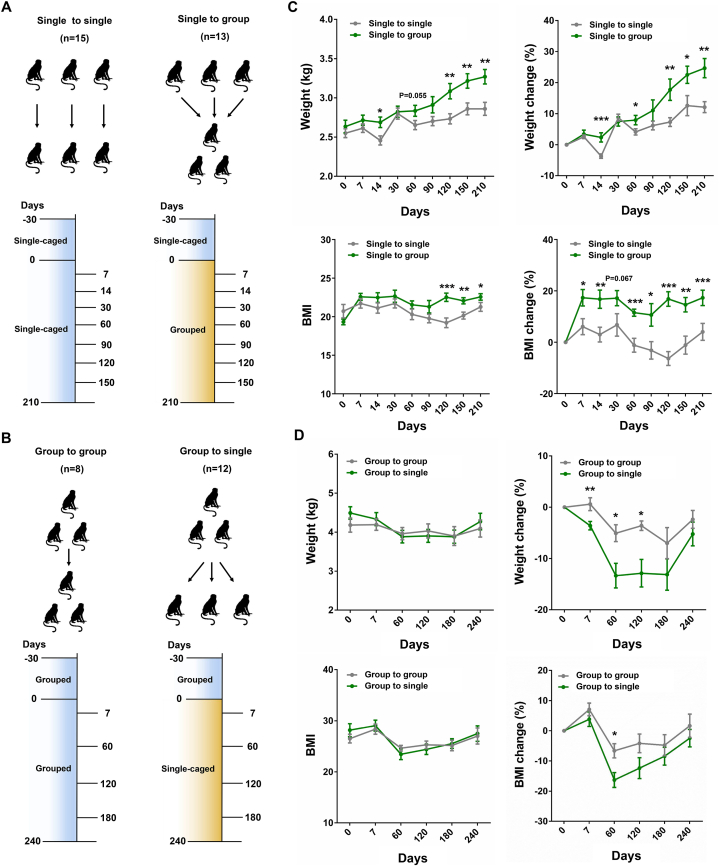
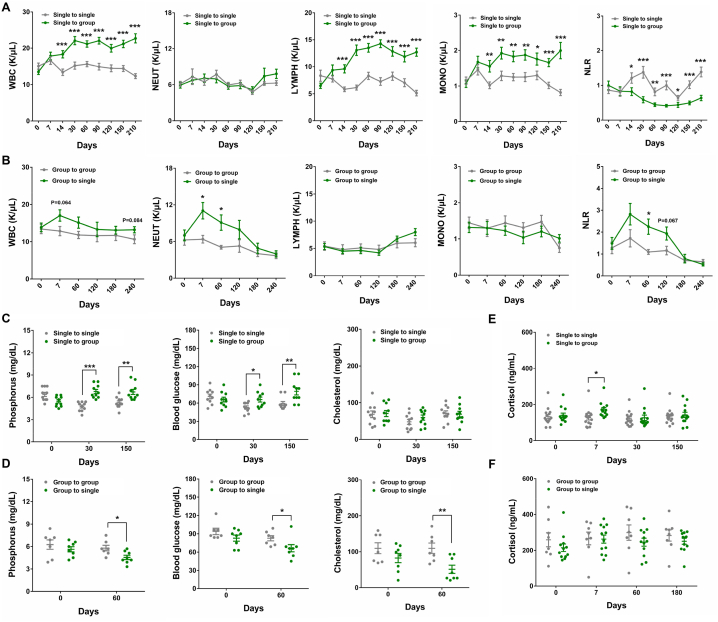
Laboratory non-human primates (NHPs) are commonly subjected to social deprivation in various scientific researches. However, the impact of social deprivation on gut microbiome remains largely unknown. We examined the health status and gut microbiota of female cynomolgus monkeys housed in isolation or social conditions and found that social deprivation brought adverse effects to monkeys by inhibiting their growth, remodeling the immune status, and decreasing the level of beneficial biochemical parameters. 16S rRNA gene sequencing revealed that the gut microbial composition and function differed between grouped and isolated monkeys. Specifically, grouping the single-caged young monkeys to socially housed condition could decrease the relative abundance of Firmicutes and increase the relative abundance of Bacteroidetes, while separating the socially housed middle-aged monkeys into single cages showed the opposite trend. Besides, training female monkeys to detect menstruation under socially-housed condition could increase their body weight change and adjusting their immune status, thus attenuating the adverse effects of separating them to single cages. Our results verified the significant role of grouping in mitigating adverse health and microbiota alterations caused by isolation in female cynomolgus monkeys and emphasized the importance of training NHPs to cooperate with experimental procedures under socially housed condition, which could not only improve the welfare of cynomolgus monkeys but also enhance the accuracy and reliability of scientific results.
在各种科学研究中,实验用非人灵长类动物(NHPs)通常会遭受社会剥夺。然而,社会剥夺对肠道微生物群的影响在很大程度上仍不清楚。我们检查了单独饲养或群居条件下的雌性食蟹猴的健康状况和肠道微生物群,发现社会剥夺通过抑制其生长、重塑免疫状态和降低有益生化参数水平给猴子带来了不利影响。16S rRNA基因测序显示,群居和单独饲养的猴子的肠道微生物组成和功能存在差异。具体而言,将单笼饲养的幼猴分组到群居条件下可以降低厚壁菌门的相对丰度,增加拟杆菌门的相对丰度,而将群居的中年猴子分到单笼中则呈现相反的趋势。此外,训练雌性猴子在群居条件下检测月经可以增加它们的体重变化并调节其免疫状态,从而减轻将它们分到单笼中的不利影响。我们的结果证实了分组在减轻雌性食蟹猴因隔离导致的不良健康和微生物群改变方面的重要作用,并强调了训练非人灵长类动物在群居条件下配合实验程序的重要性,这不仅可以提高食蟹猴的福利,还可以提高科学结果的准确性和可靠性。