Yadav Arun Singh, Rajendra Kiragasur Madegowda, Sravanti Lakshmi, Kommu John Vijay Sagar, Seshadri Shekhar, Girimaji Satish Chandra
Department of Psychiatry, 174 Military Hospital, Bathinda Cantt., Bathinda, Punjab, India.
Department of Child and Adolescent Psychiatry, NIMHANS, Bengaluru, Karnataka, India.
Ind Psychiatry J. 2024 Jul-Dec;33(2):305-311. doi: 10.4103/ipj.ipj_133_24. Epub 2024 Dec 17.
School refusal behaviour is an umbrella term that often subsumes constructs such as truancy, school refusal, and school phobia. It is influenced by various psychological and psychosocial factors and can lead to significant distress to the child and the family.
To assess the clinical and functional profile of school refusal behavior in children and adolescents presenting to a tertiary care child and adolescent psychiatry center in the Indian context.
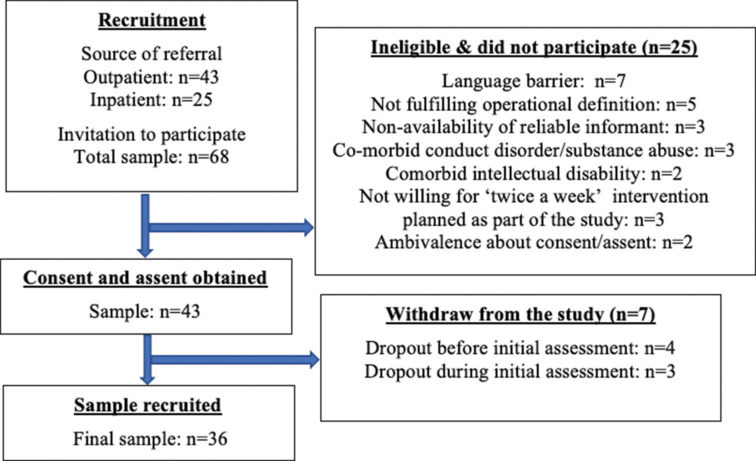
Thirty-six subjects (6-17 years) presenting to a tertiary Child and Adolescent Psychiatry service with school refusal behavior (SRB) were evaluated using the MINI-KID 6.0 and School Refusal Assessment Scale-Revised (SRAS-R). The sociodemographic and clinical characteristics of the sample were studied using frequency analysis and central tendencies. The association between school refusal and these variables was examined using Cramer's coefficient.
Anxiety in social/evaluative situations associated with tangible rewards at home was the predominant primary reason for school refusal in this sample. There was a significant statistical association between functions of school refusal and scholastic performance, psychiatric diagnosis, and family stressors. The Children's Global Assessment Scale (CGAS) scores varied widely from 30 to 80 indicating an inability to function in almost all areas to no more than a slight impairment in functioning.
School refusal is a complex multifactorial phenomenon with both individual and psychosocial contributing factors. Understanding the phenomenon from a functional perspective helps in devising an individualized treatment plan that may lead to better outcomes.
拒学行为是一个统称,通常包含逃学、拒学和学校恐惧症等概念。它受到多种心理和社会心理因素的影响,会给儿童及其家庭带来极大困扰。
在印度背景下,评估前往三级儿童和青少年精神病学中心就诊的儿童和青少年拒学行为的临床和功能特征。
使用儿童版简明国际神经精神访谈量表(MINI-KID 6.0)和修订版拒学评估量表(SRAS-R)对36名(6至17岁)因拒学行为(SRB)前往三级儿童和青少年精神病学服务机构就诊的受试者进行评估。通过频率分析和集中趋势研究样本的社会人口统计学和临床特征。使用克莱默系数检验拒学与这些变量之间的关联。
在社交/评估情境中伴有家中切实奖励的焦虑是该样本中拒学的主要首要原因。拒学功能与学业成绩、精神诊断和家庭压力源之间存在显著的统计学关联。儿童总体评估量表(CGAS)得分在30至80之间差异很大,表明在几乎所有领域都无法正常发挥功能到功能仅有轻微受损。
拒学是一种复杂的多因素现象,涉及个体和社会心理因素。从功能角度理解这一现象有助于制定个性化的治疗方案,可能会带来更好的治疗效果。