Henricks Jonathan, Haddad Tyler, Ahmed Omair, Schoenhals Jonathan, Kumar Pavnesh, Wilson Ryan, Ma Jianing, Wang Jing Gennie, Wert Michael, Esguerra Vincent, Bentley Ian, Johnson Kai, Stover Daniel, Jhawar Sachin R, Gatti-Mays Margaret, Ho Kevin
Department of Internal Medicine, Ohio State University, Columbus, OH, USA.
Department of Pulmonary, Critical Care, and Sleep Medicine, Ohio State University, Columbus, OH, USA.
Breast Cancer Res. 2025 Feb 3;27(1):16. doi: 10.1186/s13058-025-01967-1.
Trastuzumab deruxtecan (T-DXd) is FDA-approved for treatment of patients with HER2 positive and HER2-low metastatic breast cancer. Currently, there is limited understanding of pre-treatment risk factors for pneumonitis associated with T-DXd.
Consecutive breast cancer patients who received at least one dose of T-DXd at a single academic cancer study between January 1, 2019, and February 20, 2024, were identified for analysis. Pneumonitis was documented by the treating oncologist at the time of toxicity and retrospectively independently confirmed by a member of the study team through chart and radiologic review. Pre-treatment variables of interest were collected, including patient demographics, radiation dosimetry variables, and chest imaging abnormalities.
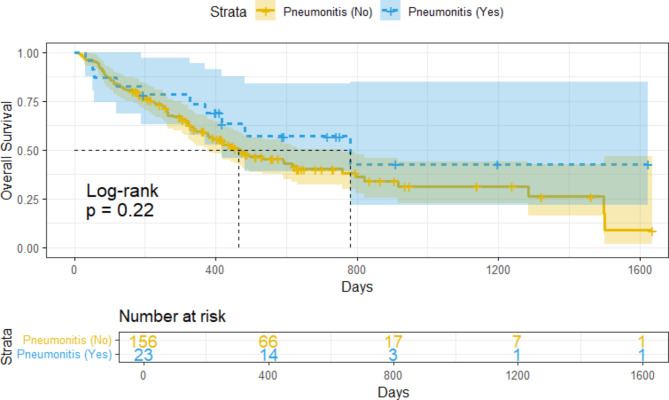
Of 179 total patients, 23 (12.8%) had pneumonitis after T-DXd exposure. Patients with pneumonitis had lower baseline oxygen saturation (98% vs. 97%, p = 0.02) and were more likely to have received abemaciclib (26.1% vs. 9.6%, p = 0.03) before T-DXd. Multiple pre-treatment variables were not found to be associated with T-DXd pneumonitis, including chest imaging abnormalities (41.9% vs. 47.8%, p = 0.59), prior immune checkpoint inhibitor treatment (16.0% vs. 8.7%, p = 0.50) and prior chest or breast radiation (61.5% vs. 47.8%, p = 0.20). On multivariate analysis, prior treatment with abemaciclib remained significantly associated with T-DXd pneumonitis (OR 3.25 [1.07-9.11], p = 0.04), while neither pre-treatment chest imaging abnormalities nor prior chest or breast radiation were associated (OR 1.60 [0.62-4.20], p = 0.33); OR 0.51 [0.20-1.33], p = 0.17).
In this cohort, prior treatment with abemaciclib may be a risk factor for T-DXd pneumonitis. Conversely, pre-treatment chest imaging abnormalities, prior immune checkpoint inhibitor treatment, and prior chest or breast radiation did not increase the risk of T-DXd pneumonitis. Larger studies are warranted to validate these findings toward an improved understanding of risk factors for pneumonitis after T-DXd exposure.
曲妥珠单抗德鲁昔单抗(T-DXd)已获美国食品药品监督管理局(FDA)批准,用于治疗人表皮生长因子受体2(HER2)阳性和HER2低表达的转移性乳腺癌患者。目前,对于与T-DXd相关的肺炎的治疗前风险因素了解有限。
确定在2019年1月1日至2024年2月20日期间于一项学术癌症研究中接受至少一剂T-DXd的连续性乳腺癌患者进行分析。肺炎由主治肿瘤学家在出现毒性反应时记录,并由研究团队成员通过病历和影像学检查进行回顾性独立确认。收集感兴趣的治疗前变量,包括患者人口统计学数据、放射剂量学变量和胸部影像学异常。
在179例患者中,23例(12.8%)在接受T-DXd治疗后发生肺炎。发生肺炎的患者基线血氧饱和度较低(98%对97%,p=0.02),且在接受T-DXd治疗前更有可能接受过阿贝西利治疗(26.1%对9.6%,p=0.03)。未发现多个治疗前变量与T-DXd相关性肺炎有关,包括胸部影像学异常(41.9%对47.8%,p=0.59)、既往免疫检查点抑制剂治疗(16.0%对8.7%,p=0.50)以及既往胸部或乳腺放疗(61.5%对47.8%,p=0.20)。多因素分析显示,既往接受阿贝西利治疗仍与T-DXd相关性肺炎显著相关(比值比[OR]3.25[1.07-9.11],p=0.04),而治疗前胸部影像学异常和既往胸部或乳腺放疗均无相关性(OR 1.60[0.62-4.20],p=0.33;OR 0.51[0.20-1.33],p=0.17)。
在该队列中,既往接受阿贝西利治疗可能是T-DXd相关性肺炎的一个风险因素。相反,治疗前胸部影像学异常、既往免疫检查点抑制剂治疗以及既往胸部或乳腺放疗并未增加T-DXd相关性肺炎的风险。需要开展更大规模的研究来验证这些发现,以更好地了解T-DXd治疗后肺炎的风险因素。