Gustafson Deborah R, Li Xuantao, Baird Alison E, Zetterberg Henrik, Blennow Kaj, Zhang Jinbing, Spence Amanda Blair, Maki Pauline, Sharma Anjali, Weber Kathleen, Yucel Recai
Department of Neurology, State University of New York Downstate Health Sciences University, Brooklyn, NY, USA.
Clinical Neurochemistry Laboratory, Sahlgrenska University Hospital, Mölndal, Sweden.
EClinicalMedicine. 2025 Jan 21;80:103052. doi: 10.1016/j.eclinm.2024.103052. eCollection 2025 Feb.
Blood-based biomarkers of Alzheimer's disease (AD) and stroke, including serum neurofilament light chain (sNFL), are understudied in women living with and without HIV.
We assessed cross-sectional and longitudinal change in sNFL between 2008 and 2019 associated with neuropsychological performance (NP) among women living with HIV (WLWH) and without HIV (WLWOH) age ≥40 years in the Women's Interagency HIV Study. Baseline and repeated ∼8-year fasting sNFL levels were measured using Simoa. Sociodemographically-adjusted NP T-scores (attention, working memory, executive function, processing speed, learning, verbal fluency and global) were calculated. Multivariable linear regression analyses stratified by HIV serostatus examined cross-sectional baseline and follow-up associations, and ∼8-year change in sNFL level related to global and domain-specific NP T-scores.
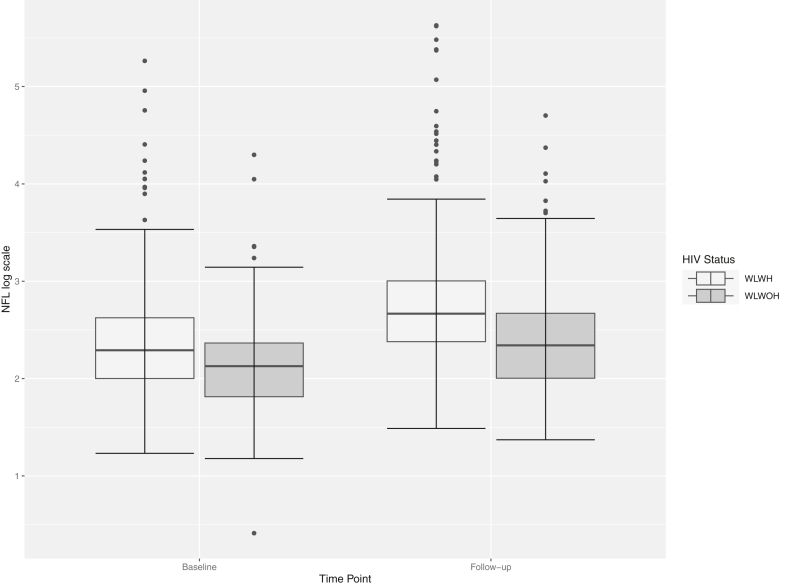
417 participants (290 WLWH, 127 WLWOH), African American/Black (55%), ≥high school education (69%), current/former smokers (79%), and overweight/obese (BMI ≥25.0 kg/m, 74%) were included. Compared to WLWOH at baseline, WLWH performed worse on memory and global NP. WLWH versus WLWOH had higher baseline (p ≤ 0.001) and follow-up median (p < 0.0001) sNFL levels and ∼8-year change (46.5% in WLWH versus 24.4% in WLWOH, p < 0.0001). Among WLWH, higher baseline sNFL was associated with poorer processing speed, learning, memory and verbal fluency. Among WLWOH, higher baseline sNFL was associated with poorer executive function, processing speed and verbal fluency. Among WLWH, higher follow-up sNFL was associated with poorer executive function. Among WLWOH, higher follow-up sNFL was associated with poorer executive function, processing speed, attention, memory, and global NP. ∼8-year increase in sNFL occurred in both WLWH and WLWOH and was associated with poorer executive function, processing speed, memory, and global performance at follow-up among WLWOH, and poorer executive function in WLWH. Adjustment for multiple comparisons showed associations at cross-sectional follow-up and ∼8-year increase in sNFL in WLWOH, only. Higher sNFL was associated with poorer baseline processing speed in WLWH only.
Higher levels and greater ∼8-year increases in sNFL were associated with poorer NP by domain in WLWH and WLWOH differentially over time.
The contents of this publication are solely the responsibility of the authors and do not represent the official views of the National Institutes of Health (NIH). MACS/WIHS Combined Cohort Study (MWCCS) (Principal Investigators: Bronx CRS (Kathryn Anastos, David Hanna, and Anjali Sharma), U01-HL146204; Brooklyn CRS (Deborah Gustafson and Tracey Wilson), U01-HL146202; Data Analysis and Coordination Center (Gypsyamber D'Souza, Stephen Gange and Elizabeth Topper), U01-HL146193; Chicago-Cook County CRS (Mardge Cohen and Audrey French), U01-HL146245; Northern California CRS (Bradley Aouizerat, Jennifer Price, and Phyllis Tien), U01-HL146242; Metropolitan Washington CRS (Seble Kassaye and Daniel Merenstein), U01-HL146205. The MWCCS is funded primarily by the National Heart, Lung, and Blood Institute (NHLBI), with additional co-funding from the Eunice Kennedy Shriver National Institute of Child Health and Human Development (NICHD), National Institute on Aging (NIA), National Institute of Dental and Craniofacial Research (NIDCR), National Institute of Allergy and Infectious Diseases (NIAID), National Institute of Neurological Disorders and Stroke (NINDS), National Institute of Mental Health (NIMH), National Institute on Drug Abuse (NIDA), National Institute of Nursing Research (NINR), National Cancer Institute (NCI), National Institute on Alcohol Abuse and Alcoholism (NIAAA), National Institute on Deafness and Other Communication Disorders (NIDCD), National Institute of Diabetes and Digestive and Kidney Diseases (NIDDK), National Institute on Minority Health and Health Disparities (NIMHD), and in coordination and alignment with the research priorities of the National Institutes of Health, Office of AIDS Research (OAR). MWCCS data collection is also supported by UL1-TR000004 (UCSF CTSA), UL1-TR003098 (JHU ICTR), UL1-TR001881 (UCLA CTSI).
在感染和未感染艾滋病毒的女性中,对阿尔茨海默病(AD)和中风的血液生物标志物,包括血清神经丝轻链(sNFL)的研究较少。
在女性机构间艾滋病毒研究中,我们评估了2008年至2019年间,年龄≥40岁的感染艾滋病毒女性(WLWH)和未感染艾滋病毒女性(WLWOH)中,sNFL的横断面和纵向变化与神经心理表现(NP)之间的关系。使用Simoa测量基线和大约8年的空腹sNFL水平。计算经社会人口统计学调整的NP T分数(注意力、工作记忆、执行功能、处理速度、学习、语言流畅性和整体)。按艾滋病毒血清学状态分层的多变量线性回归分析,检查了横断面基线和随访关联,以及sNFL水平与整体和特定领域NP T分数相关的大约8年变化。
纳入了417名参与者(290名WLWH,127名WLWOH),其中非裔美国人/黑人占55%,高中及以上学历占69%,当前/曾经吸烟者占79%,超重/肥胖(BMI≥25.0kg/m)占74%。与基线时的WLWOH相比,WLWH在记忆和整体NP方面表现更差。WLWH与WLWOH相比,基线(p≤0.001)和随访中位数(p<0.0001)的sNFL水平更高,且大约8年的变化更大(WLWH为46.5%,WLWOH为24.4%,p<0.0001)。在WLWH中,较高的基线sNFL与较差的处理速度、学习、记忆和语言流畅性相关。在WLWOH中,较高的基线sNFL与较差的执行功能、处理速度和语言流畅性相关。在WLWH中,较高的随访sNFL与较差的执行功能相关。在WLWOH中,较高的随访sNFL与较差的执行功能、处理速度、注意力、记忆和整体NP相关。WLWH和WLWOH的sNFL均出现了大约8年的增加,并且与WLWOH随访时较差的执行功能、处理速度、记忆和整体表现相关,以及与WLWH较差的执行功能相关。多重比较调整显示,仅在WLWOH的横断面随访和sNFL大约8年增加时存在关联。较高的sNFL仅与WLWH中较差的基线处理速度相关。
随着时间的推移,WLWH和WLWOH中较高的sNFL水平和更大的大约8年增加幅度,分别与特定领域较差的NP相关。
本出版物的内容仅由作者负责,并不代表美国国立卫生研究院(NIH)的官方观点。MACS/WIHS联合队列研究(MWCCS)(主要研究者:布朗克斯临床研究站点(凯瑟琳·阿纳斯托斯、大卫·汉纳和安贾利·夏尔马),U01-HL146204;布鲁克林临床研究站点(黛博拉·古斯塔夫森和特蕾西·威尔逊),U01-HL146202;数据分析与协调中心(吉普赛安布尔·德索萨、斯蒂芬·甘奇和伊丽莎白·托珀),U01-HL146193;芝加哥-库克县临床研究站点(玛吉·科恩和奥黛丽·弗伦奇),U01-HL146245;北加利福尼亚临床研究站点(布拉德利·奥伊泽拉特、詹妮弗·普赖斯和菲利斯·田),U01-HL146242;华盛顿特区临床研究站点(塞布尔·卡萨耶和丹尼尔·梅伦斯坦),U01-HL146205。MWCCS主要由美国国立心肺血液研究所(NHLBI)资助,此外还得到了尤妮斯·肯尼迪·施莱佛国家儿童健康与人类发展研究所(NICHD)、国立衰老研究所(NIA)、国立牙科和颅面研究所(NIDCR)、国立过敏和传染病研究所(NIAID)、国立神经疾病和中风研究所(NINDS)、国立精神卫生研究所(NIMH)、国立药物滥用研究所(NIDA)、国立护理研究所以及国家癌症研究所(NCI)、国立酒精滥用和酒精中毒研究所(NIAAA)、国立聋哑和其他交流障碍研究所(NIDCD)、国立糖尿病、消化和肾脏疾病研究所(NIDDK)、国立少数族裔健康和健康差异研究所(NIMHD)的共同资助,并与美国国立卫生研究院艾滋病研究办公室(OAR)的研究重点进行协调和一致。MWCCS数据收集还得到了UL1-TR000004(加州大学旧金山分校临床与转化科学中心)、UL1-TR003098(约翰霍普金斯大学临床与转化研究中心)、UL1-TR001881(加州大学洛杉矶分校临床与转化科学研究所)的支持。