
原发性葡萄膜黑色素瘤的经玻璃体视网膜脉络膜活检显示,低风险疾病中低HLA I类分子与高自然杀伤细胞丰度之间存在关联。
Transvitreal Retinochoroidal Biopsies of Primary Uveal Melanoma Reveal an Association of Low HLA Class I and High NK Cell Abundance in Low-Risk Disease.
作者信息
Bol Kalijn Fredrike, Sweep Mark Wilhelmus Dirk, Crowther Michael Douglas, Gorris Mark Antonius Johannes, Aroca Lara Pedro, Draghi Arianna, Bagger Mette Marie, Faber Carsten, Textor Johannes, Donia Marco, Kiilgaard Jens Folke, Svane Inge Marie
机构信息
Department of Medical Oncology, Radboud University Medical Center, Nijmegen, the Netherlands.
Department of Medical BioSciences, Radboud University Medical Center, Nijmegen, the Netherlands.
出版信息
Invest Ophthalmol Vis Sci. 2025 Feb 3;66(2):24. doi: 10.1167/iovs.66.2.24.
PURPOSE
Immune cells in primary uveal melanoma (PUM) have mostly been studied in enucleated tissue, thereby precluding material from thinner, low-risk PUM tumors for research purposes. Here, we investigated the feasibility of using tumor tissue acquired by transvitreal retinochoroidal (TVRC) tumor biopsies to study the tumor immune microenvironment and relation to genetic risk class.
METHODS
Collected tumor biopsies of 41 patients were tested for genetic aberrations to determine high-risk (n = 19), medium-risk (n = 12), and low-risk (n = 9) tumors and were digested for flow cytometry analysis of immune cell and tumor markers. In addition, 13 patient-matched enucleated tumors were stained using multiplex immunohistochemistry.
RESULTS
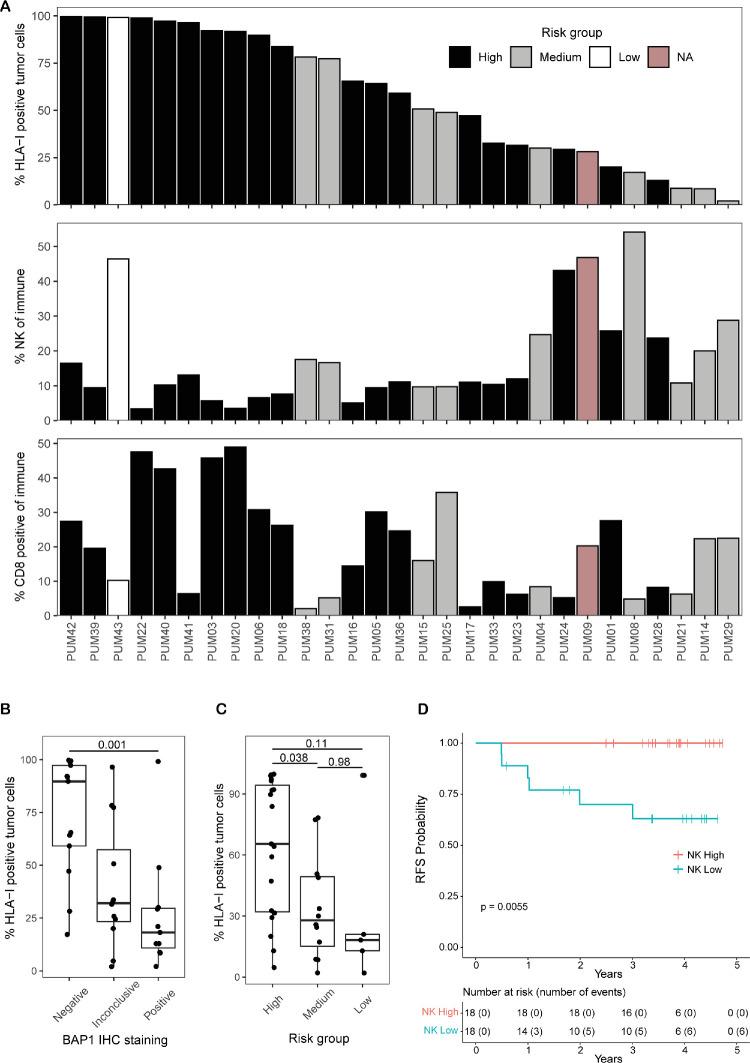
Tumor biopsies showed a high variability in the degree of immune infiltration. The tumor-specific lymphocyte infiltration pattern correlated well with the infiltration pattern in patient-matched enucleations. High-risk tumors tended to have a higher abundance of CD8 T cells, which expressed activation markers CD39, CD69, and PD-1, with reduced CD127 expression. In general, low-risk tumors exhibited decreased human leukocyte antigen (HLA) class I expression, coinciding with a higher abundance of natural killer (NK) cells (P = 0.0049), indicating a different lymphocyte infiltration pattern between low-, medium- and high-risk tumors.
CONCLUSIONS
TVRC biopsies are a suitable and valuable source of PUM tissue for research purposes. An abundance of CD8 T cells was found in high-risk PUM tumors. Further, medium- and low-risk PUM tumors are characterized by decreased HLA class I expression with a concomitant increase in NK cell infiltration as compared to high-risk PUM tumors, correlating with decreased risk of disease recurrence.
目的
原发性葡萄膜黑色素瘤(PUM)中的免疫细胞大多是在摘除的组织中进行研究,从而无法获取较薄的低风险PUM肿瘤组织用于研究目的。在此,我们研究了使用经玻璃体视网膜脉络膜(TVRC)肿瘤活检获取的肿瘤组织来研究肿瘤免疫微环境及其与遗传风险分类的关系的可行性。
方法
对收集的41例患者的肿瘤活检样本进行基因异常检测,以确定高风险(n = 19)、中风险(n = 12)和低风险(n = 9)肿瘤,并进行消化处理以进行免疫细胞和肿瘤标志物的流式细胞术分析。此外,对13例患者匹配的摘除肿瘤进行多重免疫组化染色。
结果
肿瘤活检显示免疫浸润程度存在高度变异性。肿瘤特异性淋巴细胞浸润模式与患者匹配的摘除肿瘤中的浸润模式密切相关。高风险肿瘤往往有更高丰度的CD8 T细胞,其表达激活标志物CD39、CD69和PD - 1,同时CD127表达降低。一般来说,低风险肿瘤表现出人类白细胞抗原(HLA)I类表达降低,同时自然杀伤(NK)细胞丰度较高(P = 0.0049),表明低、中、高风险肿瘤之间存在不同的淋巴细胞浸润模式。
结论
TVRC活检是用于研究目的的PUM组织的合适且有价值的来源。在高风险PUM肿瘤中发现了大量的CD8 T细胞。此外,与高风险PUM肿瘤相比,中、低风险PUM肿瘤的特征是HLA I类表达降低,同时NK细胞浸润增加,这与疾病复发风险降低相关。


 Zotero 插件