Kumar Ashok, Anwar Shayan Sirat Maheen, Bilal Khawar, Ahmed Anwar, Samnani Saira, Zafar Burhan
Department of Radiology, The Aga Khan University Hospital, Karachi, Pakistan.
Surg Neurol Int. 2025 Jan 31;16:31. doi: 10.25259/SNI_1021_2024. eCollection 2025.
Neurovascular conflict is considered one of the main causes of Trigeminal neuralgia, and 3D fast imaging employing steady-state acquisition magnetic resonance imaging (MRI) is the diagnostic imaging of choice. However, no tool is available to confirm imaging findings as the primary cause of trigeminal neuralgia because neurovascular contact is frequently found in asymptomatic individuals, according to some literature, although very little data is available till now. Therefore, we aim to determine the frequency of trigeminal neurovascular contact, involved nerve segment, culprit vessel, and characteristics of contacts in asymptomatic individuals. Knowledge about this is very crucial so that every patient may not be labeled as having neurovascular conflict as the primary cause and can be saved from unnecessary surgeries.
A retrospective observational study was conducted on 105 MRI brain scans of asymptomatic individuals for trigeminal neurovascular relationships by two expert neuro-radiologists. Percentages calculated for categorical variables and for continuous variables Shapiro-Wilk test were used. The Fisher Exact test is used to assess the association between conflict and other variables. Inter-rater reliability was computed for the outcome and other variables and Cohen's kappa to evaluate the strength of agreement. All calculations were performed using STATA version 17.0.
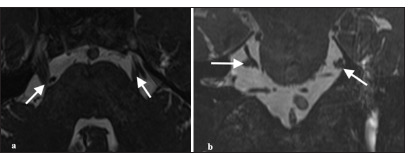
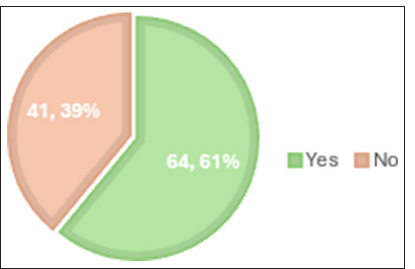
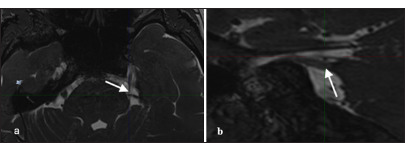
Out of 105 cases, neuro-vascular contact was identified in 64 cases. The most common contacting vessel was the superior cerebellar artery. The most common nerve segment involved was the cisternal segment, followed by the Root entry zone and porous trigeminus. In about 54 cases, the vessel was abutting the nerve, while in eight cases, it was compressing and, in two cases, displacing the nerve. The superior surface of the nerve was commonly involved. The inter-rater reliability between both neuroradiologists showed significant agreement.
Neurovascular contact is found in asymptomatic individuals, so just the presence of contact in symptomatic individuals on MRI should not be considered as only the cause of trigeminal neuralgia. It is important to identify nerve thinning and distortion, which are more reliable signs.
神经血管冲突被认为是三叉神经痛的主要原因之一,采用稳态采集磁共振成像(MRI)的三维快速成像技术是首选的诊断成像方法。然而,由于根据一些文献报道,尽管目前可用的数据很少,但在无症状个体中经常发现神经血管接触,因此尚无工具可确认成像结果是三叉神经痛的主要原因。因此,我们旨在确定无症状个体中三叉神经血管接触的频率、受累神经节段、责任血管以及接触的特征。了解这些知识非常关键,这样就不会将每个患者都标记为以神经血管冲突为主要原因,从而避免不必要的手术。
由两位神经放射学专家对105例无症状个体的脑部MRI扫描进行回顾性观察研究,以分析三叉神经血管关系。对分类变量计算百分比,对连续变量使用Shapiro-Wilk检验。采用Fisher精确检验评估冲突与其他变量之间的关联。计算结果和其他变量的评分者间信度,并使用Cohen's kappa评估一致性强度。所有计算均使用STATA 17.0版本进行。
在105例病例中,64例发现神经血管接触。最常见的接触血管是小脑上动脉。最常受累的神经节段是脑池段,其次是神经根入区和三叉神经孔。约54例中,血管与神经相邻,8例中血管对神经有压迫,2例中血管对神经有移位。神经的上表面通常受累。两位神经放射科医生之间的评分者间信度显示出显著的一致性。
在无症状个体中发现神经血管接触,因此仅在有症状个体的MRI上发现接触不应被视为三叉神经痛的唯一原因。识别神经变细和扭曲很重要,这些是更可靠的体征。