
Pressure Swing Absorption and Desorption of Ammonia in Calcium Halide Solid Mixtures.
作者信息
Tokushige Manabu, Fujisawa Ryota, Aika Ken-Ichi, Ryu Junichi
机构信息
Graduate School of Engineering, Chiba University, Chiba 263-8522, Japan.
Green Ammonia Research Center, Numazu Kogyo Koto Senmon Gakko, Numazu, Shizuoka 410-0022, Japan.
出版信息
ACS Omega. 2025 Jan 24;10(4):3709-3717. doi: 10.1021/acsomega.4c08919. eCollection 2025 Feb 4.
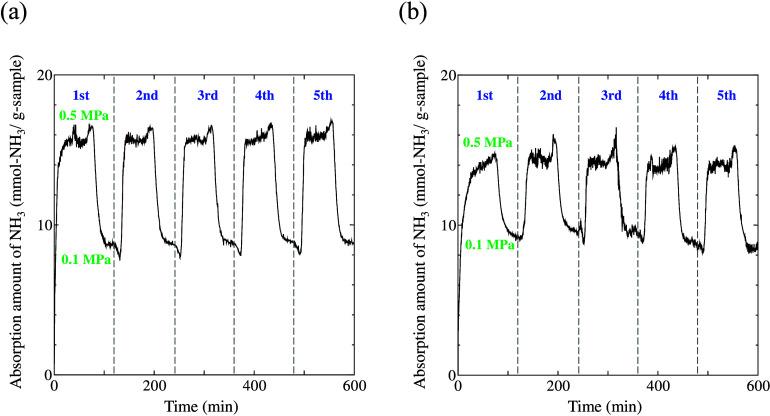
The absorption and desorption behaviors of NH in solid CaCl-CaBr were investigated using the pressure-swing method at 473 K. Various compositions of CaCl-CaBr solid mixture particles were formed by the impregnation method, and the solid-mixture effect on the NH absorption behavior was evaluated. The compositional changes in the lattice sizes followed Vegard's law. For the solid mixture, the absorption rate of NH increased because NH was absorbed into CaCl-CaBr at a lower energy and higher rate than CaCl single salt. For = 1.67 in CaCl Br , the highest storage capacity was obtained; however, NH desorption was not observed until ≤ 1.00 in CaCl Br , similar to the findings of CaBr single salt. Two absorption energy curves were observed for CaCl-CaBr with different compositions, indicating the formation of solid mixtures with different solvent lattices, namely, a CaCl-CaBr solid mixture in the CaCl and CaBr lattices, respectively. After five cycles of NH absorption/desorption, degradations such as capacity fade and phase segregation in the CaCl-CaBr particles were not observed, confirming their stability toward these processes at 473 K.




 Zotero 插件