Sardar Puspendu, Beresford-Jones Benjamin S, Xia Wangmingyu, Shabana Omar, Suyama Satoshi, Ramos Ruben J F, Soderholm Amelia T, Tourlomousis Panagiotis, Kuo Paula, Evans Alexander C, Imianowski Charlotte J, Conti Alberto G, Wesolowski Alexander J, Baker Natalie M, McCord Emily A L, Okkenhaug Klaus, Whiteside Sarah K, Roychoudhuri Rahul, Bryant Clare E, Cross Justin R, Pedicord Virginia A
Cambridge Institute of Therapeutic Immunology and Infectious Disease, University of Cambridge, Cambridge, UK.
Department of Medicine, School of Clinical Medicine, University of Cambridge, Cambridge, UK.
Nat Microbiol. 2025 Mar;10(3):795-807. doi: 10.1038/s41564-025-01930-y. Epub 2025 Feb 10.
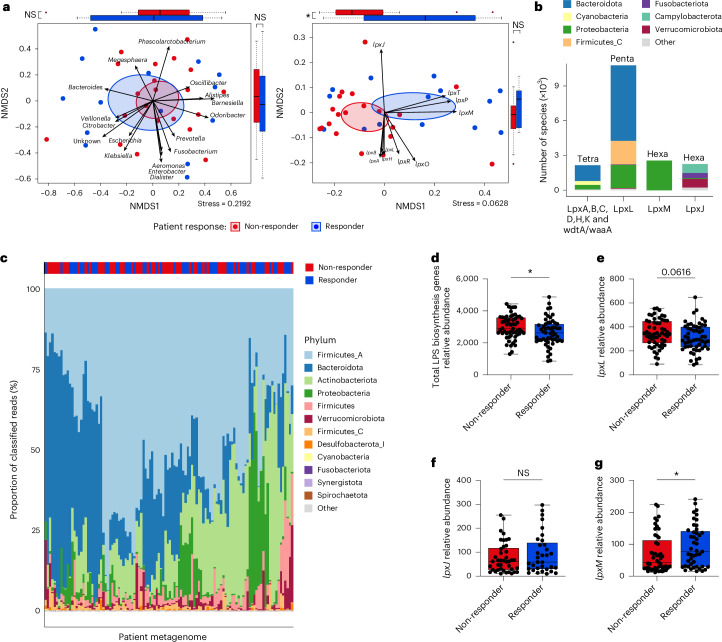
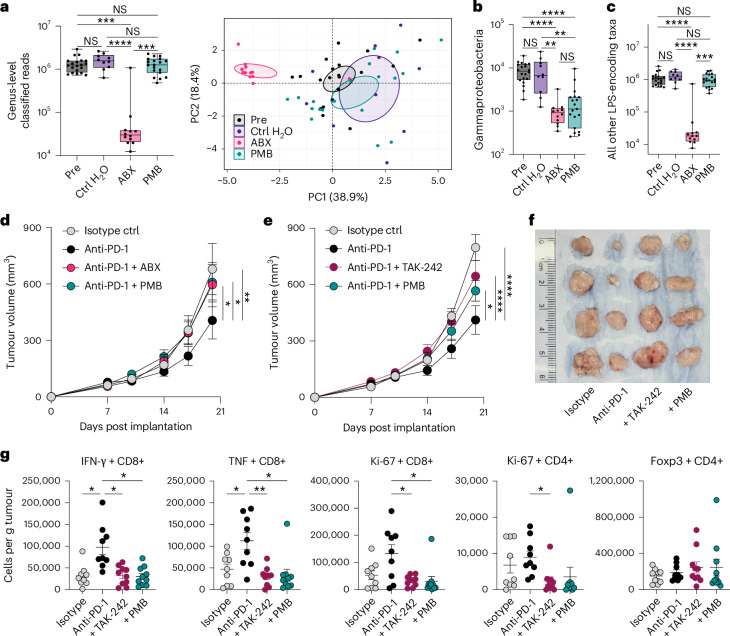
The gut microbiome modulates immunotherapy treatment responses, and this may explain why immune checkpoint inhibitors, such as anti-PD-1, are only effective in some patients. Previous studies correlated lipopolysaccharide (LPS)-producing gut microbes with poorer prognosis; however, LPS from diverse bacterial species can range from immunostimulatory to inhibitory. Here, by functionally analysing faecal metagenomes from 112 patients with melanoma, we found that a subset of LPS-producing bacteria encoding immunostimulatory hexa-acylated LPS was enriched in microbiomes of clinical responders. In an implanted tumour mouse model of anti-PD-1 treatment, microbiota-derived hexa-acylated LPS was required for effective anti-tumour immune responses, and LPS-binding antibiotics and a small-molecule TLR4 antagonist abolished anti-PD-1 efficacy. Conversely, oral administration of hexa-acylated LPS to mice significantly augmented anti-PD-1-mediated anti-tumour immunity. Penta-acylated LPS did not improve anti-PD-1 efficacy in vivo and inhibited hexa-acylated LPS-induced immune activation in vitro. Microbiome hexa-acylated LPS therefore represents an accessible predictor and potential enhancer of immunotherapy responses.
肠道微生物群可调节免疫治疗的反应,这或许可以解释为什么诸如抗PD-1等免疫检查点抑制剂仅在部分患者中有效。先前的研究将产生脂多糖(LPS)的肠道微生物与较差的预后相关联;然而,来自不同细菌种类的LPS的免疫刺激作用范围从刺激到抑制。在这里,通过对112例黑色素瘤患者的粪便宏基因组进行功能分析,我们发现,编码免疫刺激六酰化LPS的产生LPS的细菌亚群在临床反应者的微生物群中富集。在抗PD-1治疗的植入肿瘤小鼠模型中,微生物群衍生的六酰化LPS是有效的抗肿瘤免疫反应所必需的,而LPS结合抗生素和一种小分子TLR4拮抗剂会消除抗PD-1的疗效。相反,给小鼠口服六酰化LPS可显著增强抗PD-1介导的抗肿瘤免疫力。五酰化LPS在体内并未改善抗PD-1的疗效,并且在体外抑制六酰化LPS诱导的免疫激活。因此,微生物群六酰化LPS代表了一种易于获取的免疫治疗反应预测指标和潜在增强剂。