Stæger Frederik Filip, Andersen Mette K, Li Zilong, Hjerresen Jasmin Pernille, He Shixu, Santander Cindy G, Jensen Rasmus Tanderup, Rex Karsten Fleischer, Thuesen Anne Cathrine Baun, Hanghøj Kristian, Seiding Inge Høst, Jørsboe Emil, Stinson Sara Elizabeth, Rasmussen Malthe Sebro, Balboa Renzo F, Larsen Christina Viskum Lytken, Bjerregaard Peter, Schubert Mikkel, Meisner Jonas, Linneberg Allan, Grarup Niels, Zeggini Eleftheria, Nielsen Rasmus, Jørgensen Marit E, Hansen Torben, Moltke Ida, Albrechtsen Anders
Department of Biology, Section for Computational and RNA Biology, University of Copenhagen, Copenhagen, Denmark.
Novo Nordisk Foundation Center for Basic Metabolic Research, Faculty of Health and Medical Sciences, University of Copenhagen, Copenhagen, Denmark.
Nature. 2025 Mar;639(8054):404-410. doi: 10.1038/s41586-024-08516-4. Epub 2025 Feb 12.
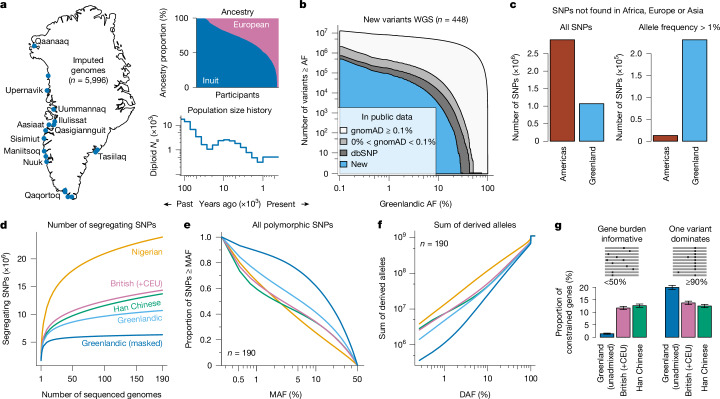
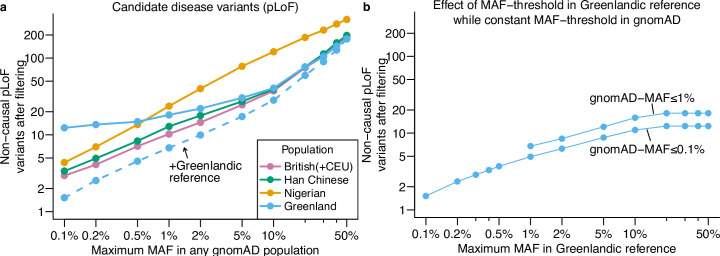
Greenlandic Inuit and other indigenous populations are underrepresented in genetic research, leading to inequity in healthcare opportunities. To address this, we performed analyses of sequenced or imputed genomes of 5,996 Greenlanders with extensive phenotypes. We quantified their historical population bottleneck and how it has shaped their genetic architecture to have fewer, but more common, variable sites. Consequently, we find twice as many high-impact genome-wide associations to metabolic traits in Greenland compared with Europe. We infer that the high-impact variants arose after the population split from Native Americans and thus are Arctic-specific, and show that some of them are common due to not only genetic drift but also selection. We also find that European-derived polygenic scores for metabolic traits are only half as accurate in Greenlanders as in Europeans, and that adding Arctic-specific variants improves the overall accuracy to the same level as in Europeans. Similarly, lack of representation in public genetic databases makes genetic clinical screening harder in Greenlandic Inuit, but inclusion of Greenlandic data remedies this by reducing the number of non-causal candidate variants by sixfold. Finally, we identify pronounced genetic fine structure that explains differences in prevalence of monogenic diseases in Greenland and, together with recent changes in mobility, leads to a predicted future reduction in risk for certain recessive diseases. These results illustrate how including data from Greenlanders can greatly reduce inequity in genomic-based healthcare.
格陵兰因纽特人和其他原住民在基因研究中的代表性不足,导致医疗保健机会不平等。为了解决这一问题,我们对5996名具有广泛表型的格陵兰人的测序或推断基因组进行了分析。我们量化了他们历史上的种群瓶颈,以及这一瓶颈如何塑造了他们的基因结构,使其可变位点更少但更常见。因此,我们发现格陵兰与欧洲相比,与代谢性状相关的全基因组高影响关联数量是欧洲的两倍。我们推断,这些高影响变异是在与美洲原住民种群分裂后出现的,因此是北极特有的,并表明其中一些变异不仅由于遗传漂变,还由于选择而变得常见。我们还发现,欧洲人代谢性状的多基因评分在格陵兰人中的准确性仅为欧洲人的一半,而加入北极特有的变异可将整体准确性提高到与欧洲人相同的水平。同样,公共基因数据库中缺乏相关数据使得格陵兰因纽特人的基因临床筛查更加困难,但纳入格陵兰数据通过将非因果候选变异的数量减少六倍来弥补这一问题。最后,我们确定了明显的基因精细结构,它解释了格陵兰单基因疾病患病率的差异,并与近期流动性的变化一起,导致某些隐性疾病的预测未来风险降低。这些结果说明了纳入格陵兰人的数据如何能够大大减少基于基因组的医疗保健中的不平等现象。