Smolsky Joseph, Leach Kyle G, Abells Ryan, Amaro Pedro, Andoche Adrien, Borbridge Keith, Bray Connor, Cantor Robin, Diercks David, Fretwell Spencer, Friedrich Stephan, Gillespie Abigail, Guerra Mauro, Hall Ad, Harris Cameron N, Harris Jackson T, Hayen Leendert M, Hervieux Paul-Antoine, Hinkle Calvin, Kim Geon-Bo, Kim Inwook, Lamm Amii, Lennarz Annika, Lordi Vincenzo, Machado Jorge, Marino Andrew, McKeen David, Mougeot Xavier, Ponce Francisco, Ruiz Chris, Samanta Amit, Santos José Paulo, Stone-Whitehead Caitlyn, Taylor John, Templet Joseph, Upadhyayula Sriteja, Wagner Louis, Warburton William K
Department of Physics, Colorado School of Mines, Golden, CO, USA.
Facility for Rare Isotope Beams, Michigan State University, East Lansing, MI, USA.
Nature. 2025 Feb;638(8051):640-644. doi: 10.1038/s41586-024-08479-6. Epub 2025 Feb 12.
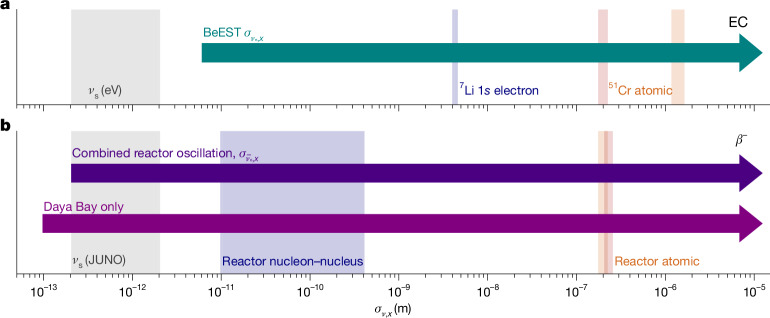
Despite their high relative abundance in our Universe, neutrinos are the least understood fundamental particles of nature. In fact, the quantum properties of neutrinos emitted in experimentally relevant sources are theoretically contested and the spatial extent of the neutrino wavepacket is only loosely constrained by reactor neutrino oscillation data with a spread of 13 orders of magnitude. Here we present a method to directly access this quantity by precisely measuring the energy width of the recoil daughter nucleus emitted in the radioactive decay of beryllium-7. The final state in the decay process contains a recoiling lithium-7 nucleus, which is entangled with an electron neutrino at creation. The lithium-7 energy spectrum is measured to high precision by directly embedding beryllium-7 radioisotopes into a high-resolution superconducting tunnel junction that is operated as a cryogenic sensor. Under this approach, we set a lower limit on the Heisenberg spatial uncertainty of the recoil daughter of 6.2 pm, which implies that the final-state system is localized at a scale more than a thousand times larger than the nucleus itself. From this measurement, the first, to our knowledge, direct lower limit on the spatial extent of a neutrino wavepacket is extracted. These results may have implications in several areas including the theoretical understanding of neutrino properties, the nature of localization in weak nuclear decays and the interpretation of neutrino physics data.