Tanaka Yudai, Kitano Daisuke, Yoda Shunichi, Mizobuchi Saki, Miyagawa Masatsugu, Fukumoto Katsunori, Fujito Hidesato, Hatta Takumi, Saito Yuki, Toyama Kazuto, Okumura Yasuo
Division of Cardiology, Department of Medicine, Nihon University School of Medicine, 30-1 Oyaguchi-kamicho, Itabashi-ku, Tokyo, 173-8610, Japan.
Division of Advanced Cardiovascular Imaging, Department of Medicine, Nihon University School of Medicine, Tokyo, Japan.
BMC Cardiovasc Disord. 2025 Feb 13;25(1):98. doi: 10.1186/s12872-025-04548-4.
Stress phase bandwidth (SPBW), assessed using single-photon emission computed tomography (SPECT), is considered to be a useful indicator of left ventricular dyssynchrony. However, few reports have examined whether it can be used as an indicator for improvement of left ventricular ejection fraction (LVEF) in new-onset heart failure with reduced ejection fraction (HFrEF).
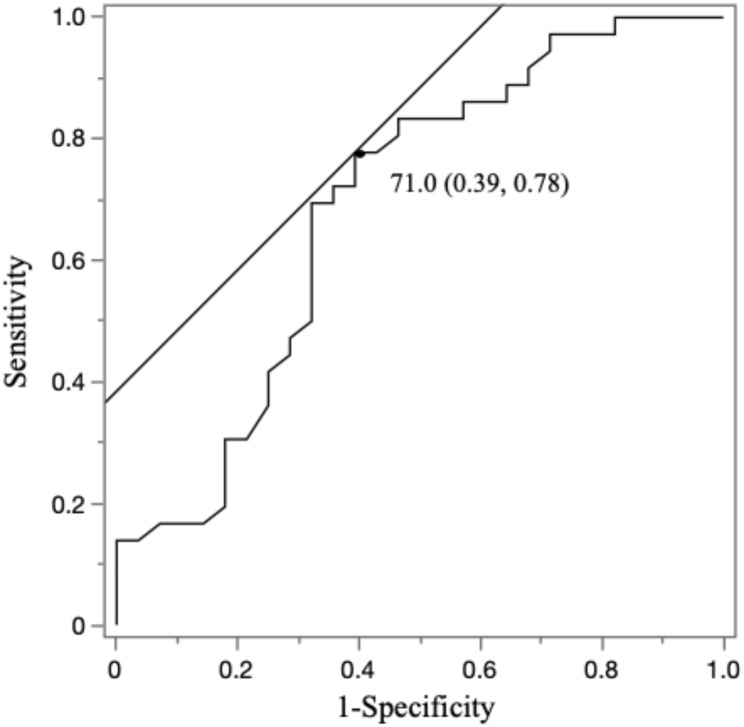
A total of 64 patients (mean age 56 years, 39 male) who were admitted to our hospital with new-onset non-ischemic HFrEF (median LVEF 24.7%) from January 2018 to December 2022 in the SAKURA-HF registry and underwent SPECT were enrolled. The relationship between SPBW in the acute phase and LVEF improvement in the chronic phase was retrospectively investigated in the present study. LVEF improved significantly in the 36 patients (from 27.1 to 62.8%, p < 0.001). Guideline-directed medical therapy in both groups was comparable. SPBW was significantly lower in the group with improved LVEF (median 55.5° vs. 79.0°, p = 0.010). Logistic regression analysis revealed that SPBW was an independent predictor for LVEF improvement. Moreover, an SPBW of 71.0° was suggested as a possible cut-off value.
SPBW may predict the improvement of LVEF in new-onset non-ischemic HFrEF, suggesting its potential utility in heart failure management.
使用单光子发射计算机断层扫描(SPECT)评估的应激期带宽(SPBW)被认为是左心室不同步的一个有用指标。然而,很少有报告研究它是否可作为射血分数降低的新发心力衰竭(HFrEF)患者左心室射血分数(LVEF)改善的指标。
共有64例患者(平均年龄56岁,男性39例)纳入SAKURA-HF注册研究,这些患者于2018年1月至2022年12月因新发非缺血性HFrEF(中位LVEF 24.7%)入住我院并接受了SPECT检查。本研究回顾性调查了急性期SPBW与慢性期LVEF改善之间的关系。36例患者的LVEF显著改善(从27.1%提高到62.8%,p < 0.001)。两组的指南导向药物治疗相当。LVEF改善组的SPBW显著更低(中位值55.5°对79.0°,p = 0.010)。逻辑回归分析显示SPBW是LVEF改善的独立预测因素。此外,建议将71.0°作为一个可能的截断值。
SPBW可能预测新发非缺血性HFrEF患者LVEF的改善,提示其在心力衰竭管理中的潜在效用。