Wang Yun, Zhang Ting-Juan, Zhang Liu-Chao, Xu Zi-Jun, Chu Ming-Qiang, Zhao Yang-Jing, Lin Jiang, Qian Jun, Zhou Jing-Dong
Department of Hematology, The Affiliated People's Hospital of Jiangsu University, Zhenjiang, Jiangsu, 212002, China.
Institute of Hematology, Jiangsu University, Zhenjiang, Jiangsu, 212002, China.
BMC Cancer. 2025 Feb 13;25(1):253. doi: 10.1186/s12885-025-13613-2.
Receptor-interacting protein kinase 3 (RIPK3) has been implicated in the pathogenesis of diverse human cancers. However, the role of RIPK3 in acute myeloid leukemia (AML) is not fully understood, which needs further research and clarification.
We first identified the expression and clinical prognostic value of RIPK3 in AML through a public database and further validated in our research cohort. In addition, the biological function of RIPK3 in leukemic development was further verified through in vitro experiments.
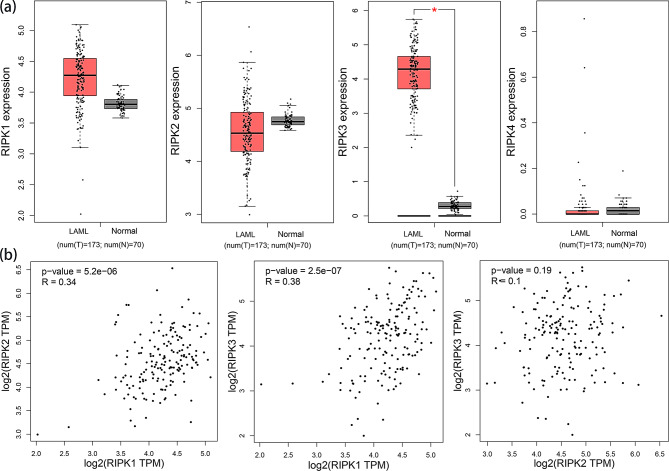
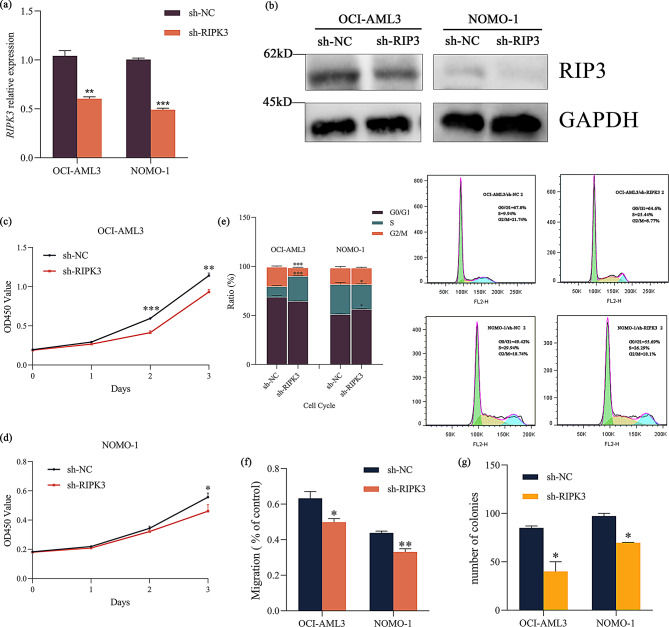
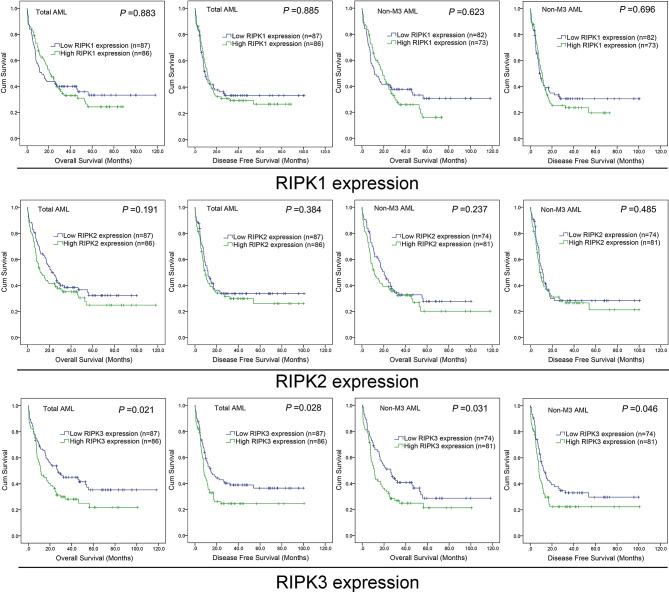
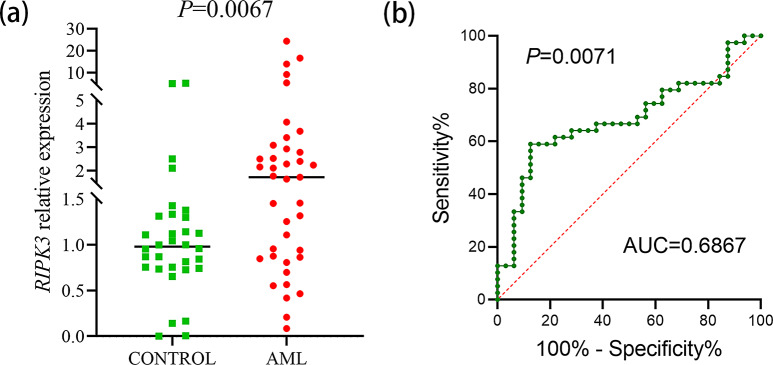
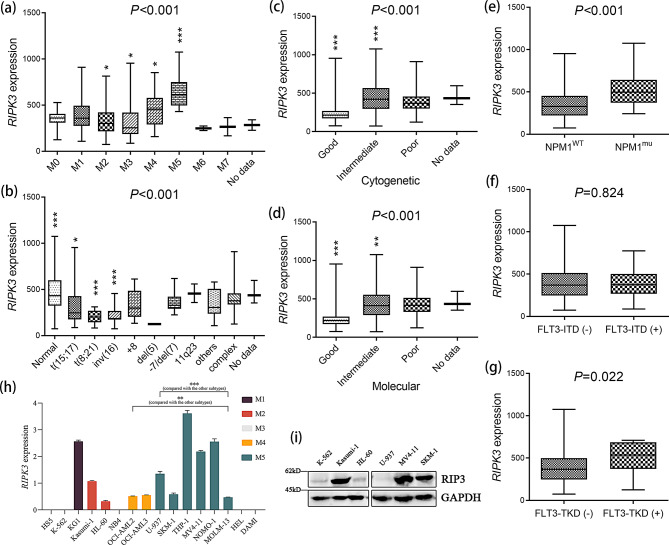
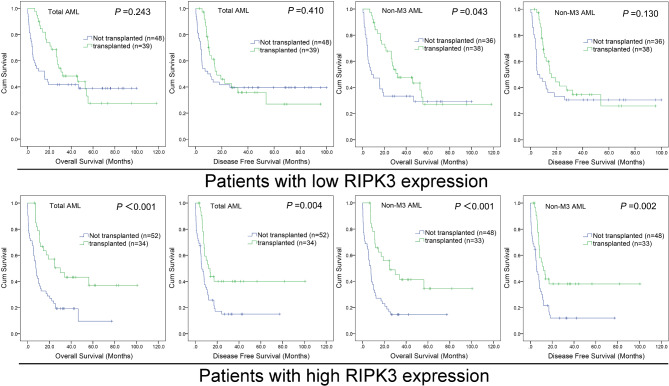
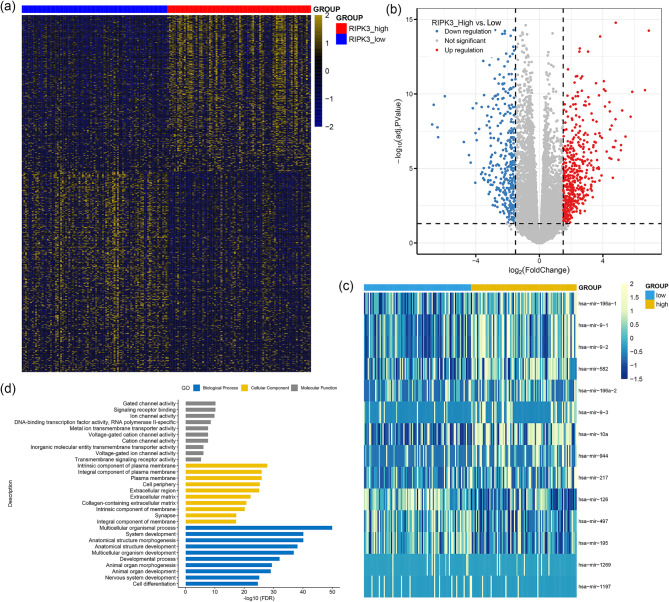
Based on the GEPIA database, we screened that RIPK3 overexpression among RIPK family was associated with poor prognosis in AML. Afterwards, another independent cohort from our research center further confirmed the expression pattern of RIPK3 in AML patients. Clinically, increased RIPK3 expression was closely related to specific subtypes of AML, such as FAB-M4/M5, normal karyotype and NPM1 mutation. The significant association of RIPK3 overexpression with FAB-M4/M5 was further validated in AML cell lines. Notably, AML patients with RIPK3 overexpression received transplantation presented a markedly longer survival than those just receiving chemotherapy, whereas those with RIPK3 underexpression showed similar survival between transplantation and chemotherapy group. Bioinformatics analysis showed the significant association of RIPK3 expression with diverse oncogenes/tumor suppressor genes and tumor-related biological processes in AML. Subsequently, we further performed functional experiments in vitro confirmed the potential oncogenic role of RIPK3 in AML.
Overexpression of RIPK3 was associated with specific subtypes of AML, such as FAB-M4/M5, normal karyotype and NPM1 mutation, and may facilitate the leukemic development. Moreover, RIPK3 overexpression was associated poor prognosis, and may guide treatment choice in AML.
受体相互作用蛋白激酶3(RIPK3)与多种人类癌症的发病机制有关。然而,RIPK3在急性髓系白血病(AML)中的作用尚未完全明确,需要进一步研究和阐明。
我们首先通过公共数据库确定RIPK3在AML中的表达及临床预后价值,并在我们的研究队列中进一步验证。此外,通过体外实验进一步验证RIPK3在白血病发生中的生物学功能。
基于GEPIA数据库,我们筛选出RIPK家族中RIPK3过表达与AML预后不良相关。随后,我们研究中心的另一个独立队列进一步证实了RIPK3在AML患者中的表达模式。临床上,RIPK3表达增加与AML的特定亚型密切相关,如FAB-M4/M5、正常核型和NPM1突变。RIPK3过表达与FAB-M4/M5的显著关联在AML细胞系中进一步得到验证。值得注意的是,RIPK3过表达的AML患者接受移植后的生存期明显长于仅接受化疗的患者,而RIPK3低表达的患者在移植组和化疗组之间的生存期相似。生物信息学分析显示RIPK3表达与AML中多种癌基因/肿瘤抑制基因及肿瘤相关生物学过程显著相关。随后,我们进一步进行体外功能实验,证实了RIPK3在AML中的潜在致癌作用。
RIPK3过表达与AML的特定亚型相关,如FAB-M4/M5、正常核型和NPM1突变,可能促进白血病的发展。此外,RIPK3过表达与预后不良相关,可能指导AML的治疗选择。