Patel Vasumati I, Thakkar Karan R, Gupta Shalini S, Pujara Meghna J
Department of Periodontics, Faculty of Dental Science, Dharmsinh Desai University, Nadiad, Gujarat, India.
J Oral Maxillofac Pathol. 2024 Oct-Dec;28(4):694-700. doi: 10.4103/jomfp.jomfp_25_24. Epub 2024 Dec 31.
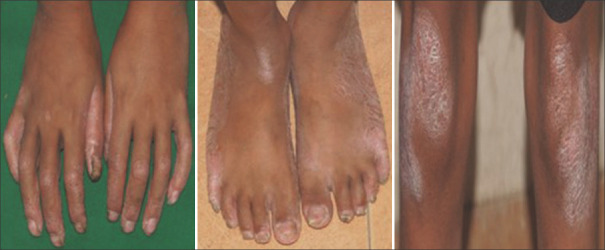
Papillon-Lefevre syndrome (PLS) is an exceptional autosomal recessive disorder characterized by palmoplantar keratinization and premature loss of deciduous and permanent teeth. The palmoplantar keratoderma commonly has its onset between the ages of 1 and 4 years with severe periodontitis initiating at 3 or 4 years old. Parental consanguinity has been demonstrated in 20% to 40% of the cases. Management and preservation of teeth in such patients is a challenge to periodontists. Genetic studies have shown that mutation in the major gene locus of chromosome 11q14.1-q14.3 with the loss of function of the Cathepsin-C (CTSC) gene is responsible for PLS. An early diagnosis of the syndrome can help preserve the teeth through early institution of treatment, using a multidisciplinary approach. We hereby present four cases having all the characteristic features of the syndrome.
掌跖角化-牙周破坏综合征(PLS)是一种罕见的常染色体隐性疾病,其特征为掌跖角化以及乳牙和恒牙过早缺失。掌跖角化病通常在1至4岁之间发病,严重的牙周炎在3或4岁时开始。20%至40%的病例显示存在近亲婚配。对此类患者的牙齿进行管理和保存对牙周病医生来说是一项挑战。基因研究表明,位于11号染色体q14.1-q14.3主要基因座的突变以及组织蛋白酶C(CTSC)基因功能丧失是导致PLS的原因。该综合征的早期诊断有助于通过早期采用多学科方法进行治疗来保存牙齿。我们在此呈现四例具有该综合征所有特征的病例。