Qu Chao, Zeng Piaoe, Li Changlei, Hu Weiyu, Yang Dongxia, Wang Hangyan, Yuan Huishu, Cao Jingyu, Xiu Dianrong
Department of Hepatobiliary and Pancreatic Surgery, The Affiliated Hospital of Qingdao University, Qingdao, China.
Department of General Surgery, Peking University Third Hospital, Beijing, China.
Insights Imaging. 2025 Feb 17;16(1):38. doi: 10.1186/s13244-025-01915-9.
To develop a machine learning (ML) model combining preoperative multiparametric diffusion-weighted imaging (DWI) and clinical features to better predict overall survival (OS) and recurrence-free survival (RFS) following radical surgery for pancreatic ductal adenocarcinoma (PDAC).
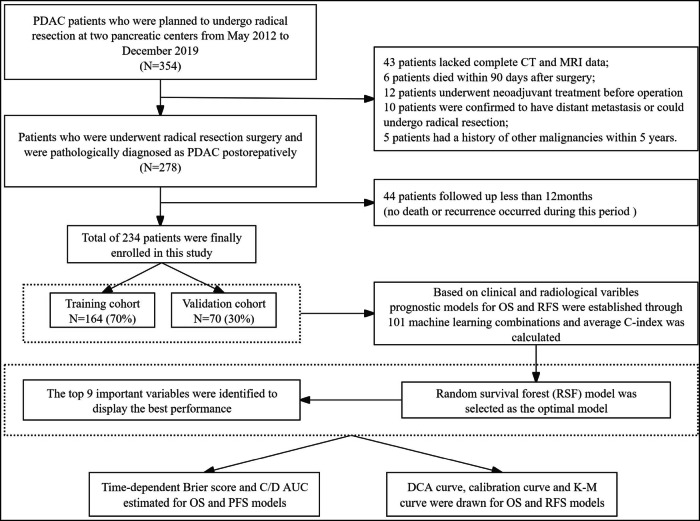
A retrospective analysis was conducted on 234 PDAC patients who underwent radical resection at two centers. Among 101 ML models tested for predicting postoperative OS and RFS, the best-performing model was identified based on comprehensive evaluation metrics, including C-index, Brier scores, AUC curves, clinical decision curves, and calibration curves. This model's risk stratification capability was further validated using Kaplan-Meier survival analysis.
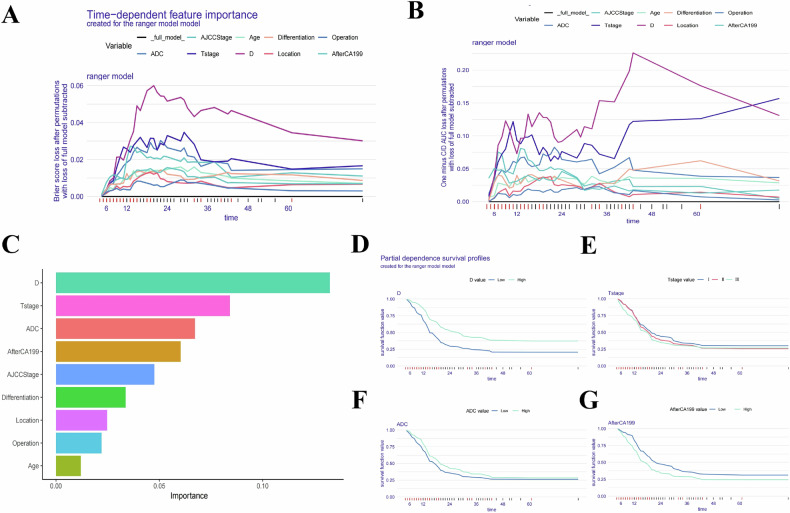
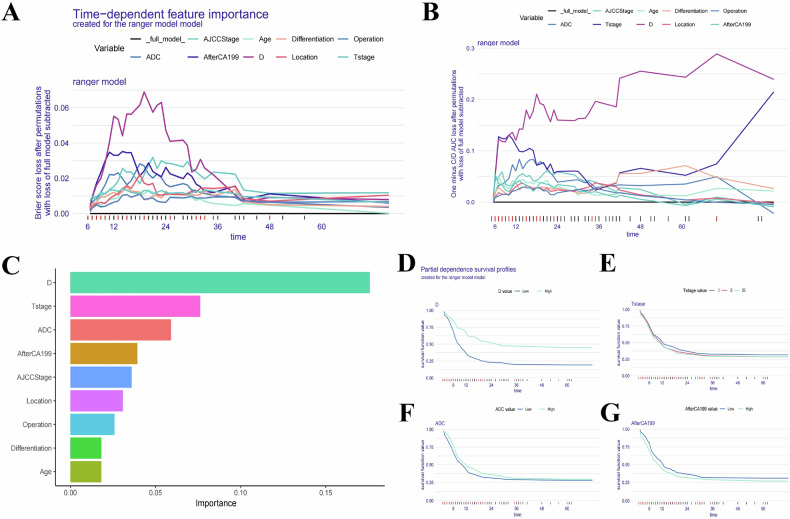
The random survival forest model achieved the highest C-index (0.828/0.723 for OS and 0.781/0.747 for RFS in training/validation cohorts). Incorporating nine key factors-D value, T-stage, ADC-value, postoperative 7th day CA19-9 level, AJCC stage, tumor differentiation, type of operation, tumor location, and age-optimized the model's predictive accuracy. The model had integrated Brier score below 0.13 and C/D AUC values above 0.85 for both OS and RFS predictions. It also outperformed traditional models in predictive ability and clinical benefit, as shown by clinical decision curves. Calibration curves confirmed good predictive consistency. Using cut-off scores of 16.73/29.05 for OS/RFS, Kaplan-Meier analysis revealed significant prognostic differences between risk groups (p < 0.0001), highlighting the model's robust risk prediction and stratification capabilities.
The random survival forest model, combining DWI and clinical features, accurately predicts survival and recurrence risk after radical resection of PDAC and effectively stratifies risk to guide clinical treatment.
The construction of 101 ML models based on multiparametric quantitative DWI combined with clinical variables has enhanced the prediction performance for survival and recurrence risks in patients undergoing radical resection for PDAC.
This study first develops DWI-based radiological-clinical ML models predicting PDAC prognosis. Among 101 models, RFS is the best and outperforms other traditional models. Multiparametric DWI is the key prognostic predictor, with model interpretations through SurvSHAP.
开发一种结合术前多参数扩散加权成像(DWI)和临床特征的机器学习(ML)模型,以更好地预测胰腺导管腺癌(PDAC)根治性手术后的总生存期(OS)和无复发生存期(RFS)。
对在两个中心接受根治性切除的234例PDAC患者进行回顾性分析。在测试的101个用于预测术后OS和RFS的ML模型中,基于包括C指数、Brier评分、AUC曲线、临床决策曲线和校准曲线在内的综合评估指标,确定了性能最佳的模型。使用Kaplan-Meier生存分析进一步验证该模型的风险分层能力。
随机生存森林模型在训练/验证队列中实现了最高的C指数(OS为0.828/0.723,RFS为0.781/0.747)。纳入九个关键因素——D值、T分期、ADC值、术后第7天CA19-9水平、AJCC分期、肿瘤分化程度、手术类型、肿瘤位置和年龄,优化了模型的预测准确性。该模型对于OS和RFS预测的综合Brier评分低于0.13,C/D AUC值高于0.85。临床决策曲线显示,其预测能力和临床获益也优于传统模型。校准曲线证实了良好的预测一致性。使用OS/RFS的截断分数16.73/29.05,Kaplan-Meier分析显示风险组之间存在显著的预后差异(p < 0.0001),突出了该模型强大的风险预测和分层能力。
结合DWI和临床特征的随机生存森林模型准确预测了PDAC根治性切除后的生存和复发风险,并有效地对风险进行分层以指导临床治疗。
基于多参数定量DWI结合临床变量构建101个ML模型,提高了接受PDAC根治性切除患者生存和复发风险的预测性能。
本研究首次开发了基于DWI的放射学-临床ML模型来预测PDAC预后。在101个模型中,RFS模型最佳,且优于其他传统模型。多参数DWI是关键的预后预测指标,并通过SurvSHAP对模型进行解读。