Haj-Yehia Elias, Michel Lars, Mincu Raluca I, Rassaf Tienush, Totzeck Matthias
Department of Cardiology and Vascular Medicine, West German Heart and Vascular Center Essen, University Hospital Essen, Hufelandstraße 55, 45147, Essen, Germany.
Curr Heart Fail Rep. 2025 Feb 19;22(1):9. doi: 10.1007/s11897-025-00697-x.
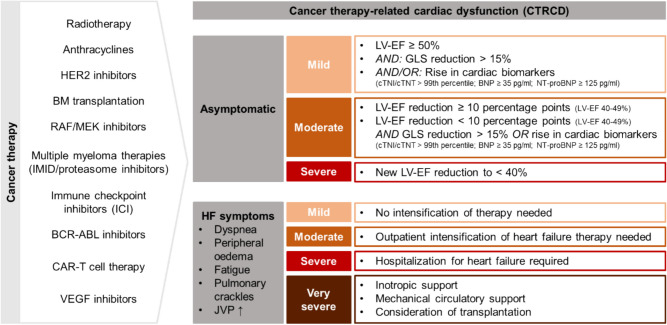
Introduction of modern cancer therapies has led to increased survival of affected patients. With this advantage, the incidence of cancer therapy-related cardiac dysfunction (CTRCD) has increased and reasonable prevention strategies become necessary. This review outlines the major approaches to limit development and progression of CTRCD.
A broad range of cancer therapies can provoke CTRCD ranging from mild asymptomatic forms to severe heart failure. Profound cardiological assessment of cardiovascular comorbidities before initiation of cancer therapy allows identification of cancer patients at higher risk developing CTRCD which may also require closer surveillance. Cardioprotective adjustment of cancer therapy and initiation of cardioprotective medication and lifestyle optimization prior to anti-cancer treatment additionally limit the risk of CTRCD. During therapy, regular examination of cancer patients using high-sensitive cardiological diagnostic tools as three-dimensional (3D) echocardiography and global longitudinal strain (GLS) enables early detection of mild forms of CTRCD. This allows appropriate adjustment of cancer therapy and initiation of CTRCD treatment to prevent further progression to severe forms. Cardiological risk stratification before treatment initiation, cardioprotective interventions before and during cancer therapy, along with regular monitoring of treated cancer patients, can help prevent the development of CTRCD. This maintains the antitumor effects of cancer therapy while limiting cardiotoxic side effects resulting in improved quality of life and mortality of affected cancer patients.
现代癌症疗法的引入提高了患者的生存率。伴随这一优势,癌症治疗相关心脏功能障碍(CTRCD)的发生率增加,因此有必要制定合理的预防策略。本综述概述了限制CTRCD发生和发展的主要方法。
多种癌症疗法均可引发CTRCD,其表现形式从轻度无症状到严重心力衰竭不等。在开始癌症治疗前对心血管合并症进行全面的心脏评估,有助于识别发生CTRCD风险较高的癌症患者,这类患者可能还需要更密切的监测。在抗癌治疗前对癌症治疗进行心脏保护调整、启动心脏保护药物治疗及优化生活方式,可进一步降低发生CTRCD的风险。在治疗期间,使用高灵敏度心脏诊断工具,如三维(3D)超声心动图和整体纵向应变(GLS)对癌症患者进行定期检查,能够早期发现轻度CTRCD。这有助于适当调整癌症治疗方案并启动CTRCD治疗,以防止病情进一步发展为严重形式。治疗开始前进行心脏风险分层、癌症治疗前和治疗期间进行心脏保护干预,以及对接受治疗的癌症患者进行定期监测,有助于预防CTRCD的发生。这在维持癌症治疗抗肿瘤效果的同时,限制心脏毒性副作用,从而改善受影响癌症患者的生活质量和死亡率。