Frier Emily M, Lahti-Pulkkinen Marius, Lin Chun, Decrue Fabienne, Zoega Helga, Allegaert Karel, Been Jasper V, Burgner David, Duhig Kate, Einarsdóttir Kristjana, Florian Lani, Fraser Abigail, Gissler Mika, Gyamfi-Bannerman Cynthia, Pedersen Lars Henning, Miller Jessica E, Mol Ben W, Murray Sarah R, Norman Jane, Roberts Devender, Schuit Ewoud, Shi Ting, Sheikh Aziz, Vogel Joshua P, Wood Rachael, McGoldrick Emma, Jacobsson Bo, Krispin Eyal, Reynolds Rebecca M, Stock Sarah J
MRC Centre for Reproductive Health, The Queen's Medical Research Institute, The University of Edinburgh, Edinburgh, UK.
Department of Psychology and Logopedics, Faculty of Medicine, University of Helsinki and Helsinki University Central Hospital, Helsinki, Finland.
BJOG. 2025 Jun;132(7):902-915. doi: 10.1111/1471-0528.18101. Epub 2025 Feb 19.
To examine the associations of antenatal corticosteroid (ACS) exposure with neurodevelopment in early childhood, and how these vary with gestational age at birth.
Population-based cohort study.
Scotland, UK.
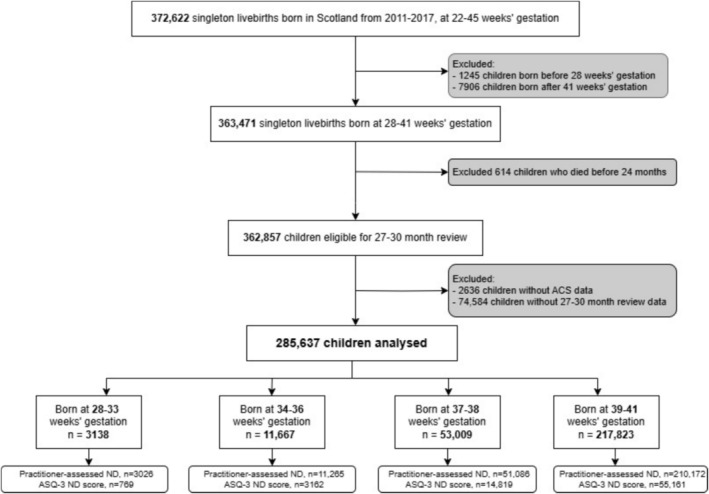
285 637 singleton children born at 28-41 weeks' gestation, between 1st January 2011 and 31st December 2017, who underwent health reviews at 27-30 months of age.
Logistic and linear regression analyses, stratified by gestation at birth (28-33, 34-36, 37-38 and 39-41 weeks' gestation), were used to evaluate the associations between ACS exposure and neurodevelopmental outcomes, and adjusted for maternal age, body mass index, diabetes, antenatal smoking, parity, neighbourhood deprivation, birth year, child sex and age at review.
Practitioner-identified concerns about any neurodevelopmental domain, and the average of five domain scores on neurodevelopmental milestones from the parent-rated Ages and Stages Questionnaire (ASQ-3).
After adjustment for covariates, ACS exposure was associated with reduced neurodevelopmental concerns in children born at 28-33 weeks' gestation (OR = 0.79, 95% CI = 0.62-0.999) and with increased neurodevelopmental concerns in children born at 34-36 weeks' gestation (OR = 1.11, 95% CI = 1.01-1.21). No independent associations emerged in children born at later gestations. ACS exposure was not associated with ASQ-3 scores in any gestational age group.
In early childhood, ACS exposure was associated with statistically significantly reduced neurodevelopmental concerns in children born at 28-33 weeks' gestation, and with statistically significantly increased neurodevelopment concerns in children born at 34-36 weeks' gestation. However, the effect sizes of these associations were small. No independent associations were found between ACS exposure and neurodevelopment in term-born children.
研究产前使用糖皮质激素(ACS)与幼儿神经发育之间的关联,以及这些关联如何随出生孕周而变化。
基于人群的队列研究。
英国苏格兰。
2011年1月1日至2017年12月31日期间出生的285637名单胎儿童,孕周为28 - 41周,在27 - 30月龄时接受了健康检查。
采用逻辑回归和线性回归分析,按出生孕周(28 - 33周、34 - 36周、37 - 38周和39 - 41周)分层,评估ACS暴露与神经发育结局之间的关联,并对母亲年龄、体重指数、糖尿病、产前吸烟、产次、邻里贫困程度、出生年份、儿童性别和检查时年龄进行了校正。
从业者确定的对任何神经发育领域的担忧,以及来自家长评定的《年龄与发育阶段问卷》(ASQ - 3)中神经发育里程碑的五个领域得分的平均值。
校正协变量后,ACS暴露与28 - 33周出生儿童的神经发育担忧减少相关(OR = 0.79,95%CI = 0.62 - 0.999),与34 - 36周出生儿童的神经发育担忧增加相关(OR = 1.11,95%CI = 1.01 - 1.21)。在孕周较大出生的儿童中未发现独立关联。ACS暴露在任何孕周组中均与ASQ - 3得分无关。
在幼儿期,ACS暴露与28 - 33周出生儿童的神经发育担忧在统计学上显著降低相关,与34 - 36周出生儿童的神经发育担忧在统计学上显著增加相关。然而,这些关联的效应大小较小。在足月儿中未发现ACS暴露与神经发育之间存在独立关联。