Mai Zhiyan, Liu Xudong, Duan Weixun, Yang Chen, Zhou Yenong, Chen Tao, Su Zheng, Yang Yang, Liu Jincheng, Jin Zhenxiao
Department of Cardiovascular Surgery, Xijing Hospital, The Fourth Military Medical University, 127 Changle West Road, Xi'an, 710032, China.
Department of Cardiovascular Surgery, General Hospital of Ningxia Medical University, Yinchuan, 750004, China.
BMC Cardiovasc Disord. 2025 Feb 20;25(1):121. doi: 10.1186/s12872-025-04527-9.
Sivelestat may reduce postoperative pulmonary injury after total arch replacement (TAR). This study aimed to evaluate whether the preoperative PaO/FiO (P/F) ratio affects the efficacy of sivelestat in reducing postoperative pulmonary injury in patients with acute aortic dissection (AAD) who underwent TAR using deep hypothermic circulatory arrest (DHCA).
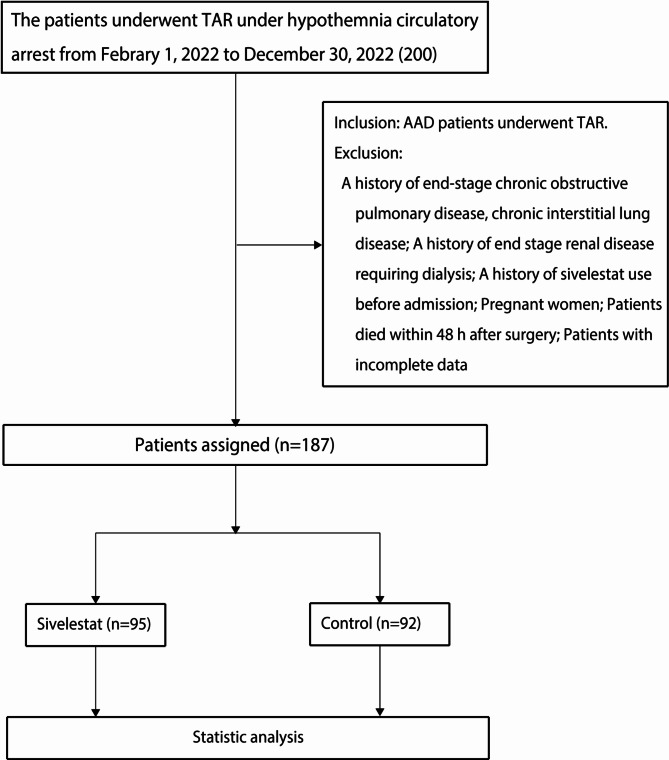
Data of patients with AAD who underwent TAR using DHCA in a tertiary hospital between February 1, 2022, and December 30, 2022, were retrospectively reviewed. The patients were divided into the sivelestat and control groups. Three subgroup analyses were performed based on the postoperative P/F ratio. The primary clinical outcomes were assessed to determine the efficacy and safety of sivelestat in managing postoperative pulmonary dysfunction in patients undergoing cardiopulmonary bypass.
A total of 187 patients were included, with 95 in the sivelestat group and 92 in the control group. No significant differences were found in the clinical variables between the two groups (all P > 0.05), except for some improvements in the inflammatory biomarker levels (including white blood cell count, neutrophil count, and C-reactive protein). Subgroup analysis revealed that sivelestat treatment significantly increased the P/F ratio on the 4th day and 3rd day after TAR in patients with mild lung injury (P = 0.02) and moderate lung injury (P = 0.03), respectively. Additionally, sivelestat reduced the levels of several postoperative inflammatory biomarkers in both subgroups.
Among patients with AAD with mild or moderate preoperative lung injury, defined by a low P/F ratio, sivelestat significantly improved the postoperative P/F ratio and attenuated inflammatory responses after TAR. These findings suggest an important avenue for further research.
西维来司他可能会减轻全弓置换术(TAR)后的肺部损伤。本研究旨在评估术前动脉血氧分压/吸入氧分数值(PaO₂/FiO₂,P/F)比值是否会影响西维来司他对接受深低温停循环(DHCA)下TAR的急性主动脉夹层(AAD)患者减轻术后肺部损伤的疗效。
回顾性分析2022年2月1日至2022年12月30日在一家三级医院接受DHCA下TAR的AAD患者的数据。将患者分为西维来司他组和对照组。根据术后P/F比值进行了三项亚组分析。评估主要临床结局以确定西维来司他在管理体外循环患者术后肺功能障碍方面的疗效和安全性。
共纳入187例患者,西维来司他组95例,对照组92例。两组间临床变量无显著差异(所有P>0.05),但炎症生物标志物水平(包括白细胞计数、中性粒细胞计数和C反应蛋白)有一些改善。亚组分析显示,西维来司他治疗分别使轻度肺损伤(P=0.02)和中度肺损伤(P=0.03)患者在TAR后第4天和第3天的P/F比值显著升高。此外,西维来司他降低了两个亚组中几种术后炎症生物标志物的水平。
在术前因P/F比值低而定义为轻度或中度肺损伤的AAD患者中,西维来司他显著改善了术后P/F比值,并减轻了TAR后的炎症反应。这些发现提示了一条重要的进一步研究途径。