Happe Myra, Lynch Rebecca M, Fichtenbaum Carl J, Heath Sonya L, Koletar Susan L, Landovitz Raphael J, Presti Rachel M, Santana-Bagur Jorge L, Tressler Randall L, Holman LaSonji A, Novik Laura, Roa Jhoanna C, Rothwell Ro Shauna, Strom Larisa, Wang Jing, Hu Zonghui, Conan-Cibotti Michelle, Bhatnagar Anjali M, Dwyer Bridget, Ko Sung Hee, Belinky Frida, Namboodiri Aryan M, Pandey Janardan P, Carroll Robin, Basappa Manjula, Serebryannyy Leonid, Narpala Sandeep R, Lin Bob C, McDermott Adrian B, Boritz Eli A, Capparelli Edmund V, Coates Emily E, Koup Richard A, Ledgerwood Julie E, Mascola John R, Chen Grace L, Tebas Pablo
Vaccine Research Center, National Institute of Allergy and Infectious Diseases, NIH, Bethesda, Maryland, USA.
Department of Microbiology, Immunology, and Tropical Medicine, The George Washington University, Washington, DC, USA.
JCI Insight. 2025 Feb 24;10(4):e181496. doi: 10.1172/jci.insight.181496.
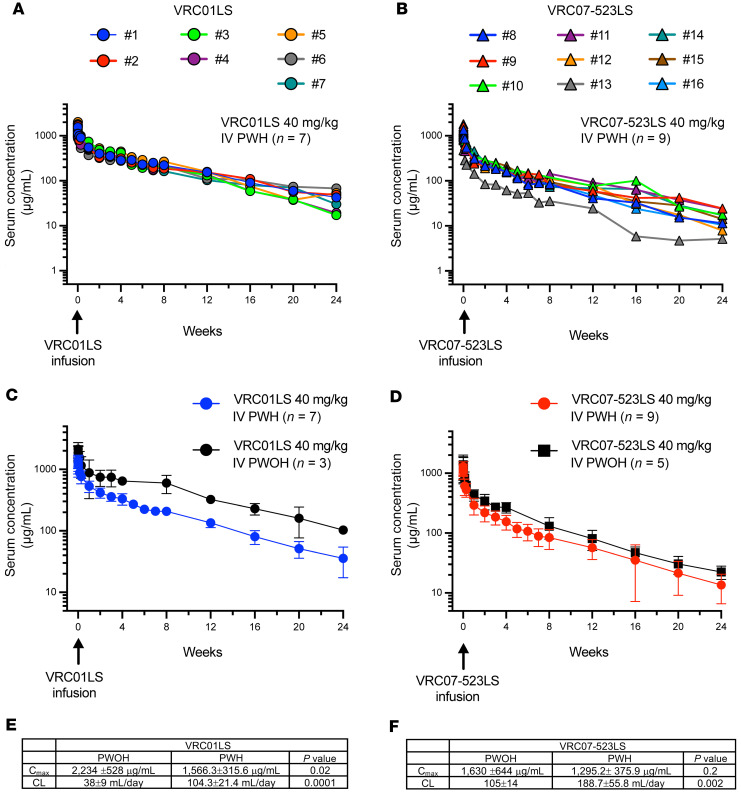
BACKGROUNDHIV-1-specific broadly neutralizing monoclonal antibodies (bNAbs) have emerged as promising interventions with the potential to effectively treat and prevent HIV-1 infections. We conducted a phase I clinical trial evaluating the potent CD4-binding site-specific (CD4bs-specific) bNAbs VRC01LS and VRC07-523LS in people with HIV-1 (PWH) not receiving antiretroviral therapy (ART).METHODSParticipants received a single intravenous 40 mg/kg dose of either VRC01LS (n = 7) or VRC07-523LS (n = 9) and did not initiate ART for a minimum of 14 days. The primary study objective was to evaluate safety and tolerability; the secondary study objectives were to evaluate pharmacokinetics (PK) and the impact of administered bNAbs on viral loads (VL) and CD4+ T cell counts in the absence of ART.RESULTSThis trial enrolled 16 PWH aged 20 to 57 years. Both bNAbs were safe and well tolerated. Mild local reactogenicity was only reported in participants who received VRC07-523LS, while both bNAbs were associated with mild systemic symptoms. Maximum serum concentrations (Cmax) following VRC01LS or VRC07-523LS were 1,566 ± 316 and 1,295 ± 376 μg/mL, respectively. VRC07-523LS administration significantly decreased VL in 8 out of 9 participants, with an average decline of 1.7 ± 0.8 log10 copies/mL within 14 days after administration. In contrast, VRC01LS administration resulted in a smaller average decline (0.8 ± 0.8 log10 copies/mL), and 3 out of 7 participants showedno change in VL. Postinfusion maximum decline in VL correlated with post hoc baseline in vitro viral susceptibility results for both bNAbs.CONCLUSIONThe results of this trial support inclusion of potent CD4bs-specific bNAbs, such as VRC07-523LS, into next-generation treatment regimens for HIV-1.TRIAL REGISTRATIONClinicalTrials.gov NCT02840474.FUNDINGNational Institute of Allergy and Infectious Diseases (NIAID)/NIH (grants UM1 AI068634, UM1 AI068636, UM1 AI106701, UM1AI069424, UM1AI069501, UM1AI69415, UM1AI069534, UM1AI69494); the Intramural Research Program of the NIAID/NIH; National Center for Advancing Translational Sciences/NIH (grants UM1TR004548, UL1TR001881, and UL1TR001878); and the National Cancer Institute/NIH (contract 75N91019D00024).
背景
HIV-1特异性广泛中和单克隆抗体(bNAbs)已成为有前景的干预措施,具有有效治疗和预防HIV-1感染的潜力。我们开展了一项I期临床试验,评估强效CD4结合位点特异性(CD4bs特异性)bNAbs VRC01LS和VRC07-523LS在未接受抗逆转录病毒治疗(ART)的HIV-1感染者(PWH)中的效果。
方法
参与者静脉注射单剂量40mg/kg的VRC01LS(n = 7)或VRC07-523LS(n = 9),并至少14天不开始ART。主要研究目标是评估安全性和耐受性;次要研究目标是评估药代动力学(PK)以及在未进行ART的情况下所给予的bNAbs对病毒载量(VL)和CD4 + T细胞计数的影响。
结果
该试验纳入了16名年龄在20至57岁的PWH。两种bNAbs均安全且耐受性良好。仅在接受VRC07-523LS的参与者中报告有轻微的局部反应原性,而两种bNAbs均与轻微的全身症状相关。VRC01LS或VRC07-523LS后的最大血清浓度(Cmax)分别为1,566±316和1,295±376μg/mL。给予VRC07-523LS后,9名参与者中有8名的VL显著下降,给药后14天内平均下降1.7±0.8 log10拷贝/mL。相比之下,给予VRC01LS后的平均下降幅度较小(0.8±0.8 log10拷贝/mL),7名参与者中有3名的VL无变化。两种bNAbs输注后VL的最大下降与事后基线体外病毒敏感性结果相关。
结论
该试验结果支持将强效CD4bs特异性bNAbs,如VRC07-523LS,纳入HIV-1的下一代治疗方案。
试验注册
ClinicalTrials.gov NCT02840474。
资助
国家过敏和传染病研究所(NIAID)/国立卫生研究院(NIH)(资助项目UM1 AI068634、UM1 AI068636、UM1 AI106701、UM1AI069424、UM1AI069501、UM1AI69415、UM1AI069534、UM1AI69494);NIAID/NIH的内部研究项目;国家推进转化科学中心/NIH(资助项目UM1TR004548、UL1TR001881和UL1TR001878);以及国家癌症研究所/NIH(合同75N91019D00024)。