Li Yingchen, Yin Linan, Liu Bowen, Liu Yan, He Dongfeng, Liu Xuesong, Liu Ruibao
Department of Interventional Radiology, Harbin Medical University Cancer Hospital, No. 246 Baojian Road, Harbin, 150086, Heilongjiang Province, China.
BMC Med Genomics. 2025 Feb 25;18(1):38. doi: 10.1186/s12920-025-02107-6.
The aim of this study is to assess the clinical utility of RecQ Like Helicase 4 (RECQL4) as a prognostic marker in hepatocellular carcinoma (HCC) and investigate its associations with various biological processes, angiogenesis-related factors, immune cell infiltration, immune checkpoints, and drug sensitivity.
RECQL4 expression was analyzed across a range of cancer types utilizing data from the TCGA database. Disparities in RECQL4 expression levels between normal and malignant tissues were evaluated, alongside an analysis of progression-free interval (PFI), disease-specific survival (DSS), and overall survival (OS) curves. Exploration of pertinent pathways, immune cell infiltration, single-cell RNA-seq data, and drug sensitivity was conducted employing The Cancer Genome Atlas (TCGA) and Tumor Immune Single-Cell Hub (TISCH) databases. Furthermore, validation of in-silico results was validated through qPCR, Western blotting, CCK-8 assay, EdU assay, clonogenic assay, wound-healing assay, and transwell assay.
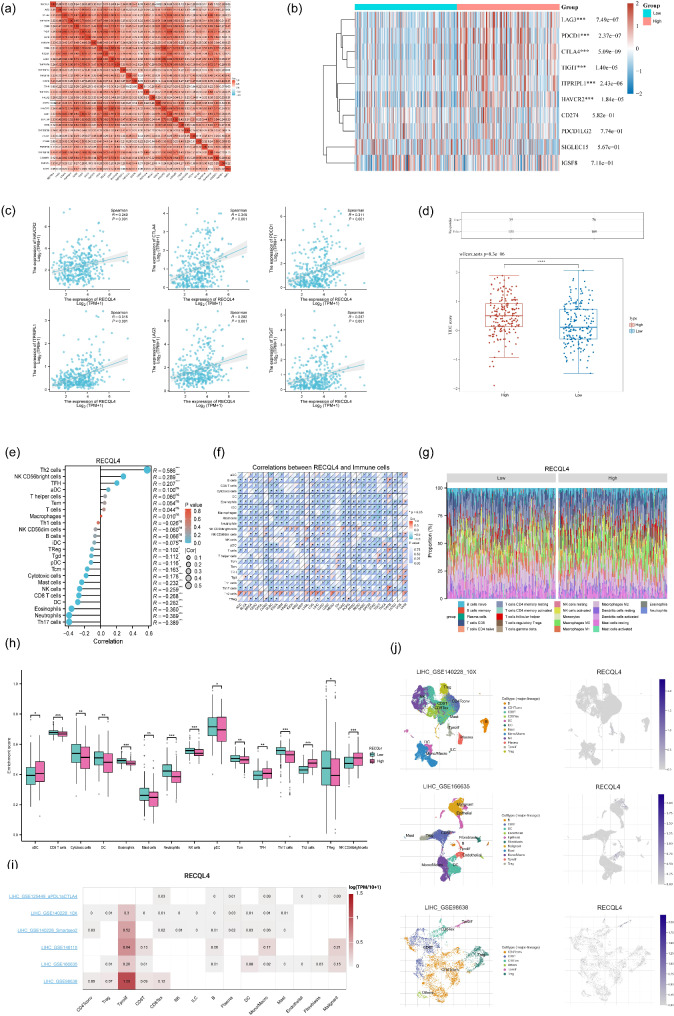
In HCC, RECQL4 was highly expressed and associated with poorer prognosis (p < 0.05). It positively correlated with pathways related to MYC targets, DNA replication, PI3K/AKT/mTOR signaling, DNA repair mechanisms, and the G2/M checkpoint (R > 0.24, p < 0.001). RECQL4 also showed significant correlations with angiogenesis-related genes, including PTK2 (R > 0.4, p < 0.05), suggesting a potential role in angiogenesis regulation. Immune analysis indicated that RECQL4 was associated with immune cell types such as T helper 2 cells, NK CD56bright cells, and follicular helper T cells, suggesting a positive relationship with their infiltration. High RECQL4 expression was also linked to increased sensitivity to drugs including Sorafenib, 5-Fluorouracil, Cisplatin, and Doxorubicin. Cellular experiments showed that RECQL4 expression at the mRNA and protein levels were significantly higher in HCC cell lines Hep3B and Huh7 compared to the normal liver cell line MHA. Moreover, RECQL4 knockdown resulted in reduced proliferation and migration in HCC cell lines (p < 0.05).
RECQL4 shows promise as a biomarker for predicting recurrence and survival in HCC and may affect angiogenesis regulation. Its expression also appears to impact sensitivity to drugs such as Sorafenib, 5-Fluorouracil, Cisplatin, and Doxorubicin. Furthermore, silencing RECQL4 significantly inhibits HCC cell line proliferation and migration.
本研究旨在评估类RecQ解旋酶4(RECQL4)作为肝细胞癌(HCC)预后标志物的临床效用,并研究其与各种生物学过程、血管生成相关因子、免疫细胞浸润、免疫检查点及药物敏感性的关联。
利用来自TCGA数据库的数据,分析了一系列癌症类型中的RECQL4表达情况。评估了正常组织与恶性组织之间RECQL4表达水平的差异,并分析了无进展生存期(PFI)、疾病特异性生存期(DSS)和总生存期(OS)曲线。利用癌症基因组图谱(TCGA)和肿瘤免疫单细胞中心(TISCH)数据库,探索相关通路、免疫细胞浸润、单细胞RNA测序数据及药物敏感性。此外,通过qPCR、蛋白质免疫印迹、CCK-8检测、EdU检测、克隆形成检测、伤口愈合检测和Transwell检测,对计算机模拟结果进行了验证。
在HCC中,RECQL4高表达且与较差的预后相关(p < 0.05)。它与MYC靶点、DNA复制、PI3K/AKT/mTOR信号传导、DNA修复机制及G2/M检查点相关的通路呈正相关(R > 0.24,p < 0.001)。RECQL4还与血管生成相关基因,包括PTK2(R > 0.4,p < 0.05),显示出显著相关性,提示其在血管生成调节中可能发挥作用。免疫分析表明,RECQL4与辅助性T细胞2型、NK CD56bright细胞和滤泡辅助性T细胞等免疫细胞类型相关,提示与其浸润呈正相关。RECQL4高表达还与对索拉非尼、5-氟尿嘧啶、顺铂和阿霉素等药物的敏感性增加有关。细胞实验表明,与正常肝细胞系MHA相比,HCC细胞系Hep3B和Huh7中RECQL4在mRNA和蛋白质水平的表达显著更高。此外,RECQL4敲低导致HCC细胞系中的增殖和迁移减少(p < 0.05)。
RECQL4有望作为预测HCC复发和生存的生物标志物,可能影响血管生成调节。其表达似乎也会影响对索拉非尼、5-氟尿嘧啶、顺铂和阿霉素等药物的敏感性。此外,沉默RECQL4可显著抑制HCC细胞系的增殖和迁移。