Pringle Samuel, D'Août Kristiaan
Department of Musculoskeletal & Ageing Science, Institute of Life Course and Medical Sciences, University of Liverpool, Liverpool L7 8TX, UK.
Biology (Basel). 2025 Feb 16;14(2):208. doi: 10.3390/biology14020208.
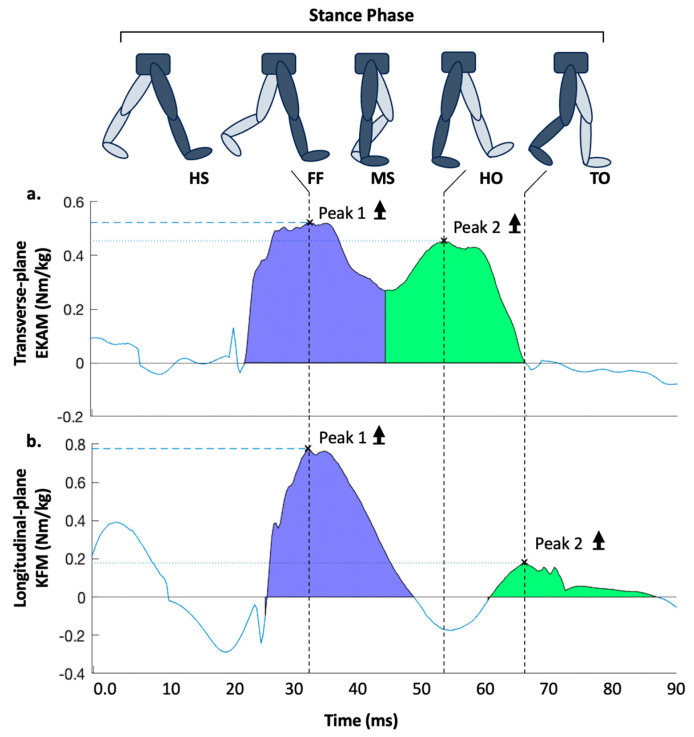
Knee post-traumatic osteoarthritis (PTOA) often develops in younger populations following anterior cruciate ligament (ACL) rupture, accounting for 12% of all symptomatic osteoarthritis (OA). The current literature implicates gait asymmetry in late-stage knee OA progression; however, early-knee PTOA development involvement is ill defined. This study explored gait asymmetry involvement in early-stage knee PTOA following ACL ruptures. Gait asymmetry, measured as asymmetry in duty factor (relative contact time), and joint loading data were collected, using infrared-camera motion capture and Kistler force plates for participants exhibiting either historical ACL ruptures (ACL+; = 4) or no previous joint trauma (ACL-; = 11). Joint loading measures included external knee adduction moment (EKAM) and external knee flexion moment (KFM), early (peak 1; EKAMp1 and KFMp1) and late (peak 2; EKAMp2 and KFMp2), stance peaks (Nm/kg), and respective time integrals (Nm·ms/kg; iEKAMp1, iEKAMp2, iKFMp1, and iKFMp2). ACL+ exhibited greater asymmetrical duty factor (78% difference) and greater joint load differences: EKAMp1 (26%), EKAMp2 (49%), KFMp1 (37%), iKFMp1 (44%), and iKFMp2 (60%). Significant relationships were found between duty factor asymmetry and both KFMp2 (R = 0.665) and iKFMp2 (R = 0.504). These preliminary data suggest gait asymmetry-induced joint loading may contribute to knee PTOA progression, but further research with increased sample sizes and the quantitative assessment of cartilage status is required.
膝关节创伤后骨关节炎(PTOA)常发生于年轻人群,继发于前交叉韧带(ACL)断裂后,占所有有症状骨关节炎(OA)的12%。当前文献表明步态不对称与晚期膝关节OA进展有关;然而,早期膝关节PTOA发展过程中的相关情况尚不明确。本研究探讨了ACL断裂后早期膝关节PTOA中的步态不对称情况。采用红外摄像机动作捕捉技术和奇石乐测力板,收集了有既往ACL断裂史(ACL+;n = 4)或无既往关节创伤史(ACL-;n = 11)参与者的步态不对称情况(以负荷因子不对称性,即相对接触时间来衡量)和关节负荷数据。关节负荷测量指标包括早期(峰值1;EKAMp1和KFMp1)和晚期(峰值2;EKAMp2和KFMp2)的膝关节外展力矩(EKAM)和膝关节屈曲力矩(KFM)、站立期峰值(Nm/kg)以及各自的时间积分(Nm·ms/kg;iEKAMp1、iEKAMp2、iKFMp1和iKFMp2)。ACL+组表现出更大的不对称负荷因子(差异78%)和更大的关节负荷差异:EKAMp1(26%)、EKAMp2(49%)、KFMp1(37%)、iKFMp1(44%)和iKFMp2(60%)。负荷因子不对称性与KFMp2(R = 0.665)和iKFMp2(R = 0.504)之间均存在显著相关性。这些初步数据表明,步态不对称引起的关节负荷可能促使膝关节PTOA进展,但需要增加样本量并对软骨状态进行定量评估的进一步研究。