Brady Lee A, Julian Christopher A, Manning Wendy D
Department of Sociology, Center for Family and Demographic Research, Bowling Green State University, Bowling Green, OH 43403 USA.
Popul Res Policy Rev. 2025;44(1):11. doi: 10.1007/s11113-025-09938-2. Epub 2025 Jan 28.
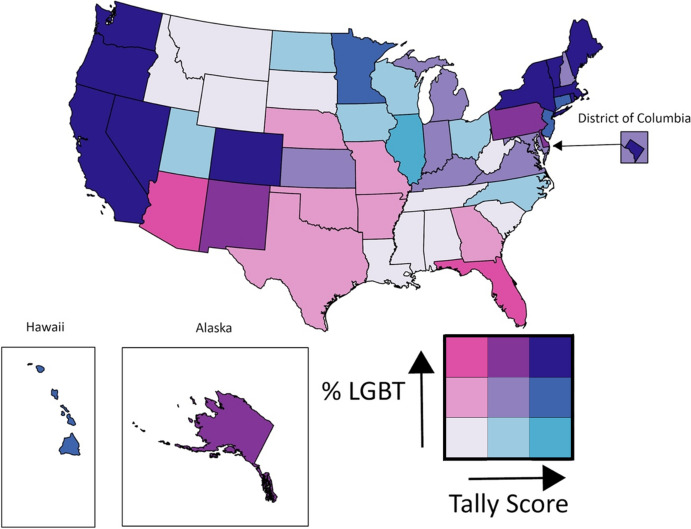
State-level social policy and LGBT (lesbian, gay, bisexual, and transgender) population concentration are key measures that are often used as indicators reflecting geographic social climate. Still, research has yet to investigate how they may be interrelated, including the degree to which the LGBT population are subject to certain policies. Using population-based experimental data from the Household Pulse Survey and policy measures from the Movement Advancement Project, we compared measures of state-level policy and concentration of the LGBT population for 2022. After calculating the correlation between these two constructs, the authors identified state-level variation in these measures for each of the 50 states and Washington, DC. With a correlation of 0.58, the findings revealed variation at the state level and indicated that LGBT population concentration and state-level LGBT policy do not necessarily reflect synonymous social phenomena and constitute distinct but complementary measures for use in constructing indices of structural heterosexism and social climate.
州级社会政策和LGBT(女同性恋、男同性恋、双性恋和跨性别者)人口集中度是常用的关键指标,用以反映地域社会氛围。然而,对于它们之间的相互关系,包括LGBT人群受特定政策影响的程度,研究尚未进行探讨。利用家庭脉搏调查的基于人口的实验数据以及运动促进项目的政策措施,我们比较了2022年州级政策和LGBT人口集中度的指标。在计算这两个指标之间的相关性后,作者确定了50个州以及华盛顿特区在这些指标上的州级差异。相关性为0.58,研究结果揭示了州级层面的差异,并表明LGBT人口集中度和州级LGBT政策不一定反映同义的社会现象,而是构成了用于构建结构性异性恋主义和社会氛围指数的不同但互补的指标。