Zhao Yue, Wang Qing, Sun Biao, Li Yanan, Meng Chang, Miao Guobin
Department of Emergency, Emergency General Hospital, XiBaHe South Road 29, Chaoyang District, Beijing, 100028, People's Republic of China.
Eur J Med Res. 2025 Mar 1;30(1):147. doi: 10.1186/s40001-025-02409-6.
Haloperidol is the most frequently prescribed medication for managing delirium in the intensive care unit (ICU). However, there is limited and inconclusive evidence regarding its efficacy. A meta-analysis was conducted by pooling data from recent clinical randomized controlled trials to assess the effectiveness of haloperidol in adult ICU patients with delirium.
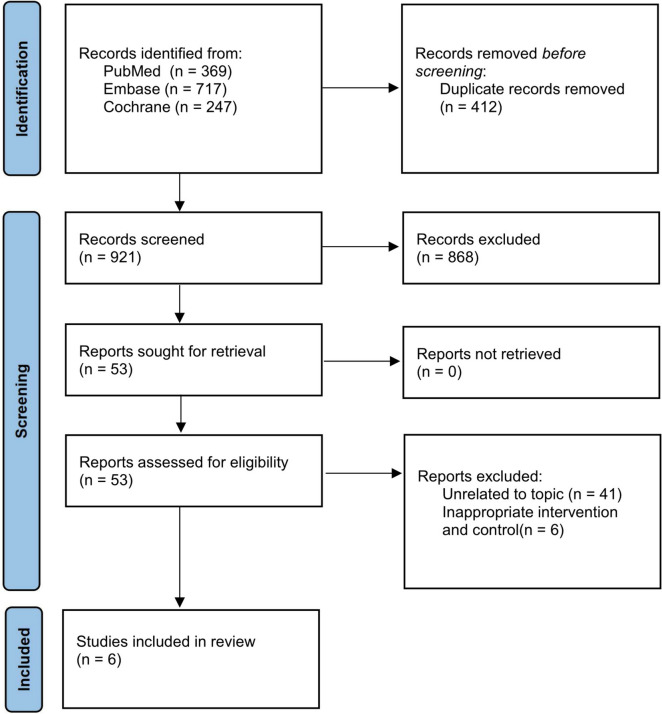
Studies were searched in PubMed, Embase and Cochrane Library databases on August 10, 2024. We performed a meta-analysis to estimate the efficacy of haloperidol for the treatment of ICU adult patients with delirium. This study is registered with INPLASY, number 202480104. The estimates are expressed as odds ratio (OR) or mean difference (MD) with a 95% confidence interval (CI).
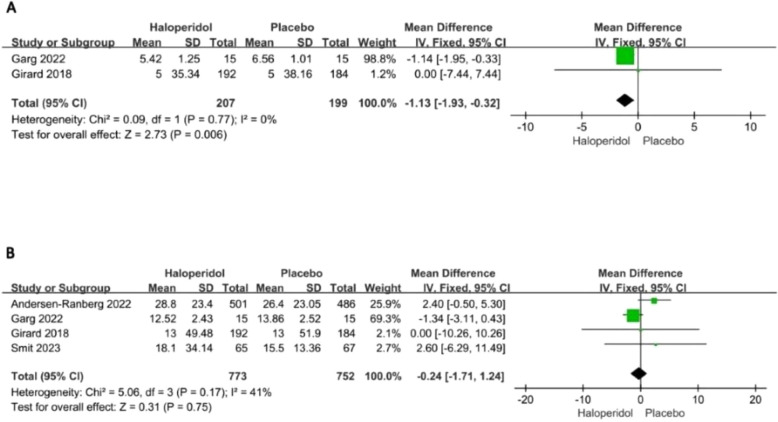
A total of 2863 patients were included in the analyses. All the included studies were randomized controlled trials. The frequency of patients diagnosed with delirium used both confusion assessment method of intensive care unit (CAM-ICU) and intensive care delirium screening checklist (ICDSC) was 34% (n = 2863), and used CAM-ICU only was 66% (n = 2863). There was no difference in short-term (28-30 days) mortality between the two groups [OR = 0.89, 95% CI 0.60-1.32, P = 0.56] and long-term (90 days to 1 year) mortality [OR = 0.87, 95% CI 0.70-1.07, P = 0.19]. Furthermore, the haloperidol group demonstrated an advantage in reducing the length of ICU stay [MD = -1.13, 95% CI - 1.93-- 0.32, P < 0.05] compared to the placebo group, with no statistically significant difference in length of hospital stay [MD = - 0.24, 95% CI -1.71-1.24, P = 0.75].
Haloperidol showed a significant trend in reducing the length of ICU stay. However, there was no statistical difference between the two groups in terms of delirium reduction.
氟哌啶醇是重症监护病房(ICU)中治疗谵妄最常用的药物。然而,关于其疗效的证据有限且尚无定论。通过汇总近期临床随机对照试验的数据进行荟萃分析,以评估氟哌啶醇对成年ICU谵妄患者的有效性。
于2024年8月10日在PubMed、Embase和Cochrane图书馆数据库中检索研究。我们进行了荟萃分析,以评估氟哌啶醇治疗成年ICU谵妄患者的疗效。本研究已在INPLASY注册,编号为202480104。估计值以比值比(OR)或平均差(MD)表示,并伴有95%置信区间(CI)。
共有2863例患者纳入分析。所有纳入研究均为随机对照试验。使用重症监护病房意识模糊评估法(CAM-ICU)和重症监护谵妄筛查清单(ICDSC)诊断为谵妄的患者频率为34%(n = 2863),仅使用CAM-ICU的患者频率为66%(n = 2863)。两组在短期(28 - 30天)死亡率[OR = 0.89,95%CI 0.60 - 1.32,P = 0.56]和长期(90天至1年)死亡率[OR = 0.87,95%CI 0.70 - 1.07, P = 0.19]方面无差异。此外,与安慰剂组相比,氟哌啶醇组在缩短ICU住院时间方面显示出优势[MD = -1.13,95%CI -1.93 - -0.32,P < 0.05],而在住院时间方面无统计学显著差异[MD = -0.24,95%CI -1.71 - 1.24,P = 0.75]。
氟哌啶醇在缩短ICU住院时间方面显示出显著趋势。然而,两组在减少谵妄方面无统计学差异。