Saliu Muhammad Auwal, Wang Qi, Salisu Mansur Dabai, Ren Yuanfeng, Zhang Pengchao, Suleiman Rabiatu Bako, Cao Bingbing, Xu Yiqiao, Liu Xudong, Lluis Frederic, Liu Maoxuan, Wan Xiaochun
Guangdong Immune Cell Therapy Engineering and Technology Research Center, Center for Protein and Cell-Based Drugs, Institute of Biomedicine and Biotechnology, Shenzhen Institutes of Advanced Technology, Chinese Academy of Sciences, Shenzhen, 518055, China.
University of Chinese Academy of Sciences, Beijing, 100049, China.
Exp Hematol Oncol. 2025 Mar 3;14(1):27. doi: 10.1186/s40164-025-00621-y.
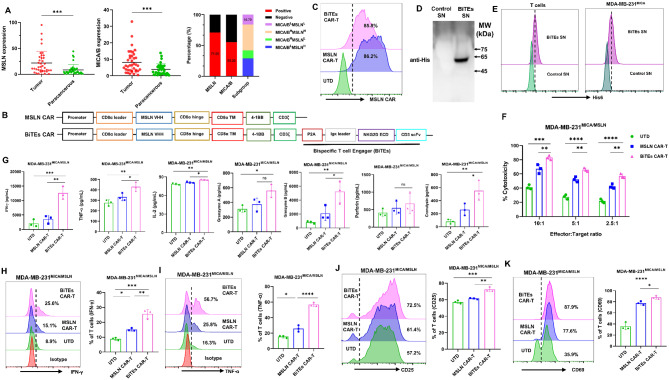
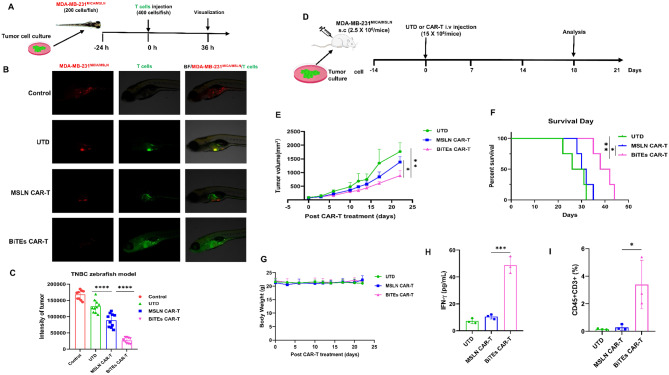
Triple-negative breast cancer (TNBC) is an aggressive subtype with poor prognosis and limited treatment options. Chimeric antigen receptor (CAR)-T cell therapy holds promise, but its efficacy is hindered by tumor antigen escape and heterogeneity. To address these challenges, we developed a novel bispecific T cell engagers CAR-T (BiTEs CAR-T) targeting Mesothelin (MSLN) and secreting NKG2D-Bispecific T cell Engagers (BiTEs) to engage NKG2D ligands (NKG2DL). Analysis of TNBC tissues using The Cancer Genome Atlas and tumor microarrays revealed high but weakly correlated expression of MSLN and NKG2DL, making them ideal targets for dual engagement. To reduce immunogenicity and enhance stability, we used a nanobody and the natural receptor NKG2D as antigen-binding domains instead of traditional scFvs in the CAR construct. The secreted BiTEs could promote the cytotoxicity of untransduced T cells against NKG2DL + tumor cells. In vitro, BiTEs CAR-T cells exhibited superior cytotoxicity, T cell activation, and cytokines production against heterogeneous target cells compared to MSLN CAR-T. In vivo, BiTEs CAR-T cells demonstrated potent antitumor activity in zebrafish and murine TNBC models, significantly reducing tumor burden and prolonging survival without detectable toxicity. These findings suggest that BiTE CAR-T cells offer a highly promising therapeutic strategy for TNBC by addressing antigen heterogeneity and immune escape mechanisms, with promising translational potential for clinical application.
三阴性乳腺癌(TNBC)是一种侵袭性亚型,预后较差且治疗选择有限。嵌合抗原受体(CAR)-T细胞疗法具有前景,但其疗效受到肿瘤抗原逃逸和异质性的阻碍。为应对这些挑战,我们开发了一种新型双特异性T细胞衔接器CAR-T(BiTEs CAR-T),靶向间皮素(MSLN)并分泌NKG2D双特异性T细胞衔接器(BiTEs)以结合NKG2D配体(NKG2DL)。使用癌症基因组图谱和肿瘤微阵列对TNBC组织进行分析,结果显示MSLN和NKG2DL表达较高但相关性较弱,使其成为双重结合的理想靶点。为降低免疫原性并增强稳定性,我们在CAR构建体中使用纳米抗体和天然受体NKG2D作为抗原结合域,而非传统的单链抗体片段(scFvs)。分泌的BiTEs可促进未转导的T细胞对NKG2DL +肿瘤细胞的细胞毒性。在体外,与MSLN CAR-T相比,BiTEs CAR-T细胞对异质性靶细胞表现出更强的细胞毒性、T细胞活化和细胞因子产生能力。在体内,BiTEs CAR-T细胞在斑马鱼和小鼠TNBC模型中表现出强大的抗肿瘤活性,显著减轻肿瘤负担并延长生存期,且未检测到毒性。这些发现表明,BiTE CAR-T细胞通过解决抗原异质性和免疫逃逸机制,为TNBC提供了一种极具前景的治疗策略,具有临床应用的潜在转化价值。