
由ZIF90纳米颗粒递送的精胺通过靶向抑制斑块中的巨噬细胞铁死亡来减轻动脉粥样硬化。
Spermine delivered by ZIF90 nanoparticles alleviates atherosclerosis by targeted inhibition of macrophage ferroptosis in plaque.
作者信息
Chen Yuwu, Xu Biyi, Lin Quan, Zhu Xinxin, Lv Ying, Bai Xiaoxuan, Weng Xiuzhu, Du Jie, Li Man, Zhu Yuxiao, Mou Junke, Wang Mengyang, Wang Yuehong, Luo Xing, Xu Changqing
机构信息
Department of Cardiology, 2, Affiliated Hospital of Harbin Medical University, Harbin, 150001, People's Republic of China.
National Key Laboratory of Frigid Zone Cardiovascular Diseases, The Key Laboratory of Myocardial Ischemia, Chinese Ministry of Education, Harbin, 150001, People's Republic of China.
出版信息
J Nanobiotechnology. 2025 Mar 4;23(1):165. doi: 10.1186/s12951-025-03271-8.
BACKGROUND
Nowadays, emerging evidence have suggested that the ferroptosis of macrophages could contribute to the progression of atherosclerosis (AS). Meanwhile, Spermine (Sp) could serve as an endogenous small molecule exhibiting a wide range of cardiovascular protective effects.
METHODS
Zeolitic imidazolate framework-90 (ZIF90) nanoparticles were synthesized and utilized to create a novel delivery nanosystem encapsulated with Sp (CD16/32-ZIF90@Sp). The efficacy of CD16/32-ZIF90@Sp in protecting against AS and ferroptosis was evaluated in ApoE mice and macrophages, with a focus on assessing potential adverse effects in vivo.
RESULTS
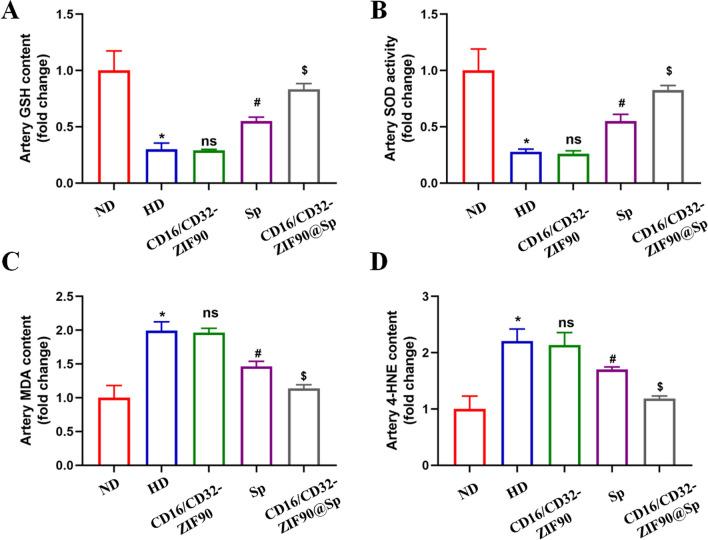
CD16/32-ZIF90@Sp exhibited reliable and stable delivery of Sp within acidic environments and ATP sensitivity. CD16/32-ZIF90@Sp effectively reduced the cytotoxicity of Sp. As is evidenced by in vitro and vivo experiments, CD16/32-ZIF90@Sp showed precise targeting of macrophages within atherosclerotic plaques and ox-LDL-activated macrophages. Furthermore, treatment with CD16/32-ZIF90@Sp effectively attenuated the progression of AS and the ferroptosis of macrophage within plaque in ApoE mice without causing significant side effects. Mechanistically, we found that CD16/32-ZIF90@Sp inhibited ferroptosis via improving mitochondrial function and upregulating the expression level of GPX4/xCT.
CONCLUSION
Our study demonstrated that CD16/32-modified ZIF90 nanoparticles could effectively target macrophages within atherosclerotic plaques, leading to the inhibition of atherosclerotic plaque progression in ApoE mice. These effects were attributed to the enhancement of mitochondrial function and the inhibition of macrophage ferroptosis, with limited side effects.
背景
如今,新出现的证据表明巨噬细胞的铁死亡可能促进动脉粥样硬化(AS)的进展。同时,精胺(Sp)可作为一种内源性小分子,具有广泛的心血管保护作用。
方法
合成了沸石咪唑酯骨架-90(ZIF90)纳米颗粒,并用于构建一种新型的包裹Sp的递送纳米系统(CD16/32-ZIF90@Sp)。在载脂蛋白E基因敲除(ApoE)小鼠和巨噬细胞中评估了CD16/32-ZIF90@Sp对AS和铁死亡的保护作用,重点评估其在体内的潜在不良反应。
结果
CD16/32-ZIF90@Sp在酸性环境中表现出可靠且稳定的Sp递送以及ATP敏感性。CD16/32-ZIF90@Sp有效降低了Sp的细胞毒性。体外和体内实验表明,CD16/32-ZIF90@Sp对动脉粥样硬化斑块内的巨噬细胞和氧化型低密度脂蛋白(ox-LDL)激活的巨噬细胞具有精确靶向性。此外,用CD16/32-ZIF90@Sp治疗可有效减轻ApoE小鼠AS的进展以及斑块内巨噬细胞的铁死亡,且未引起明显副作用。机制上,我们发现CD16/32-ZIF90@Sp通过改善线粒体功能和上调谷胱甘肽过氧化物酶4(GPX4)/胱氨酸/谷氨酸逆向转运体(xCT)的表达水平来抑制铁死亡。
结论
我们的研究表明,CD16/32修饰的ZIF90纳米颗粒可有效靶向动脉粥样硬化斑块内的巨噬细胞,从而抑制ApoE小鼠动脉粥样硬化斑块的进展。这些作用归因于线粒体功能的增强和巨噬细胞铁死亡的抑制,且副作用有限。


 Zotero 插件