Tsuchikawa Yusuke, Kai Tetsuya, Parker Joseph D, Matsumoto Yoshihiro, Shinohara Takenao
J-PARC Center, Japan Atomic Energy Agency, 2-4 Shirakata, Tokai, Ibaraki, 319-1195, Japan.
Neutron Science and Technology Center, Comprehensive Research Organization for Science and Society, 162-1 Shirakata, Tokai, Ibaraki, 319-1106, Japan.
Sci Rep. 2025 Mar 5;15(1):7687. doi: 10.1038/s41598-025-92174-7.
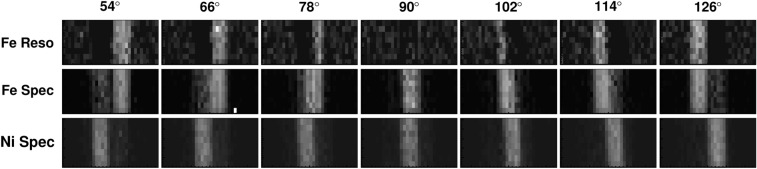
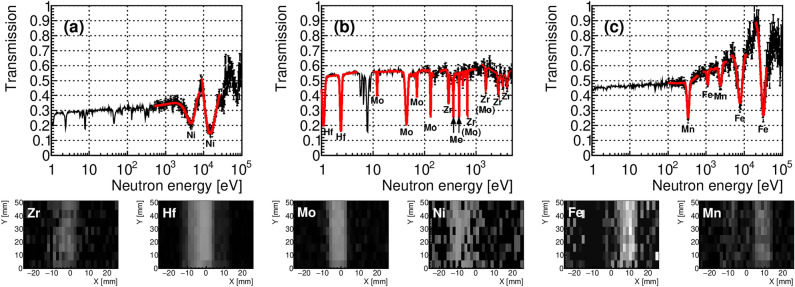
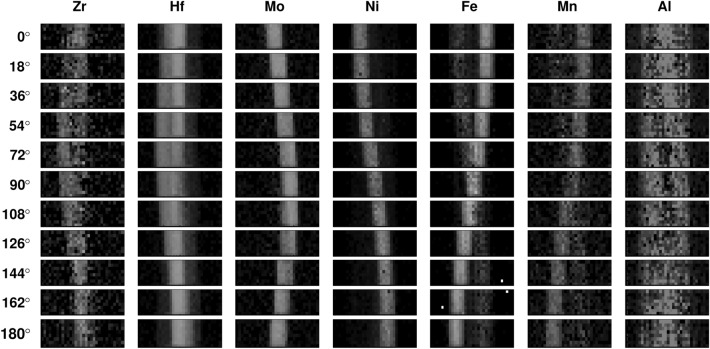
A neutron resonance absorption imaging technique to visualize two-dimensional distributions with element discrimination has been developed at the Materials and Life Science Experimental Facility of the Japan Proton Accelerator Research Complex. We measured neutron transmission spectra from 1 eV to 100 keV while rotating a sample containing iron, zirconium, nickel, molybdenum, and aluminum rods. The distributions of hafnium (impurity of zirconium) and molybdenum were clearly obtained by a straightforward analysis using the most prominent resonances. Then an analysis using multiple resonances of each element simultaneously was performed finding that the accuracy of elemental identification was improved, and iron and nickel distributions became clearer. However, these analysis methods sometimes have difficulties in the case of overlapping materials since a resonance shape can be deteriorated by those of other materials. Such an example was demonstrated with the case of iron and nickel. To overcome the issue and aiming for further improvement, we proposed a method to fit the transmission spectrum in a wide range assuming the existence of possible elements, successfully visualizing both the distributions of the sample metals and those of hafnium and manganese (impurities of zirconium and iron). The newly introduced analysis technique will contribute to the establishment of a standard analytical procedure for general users of the facility.
日本质子加速器研究中心材料与生命科学实验设施已开发出一种用于可视化具有元素分辨能力的二维分布的中子共振吸收成像技术。我们在旋转一个包含铁、锆、镍、钼和铝棒的样品时,测量了从1电子伏特到100千电子伏特的中子透射谱。通过使用最显著的共振进行直接分析,清晰地获得了铪(锆的杂质)和钼的分布。然后同时使用每种元素的多个共振进行分析,发现元素识别的准确性得到了提高,铁和镍的分布也变得更清晰。然而,这些分析方法在材料重叠的情况下有时会遇到困难,因为共振形状可能会被其他材料的共振形状破坏。铁和镍的情况就证明了这一点。为了克服这个问题并进一步改进,我们提出了一种方法,即在假设可能存在的元素的情况下,在宽范围内拟合透射谱,成功地可视化了样品金属以及铪和锰(锆和铁的杂质)的分布。新引入的分析技术将有助于为该设施的普通用户建立标准分析程序。