Keadle Sarah, Hasanaj Kristina, Leonard-Corzo Krista S, Fernandez Arlene, Freid Lena, Weiss Skylar, Legato Maria, Anand Harsh, Hagobian Todd, Phillips Siobhan, Phelan Suzanne, Guastaferro Kate, Seltzer Ryan, Buman Matthew
California Polytechnic State University.
Arizona State University.
Res Sq. 2025 Feb 24:rs.3.rs-5984168. doi: 10.21203/rs.3.rs-5984168/v1.
Using the multiphase optimization strategy (MOST) framework, we aimed to identify a feasible, acceptable and optimized set of mHealth-delivered behavioral strategies for reducing recreational sedentary screen time (rSST) by at least 60 min/day.
Eligible participants were 23-64 years old and had high rSST (> 3 h/day). We used a full factorial (23) design in which participants received a "core" mHealth application and were randomized to combinations of three components (on vs. off): LOCKOUT: rSST electronically restricted; TEXT: rSST reduction prompts; and EARN: rSST through physical activity. rSST was assessed at baseline and at 8 and 16 weeks of age via an integrated measure of sedentary time and screen time. We used a linear mixed effect model to test the change in rSST for the three intervention components and their interactions.
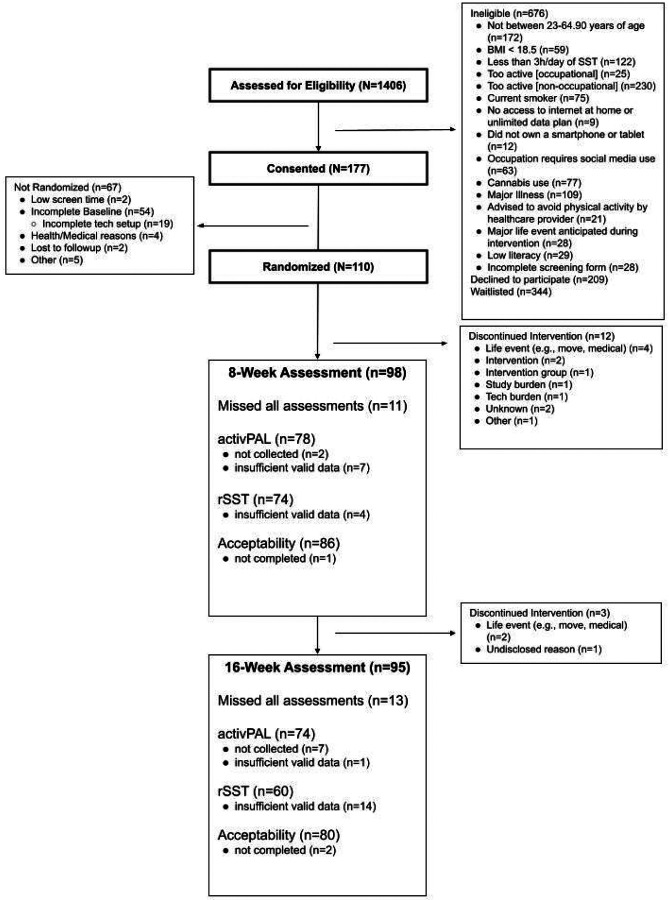
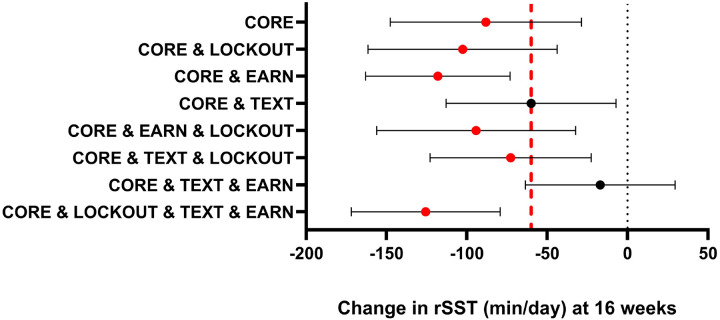
A total of 82% of the randomized participants (N = 110) were female, with a mean ± SD age of 41 ± 11.7 y and a BMI of 29.7 ± 7.8 kg/m and their mean (95% CI) rSST was 184.7 (172.8, 196.5) min/day at baseline. The expected difference (baseline vs 16 weeks) in rSST was greatest for the intervention versions with a core, LOCKOUT, TEXT, & EARN (-125.7 [-172.0, -79.3] min/day) at the "on" level. The participants were satisfied with the study and found the app helpful in reducing rSST (> 94%). Technical issues resulted in 20% being somewhat dissatisfied with the app.
We identified several promising intervention versions that exceeded our optimization objective. The intervention version that included core, LOCKOUT, TEXT, & EARN components "on" was efficacious, feasible and acceptable and should be used to test the effect of rSST reductions on health outcomes.
(clinicaltrials.gov NCT04464993).
我们旨在运用多阶段优化策略(MOST)框架,确定一套可行、可接受且经过优化的移动健康行为策略,以将娱乐性久坐屏幕时间(rSST)每天至少减少60分钟。
符合条件的参与者年龄在23至64岁之间,且rSST较高(>3小时/天)。我们采用全因子(2³)设计,参与者会收到一个“核心”移动健康应用程序,并被随机分配到三个组件(开启与关闭)的组合中:锁定:电子限制rSST;文本:rSST减少提示;以及赚取:通过体育活动减少rSST。通过久坐时间和屏幕时间的综合测量,在基线以及8周和16周龄时评估rSST。我们使用线性混合效应模型来测试三种干预组件及其相互作用导致的rSST变化。
共有82%的随机参与者(N = 110)为女性,平均年龄±标准差为41±11.7岁,体重指数为29.7±7.8kg/m²,基线时她们的平均(95%CI)rSST为184.7(172.8,196.5)分钟/天。在“开启”水平下,具有核心、锁定、文本和赚取功能的干预版本在rSST方面的预期差异(基线与16周)最大(-125.7[-172.0,-79.3]分钟/天)。参与者对该研究感到满意,并发现该应用程序有助于减少rSST(>94%)。技术问题导致20%的人对该应用程序有些不满。
我们确定了几个超过优化目标的有前景的干预版本。包含核心、锁定、文本和赚取组件且处于“开启”状态的干预版本有效、可行且可接受,应用于测试减少rSST对健康结果的影响。
(clinicaltrials.gov NCT04464993)