Madangopal Rajtarun, Zhao Yuan, Heins Conor, Zhou Jingfeng, Liang Bo, Barbera Giovanni, Lam Ka Chun, Komer Lauren E, Weber Sophia J, Thompson Drake J, Gera Yugantar, Pham Diana Q, Savell Katherine E, Warren Brandon L, Caprioli Daniele, Venniro Marco, Bossert Jennifer M, Ramsey Leslie A, Jedema Hank P, Schoenbaum Geoffrey, Lin Da-Ting, Shaham Yavin, Pereira Francisco, Hope Bruce T
Behavioral Neuroscience Research Branch, Intramural Research Program, National Institute on Drug Abuse, Baltimore, MD, USA.
Machine Learning Core, Intramural Research Program, National Institute of Mental Health, Bethesda, MD, USA.
bioRxiv. 2025 Feb 24:2025.02.23.639736. doi: 10.1101/2025.02.23.639736.
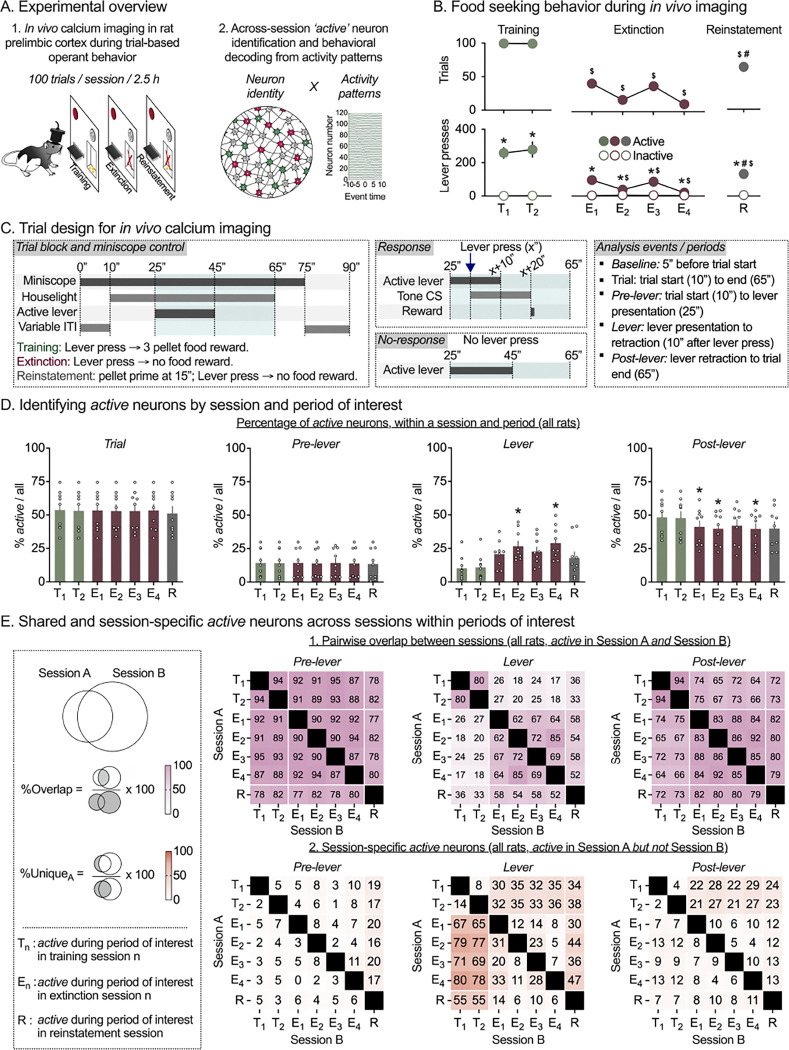
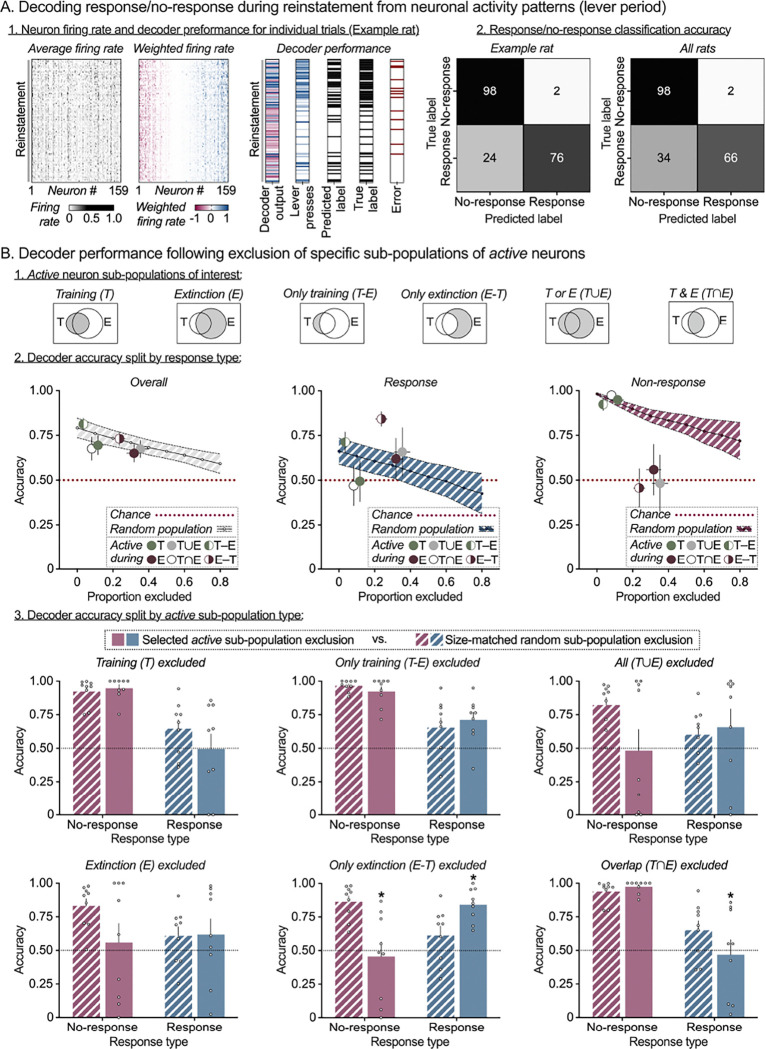
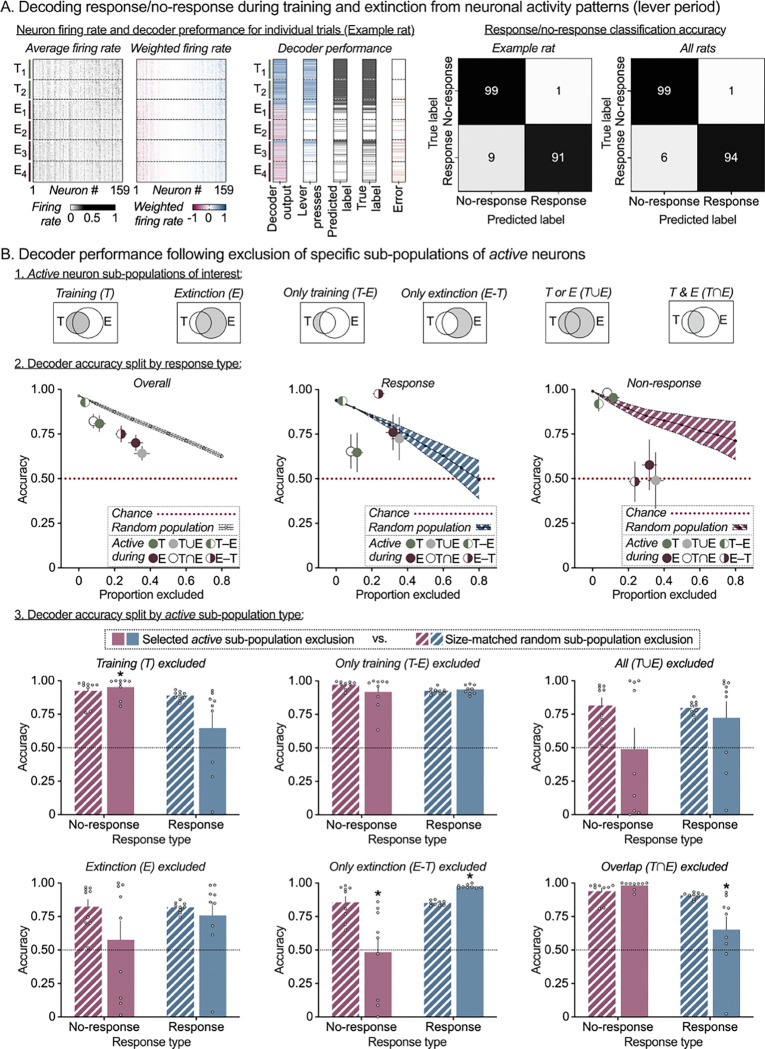
Learning when to initiate or withhold actions is essential for survival and requires integration of past experiences with new information to adapt to changing environments. While stable prelimbic cortex (PL) ensembles have been identified during reward learning, it remains unclear how they adapt when contingencies shift. Does the same ensemble adjust its activity to support behavioral suppression upon reward omission, or is a distinct ensemble recruited for this new learning? We used single-cell calcium imaging to longitudinally track PL neurons in rats across operant food reward Training, Extinction and Reinstatement, trained rat-specific decoders to predict trial-wise behavior, and implemented an deletion approach to characterize ensemble contributions to behavior. We show that operant training and extinction recruit distinct PL ensembles that encode response execution and inhibition, and that both ensembles are re-engaged and maintain their roles during Reinstatement. These findings highlight ensemble-based encoding of multiple learned associations within a region, with selective ensemble recruitment supporting behavioral flexibility under changing contingencies.
学习何时启动或停止行动对于生存至关重要,并且需要将过去的经验与新信息整合起来以适应不断变化的环境。虽然在奖励学习过程中已经确定了稳定的前边缘皮层(PL)神经元集群,但尚不清楚当意外情况发生变化时它们是如何适应的。是同一个神经元集群调整其活动以在奖励缺失时支持行为抑制,还是为这种新的学习招募了一个不同的神经元集群?我们使用单细胞钙成像技术纵向追踪大鼠在操作性食物奖励训练、消退和恢复过程中的PL神经元,训练大鼠特异性解码器以预测逐次试验的行为,并采用删除方法来表征神经元集群对行为的贡献。我们发现操作性训练和消退招募了不同的PL神经元集群,它们分别编码反应执行和抑制,并且这两个神经元集群在恢复过程中都会重新参与并保持其作用。这些发现突出了一个区域内基于神经元集群的多种学习关联编码,选择性的神经元集群招募支持在变化的意外情况下的行为灵活性。