Lee Younga Heather, Zhang Yingzhe, Espinosa Dice Ana Lucia, Li Josephine H, Tubbs Justin D, Feng Yen-Chen Anne, Ge Tian, Maihofer Adam X, Nievergelt Caroline M, Smoller Jordan W, Koenen Karestan C, Roberts Andrea L, Slopen Natalie
Center for Genomic Medicine, Massachusetts General Hospital, Boston, MA.
Department of Psychiatry, Harvard Medical School, Boston, MA.
medRxiv. 2025 Feb 28:2025.02.27.25322886. doi: 10.1101/2025.02.27.25322886.
Biomarkers can potentially improve the diagnosis, monitoring, and treatment of posttraumatic stress disorder (PTSD). However, PTSD biomarkers that are scalable and easily integrated into real-world clinical settings have not been identified.
To triangulate phenotypic and genomic evidence from a health system biobank with a goal of identifying scalable and clinically relevant biomarkers for PTSD.
The analysis was conducted between June to November 2024 using genomic samples and laboratory test results recorded in the Mass General Brigham (MGB) Health System. The analysis included 23,743 European ancestry participants from the nested MGB Biobank study.
The first exposure was polygenic risk score (PRS) for PTSD, calculated using the largest available European ancestry genome-wide association study (GWAS), employing a Bayesian polygenic scoring method. The second exposure was a clinical diagnosis of PTSD, determined by the presence of two or more qualifying PTSD phecodes in the longitudinal electronic health records (EHR).
The primary outcomes were the inverse normal quantile transformed, median lab values of 241 laboratory traits with non-zero estimates.
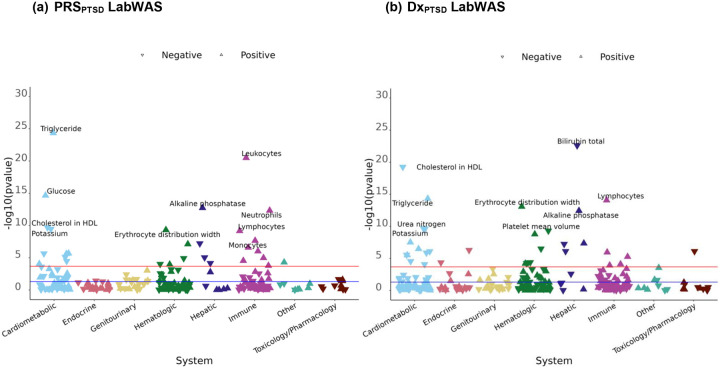
Sixteen unique laboratory traits across the cardiometabolic, hematologic, hepatic, and immune systems were implicated in both genomic and phenotypic lab-wide association scans (LabWAS). Two-sample Mendelian randomization analyses provided evidence of potential unidirectional causal effects of PTSD liability on five laboratory traits.
These findings demonstrate the potential of a triangulation approach to uncover scalable and clinically relevant biomarkers for PTSD.
生物标志物有可能改善创伤后应激障碍(PTSD)的诊断、监测和治疗。然而,尚未确定可扩展且易于整合到实际临床环境中的PTSD生物标志物。
整合来自健康系统生物样本库的表型和基因组证据,以确定可扩展且与临床相关的PTSD生物标志物。
设计、地点和参与者:分析于2024年6月至11月进行,使用了麻省总医院布莱根(MGB)健康系统中记录的基因组样本和实验室检测结果。分析纳入了来自嵌套的MGB生物样本库研究的23743名欧洲血统参与者。
第一个暴露因素是PTSD的多基因风险评分(PRS),使用最大可用的欧洲血统全基因组关联研究(GWAS),采用贝叶斯多基因评分方法计算。第二个暴露因素是PTSD的临床诊断,通过纵向电子健康记录(EHR)中两个或更多符合条件的PTSD疾病编码来确定。
主要结局是对241个实验室特征的逆正态分位数转换后的中位数实验室值,其估计值非零。
在心血管代谢、血液、肝脏和免疫系统中,有16种独特的实验室特征在基因组和表型全实验室关联扫描(LabWAS)中均有涉及。两样本孟德尔随机化分析提供了证据,表明PTSD易感性对5种实验室特征存在潜在的单向因果效应。
这些发现证明了三角测量法在揭示可扩展且与临床相关的PTSD生物标志物方面的潜力。