Triantafyllou George, Papadopoulos-Manolarakis Panagiotis, Olewnik Łukasz, Duparc Fabrice, Tsakotos George, Zielinska Nicol, Piagkou Maria
Department of Anatomy, School of Medicine, Faculty of Health Sciences, National and Kapodistrian University of Athens, 75 Mikras Asias Str., Goudi, 11527, Athens, Greece.
Department of Neurosurgery, General Hospital of Nikaia-Piraeus, Athens, Greece.
Surg Radiol Anat. 2025 Mar 10;47(1):89. doi: 10.1007/s00276-025-03601-3.
The skull base depicts significant morphological variability, which is frequently described due to its neurosurgical significance. The middle cranial fossa's accessory foramen has rarely been described.
A 53-year-old female patient's computed tomography (CT) scan was further investigated for its unusual morphology.
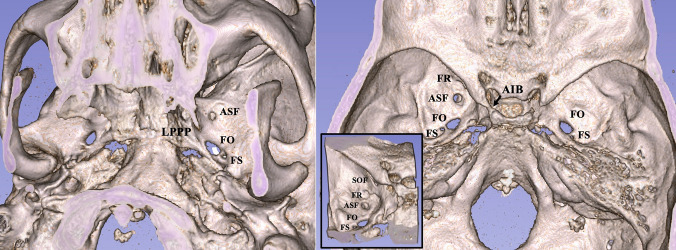
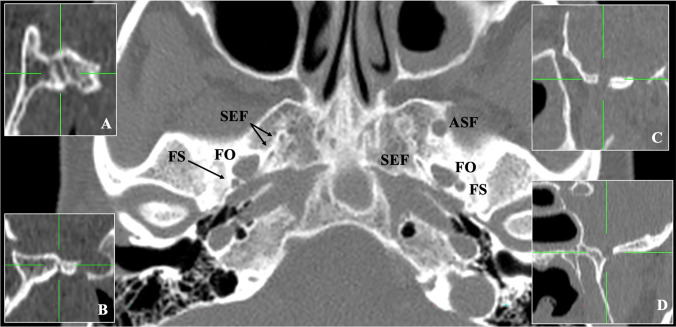
On the left-sided middle cranial fossa, an accessory sphenoidal foramen (ASF) was observed, located 3.3 mm posterior to the foramen rotundum (FR) and 5.5 mm anterior to the foramen ovale (FO). Extracranially, the ASF opened into the infratemporal fossa and coexisted with another sphenoidal emissary foramen (SEF), anteromedially to the FO. On the right side, two SEF were located anteromedially to the FO.
Similar to the current case, ASF of the middle cranial fossa were reported in a previous study with a prevalence of 0.20%. The unconstraint well described accessory foramina are the emissary foramina that transmit emissary veins, and are of interest for anatomists, radiologists and neurosurgeons.
颅底呈现出显著的形态学变异性,因其在神经外科手术中的重要意义而经常被描述。中颅窝的副孔很少被描述。
对一名53岁女性患者的计算机断层扫描(CT)进行了进一步研究,因其形态异常。
在左侧中颅窝观察到一个蝶骨副孔(ASF),位于圆孔(FR)后方3.3毫米处,卵圆孔(FO)前方5.5毫米处。颅外,ASF开口于颞下窝,并与另一个蝶骨导静脉孔(SEF)共存,位于FO的前内侧。在右侧,两个SEF位于FO的前内侧。
与当前病例类似,先前的一项研究报道中颅窝ASF的发生率为0.20%。未受严格描述的副孔是传导导静脉的导静脉孔,对解剖学家、放射科医生和神经外科医生具有重要意义。