Xie Ziwei, Feng Yuxin, He Yue, Lin Yingying, Wang Xiaohong
Department of Obstetrics and Gynaecology, Affiliated People's Hospital of Fujian University of Traditional Chinese Medicine, Fujian, China.
First Clinical Medical College, Fujian University of Traditional Chinese Medicine, Fuzhou, China.
Sci Rep. 2025 Mar 10;15(1):8291. doi: 10.1038/s41598-025-92800-4.
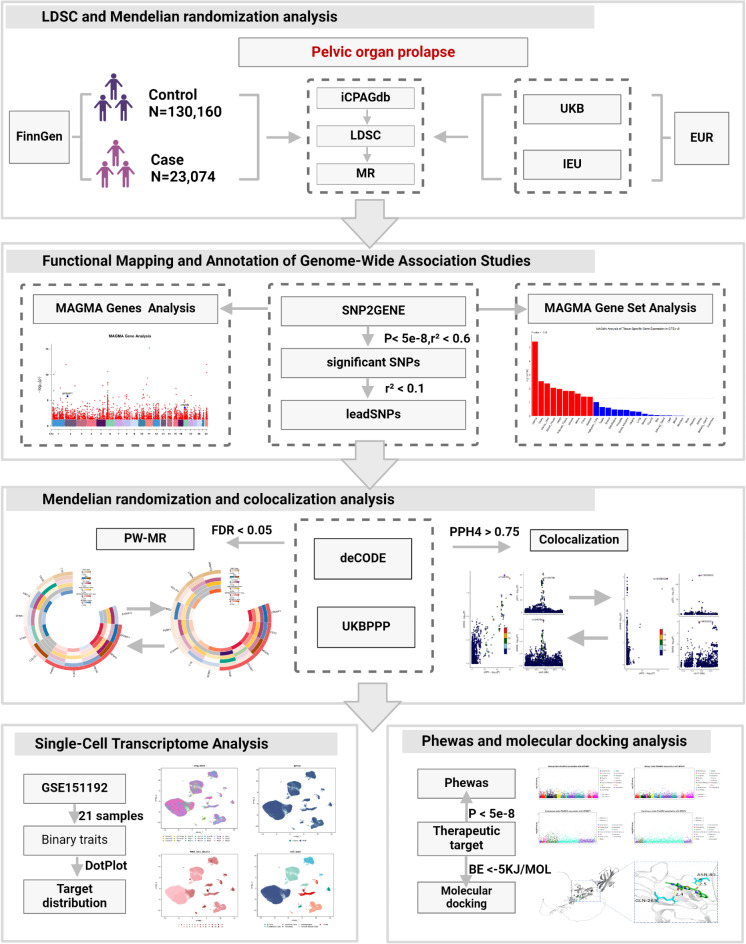
Pelvic organ prolapse (POP) significantly impacts patients' quality of life, and current treatment options remain limited due to high recurrence rates, making the exploration of new therapeutic targets essential. Using data from the FinnGen cohort, we performed a proteome-wide Mendelian randomization (PW-MR) analysis. Through PW-MR and Bayesian colocalization analyses, we identified EFEMP1 and MFAP4 as potential key drug targets, with EFEMP1 potentially exerting a protective effect, whereas MFAP4 may be associated with an increased risk of POP. To further support these findings, we analysed single-cell RNA sequencing data to evaluate the expression patterns of EFEMP1 and MFAP4 in different cell populations. The analysis revealed that EFEMP1 and MFAP4 are specifically enriched in cell types involved in tissue remodelling and fibrosis. Findings of phenome-wide association studies indicated that the risk of side effects for these targets may be low, suggesting the safety of treatment focused on these targets. Preliminary molecular docking analysis findings suggested that EFEMP1 and MFAP4 may have strong binding affinities with candidate drugs, further supporting the feasibility of EFEMP1 and MFAP4 as drug targets. In conclusion, our findings indicate that EFEMP1 and MFAP4 are promising therapeutic targets for POP, providing important insights for the development of safe and effective treatments.
盆腔器官脱垂(POP)严重影响患者的生活质量,由于复发率高,目前的治疗选择仍然有限,因此探索新的治疗靶点至关重要。利用芬兰基因队列的数据,我们进行了全蛋白质组孟德尔随机化(PW-MR)分析。通过PW-MR和贝叶斯共定位分析,我们确定EFEMP1和MFAP4为潜在的关键药物靶点,EFEMP1可能发挥保护作用,而MFAP4可能与POP风险增加有关。为了进一步支持这些发现,我们分析了单细胞RNA测序数据,以评估EFEMP1和MFAP4在不同细胞群体中的表达模式。分析表明,EFEMP1和MFAP4在参与组织重塑和纤维化的细胞类型中特异性富集。全表型关联研究结果表明,这些靶点的副作用风险可能较低,表明针对这些靶点的治疗具有安全性。初步分子对接分析结果表明,EFEMP1和MFAP4可能与候选药物具有很强的结合亲和力,进一步支持了EFEMP1和MFAP4作为药物靶点的可行性。总之,我们的研究结果表明,EFEMP1和MFAP4是有前景的POP治疗靶点,为开发安全有效的治疗方法提供了重要见解。