Alcaíno José Miguel, Vera Gonzalo, Almarza Gonzalo, Lagos Carlos F, Terraza Claudio A, Del Campo Andrea, Recabarren-Gajardo Gonzalo
Laboratorio de Fisiología y Bioenergética Celular, Facultad de Química y de Farmacia, Pontificia Universidad Católica de Chile, Santiago, 7810000, Chile.
Bioactive Heterocycles Synthesis Laboratory (BHSL), Departamento de Farmacia, Facultad de Química y de Farmacia, Pontificia Universidad Católica de Chile, Avenida Vicuña Mackenna, Macul, Santiago, 4860, 7820436, Chile.
Sci Rep. 2025 Mar 11;15(1):8380. doi: 10.1038/s41598-025-92755-6.
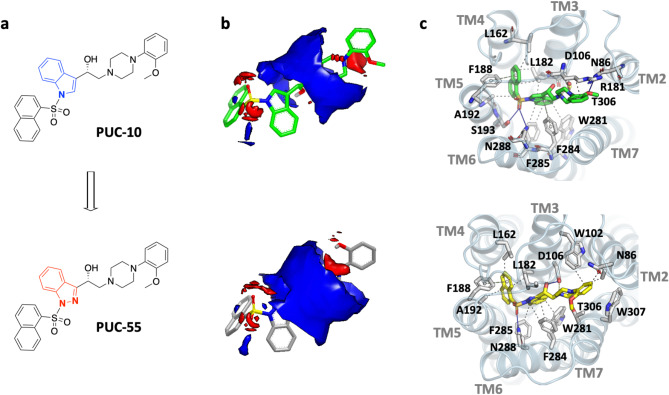
Autophagy is a natural process in which the cell degrades substances through the lysosomal pathway. One of the most studied mechanisms for regulating autophagy is the mTOR signaling pathway. Recent research has shown that the 5-HT receptor is linked to the mTOR pathway and can affect cognition in various neurodevelopmental models. Therefore, developing 5-HT receptor antagonists could improve cognition by inducing autophagy through the inhibition of the mTOR pathway. Our study reports two in-house-designed 5-HTR antagonists, PUC-10 and its indazole analogue PUC-55, that induce mTOR-dependent autophagy. PUC-10, an indole-based 5-HT receptor antagonist with high binding affinity (K = 14.6 nM) and antagonist potency (IC = 32 nM), demonstrated more than 90% at 25 µM cellular viability and a high capacity to induce autophagy in the neuroblastoma SH-SY5Y cell line. Similarly, its indazole analogue, PUC-55 (K = 37.5 nM), exhibited high cellular viability and potent autophagy-inducing activity. Both compounds induced overexpression of the 5-HT receptor after 24 h of stimulation, contrasting with the effects observed with Rapamycin (100 nM), a well-known mTOR inhibitor. Additionally, the signaling pathway was characterized, showing that both PUC-10 and PUC-55 induce autophagy by inhibiting the mTOR pathway, suggesting their potential therapeutic applications for neurological disorders.
自噬是一种细胞通过溶酶体途径降解物质的自然过程。研究最多的自噬调节机制之一是mTOR信号通路。最近的研究表明,5-羟色胺(5-HT)受体与mTOR通路相关联,并且在各种神经发育模型中会影响认知。因此,开发5-HT受体拮抗剂可通过抑制mTOR通路诱导自噬来改善认知。我们的研究报告了两种内部设计的5-羟色胺受体(5-HTR)拮抗剂,PUC-10及其吲唑类似物PUC-55,它们可诱导mTOR依赖性自噬。PUC-10是一种基于吲哚的5-HT受体拮抗剂,具有高结合亲和力(K = 14.6 nM)和拮抗剂效力(IC = 32 nM),在25 µM时细胞活力超过90%,并且在神经母细胞瘤SH-SY5Y细胞系中具有高自噬诱导能力。同样,其吲唑类似物PUC-55(K = 37.5 nM)表现出高细胞活力和强大的自噬诱导活性。在刺激24小时后,这两种化合物均诱导了5-HT受体的过表达,这与著名的mTOR抑制剂雷帕霉素(100 nM)所观察到的效果形成对比。此外,对信号通路进行了表征,表明PUC-10和PUC-55均通过抑制mTOR通路诱导自噬,这表明它们在神经系统疾病方面具有潜在的治疗应用。