Zhu Hongxia, Fu Lei, Xie Yu, Yuan Xiao, Chen Shengtao, Xie Lunli
Department of Traumatic Orthopedics, Hunan University of Medicine General Hospital, Huaihua, Hunan Province, 418000, People's Republic of China.
Department of Joint and Hand Orthopedics, Hunan University of Medicine General Hospital, Huaihua, Hunan Province, 418000, People's Republic of China.
Int Med Case Rep J. 2025 Mar 5;18:307-314. doi: 10.2147/IMCRJ.S506741. eCollection 2025.
Aseptic loosening (AL) of prostheses is a complex and multi-factorial consequences characterized by nonspecific hip start-up pain, impaired gait, or ambulation. The AL of acetabular components associated with femur prostheses can lead to challenges in accurate diagnosis and suitable therapy, potentially resulting in disaster consequence. This study reported revision of in four cases with AL of acetabular components associated with or without femur prostheses after underwent primary total hip arthroplasty.
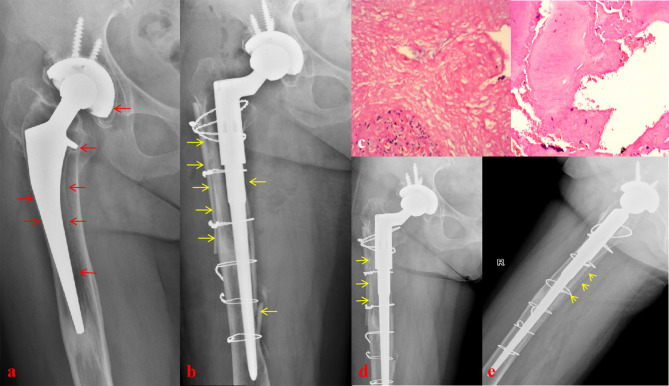
We present four cases with aseptic loosening of prostheses with a medical history of total hip arthroplasty who presented obvious clinical features of recurrent hip pain or "start-up" pain, limping gait, and worsening of walking. Basing on preoperative imaging materials, and ruling out prosthetic joint infection, the comprehensive analysis revealed migration and radiolucency line around margin of prosthesis, confirming the diagnosis of prosthetic AL. All patients accepted individual revision surgery and acquired satisfactory results basing on the month telephone follow-up duration.
Our case report suggests long femur stem associated with wires cerclage fixation combined with or without bone graft revision for treatment of aseptic loosening of the acetabular components coupled with femur prostheses is a viable technique for achieving reliable fracture healing and satisfactory clinical results. Besides, it is the critical need for individualized approaches to therapeutic method, uniquely intended to address the complexity of this AL after THA.
假体无菌性松动(AL)是一种复杂的多因素结果,其特征为非特异性的髋关节起始疼痛、步态受损或行走障碍。与股骨假体相关的髋臼组件无菌性松动会给准确诊断和合适治疗带来挑战,可能导致灾难性后果。本研究报告了4例初次全髋关节置换术后髋臼组件无菌性松动(伴或不伴有股骨假体)的翻修情况。
我们呈现了4例有全髋关节置换病史的假体无菌性松动患者,他们表现出明显的复发性髋关节疼痛或“起始”疼痛、跛行步态以及行走能力恶化等临床特征。基于术前影像学资料,并排除假体关节感染,综合分析显示假体边缘有移位和透亮线,确诊为假体无菌性松动。所有患者均接受了个体化翻修手术,并且根据术后1个月的电话随访,取得了满意的结果。
我们的病例报告表明,长股骨干结合钢丝环扎固定并联合或不联合植骨翻修治疗与股骨假体相关的髋臼组件无菌性松动,是实现可靠骨折愈合和满意临床效果的可行技术。此外,迫切需要采用个体化的治疗方法,专门针对全髋关节置换术后这种无菌性松动的复杂性。