Yu Haoxuan, Zahidi Izni, Fai Chow Ming
Department of Civil Engineering School of Engineering Monash University Malaysia Jalan Lagoon Selatan Bandar Sunway Selangor 47500 Malaysia.
Monash Climate-Resilient Infrastructure Research Hub (M-CRInfra) School of Engineering Monash University Malaysia Jalan Lagoon Selatan Bandar Sunway Selangor 47500 Malaysia.
Glob Chall. 2025 Feb 25;9(3):2400288. doi: 10.1002/gch2.202400288. eCollection 2025 Mar.
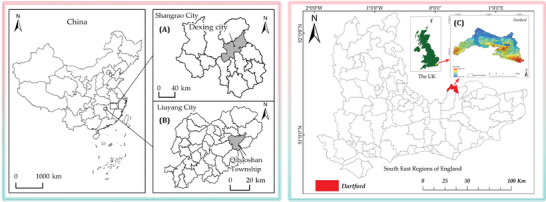
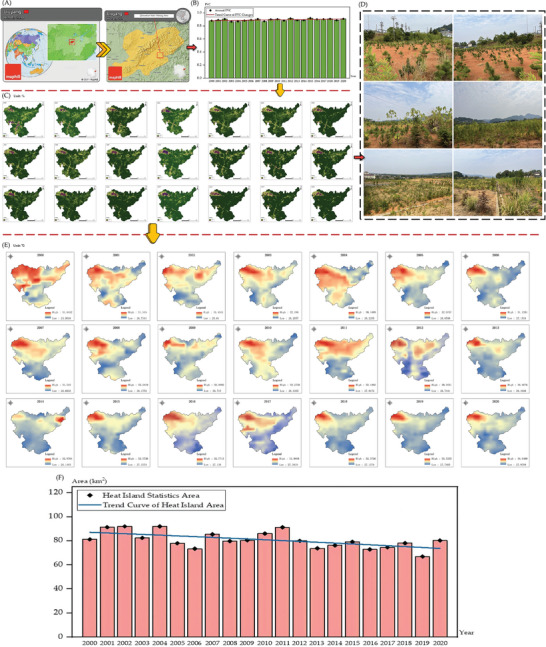
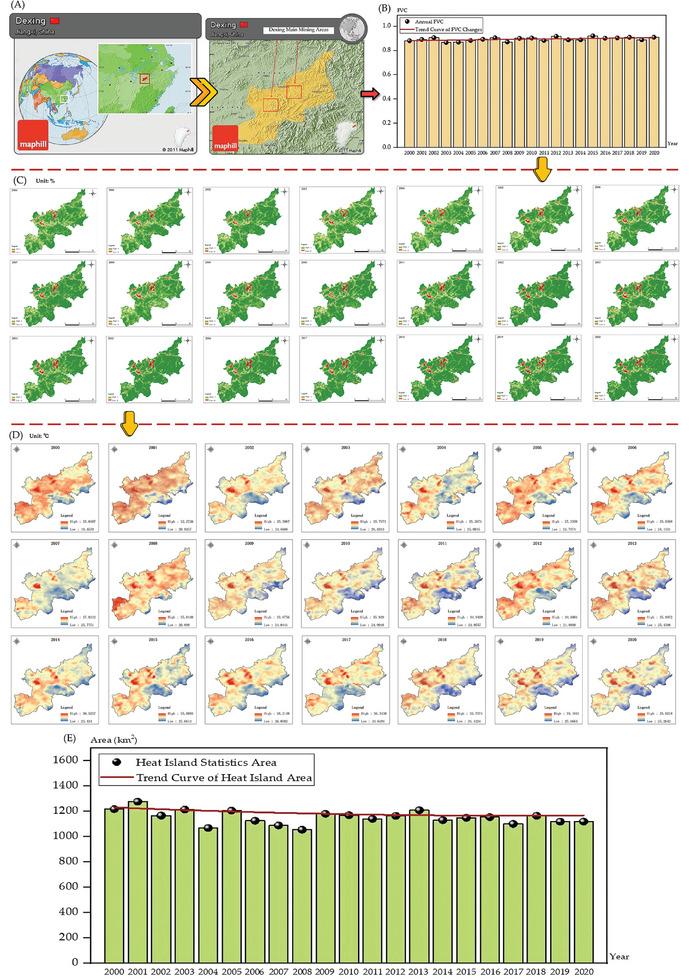
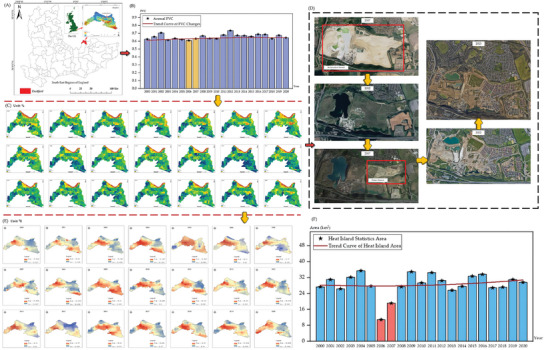
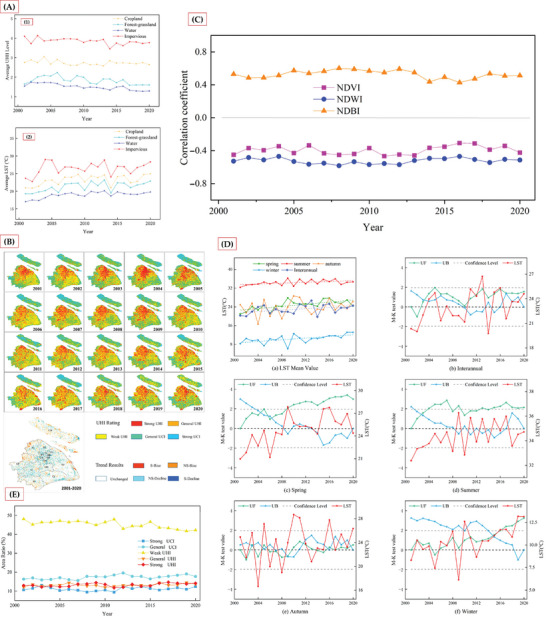
Vegetation restoration plays a critical role in mitigating urban heat island (UHI) effects and improving local climate conditions, particularly in mining-affected areas. This study analyzes vegetation cover changes and their impact on UHI from 2000 to 2020 in three locations: Dexing City and Qibaoshan Township in China, and Dartford Ebbsfleet Garden City in the UK, using satellite imagery and remote sensing data. In Dexing City, the transition from open-pit to underground mining, combined with reclamation efforts, maintained a stable fractional vegetation cover (FVC) of 0.88-0.91, reducing the UHI area from 1216.86 km² in 2000 to under 1000 km² by 2020. Qibaoshan Township saw an increase in FVC from 0.88 in 2000 to over 0.92 by 2020, resulting in a 26% reduction in UHI area. Dartford achieved a temporary peak FVC of 0.71 in 2002 through urban greening initiatives. The findings show that increased vegetation cover significantly lowers surface temperatures through evapotranspiration, shading, and albedo modification, with heavily vegetated areas maintaining temperatures up to 3°C lower than adjacent mining sites. The study demonstrates the importance of integrating ecological restoration with sustainable urban planning.
植被恢复在减轻城市热岛(UHI)效应和改善当地气候条件方面发挥着关键作用,特别是在受采矿影响的地区。本研究利用卫星图像和遥感数据,分析了2000年至2020年中国德兴市和七宝山乡以及英国达特福德埃布斯弗利特花园城三个地点的植被覆盖变化及其对城市热岛的影响。在德兴市,从露天开采到地下开采的转变,再加上土地复垦工作,使植被覆盖度(FVC)稳定在0.88 - 0.91,城市热岛面积从2000年的1216.86平方公里减少到2020年的1000平方公里以下。七宝山乡的植被覆盖度从2000年的0.88增加到2020年的0.92以上,城市热岛面积减少了26%。达特福德通过城市绿化举措在2002年实现了0.71的临时最高植被覆盖度。研究结果表明,植被覆盖度增加通过蒸散、遮荫和反照率改变显著降低了地表温度,植被茂密地区的温度比相邻采矿区低3°C。该研究证明了将生态恢复与可持续城市规划相结合的重要性。