Li Jia, Su Wei-Wei, Wang Zhen-Li, Ji Xiang-Fen, Wang Jing-Wei, Wang Kai
Qilu Hospital (Qingdao), Department of Hepatology, Shandong University, Qingdao, 266035, China.
Qilu Hospital, Department of Hepatology, Shandong University, Jinan, 250012, China.
Sci Rep. 2025 Mar 12;15(1):8521. doi: 10.1038/s41598-025-92972-z.
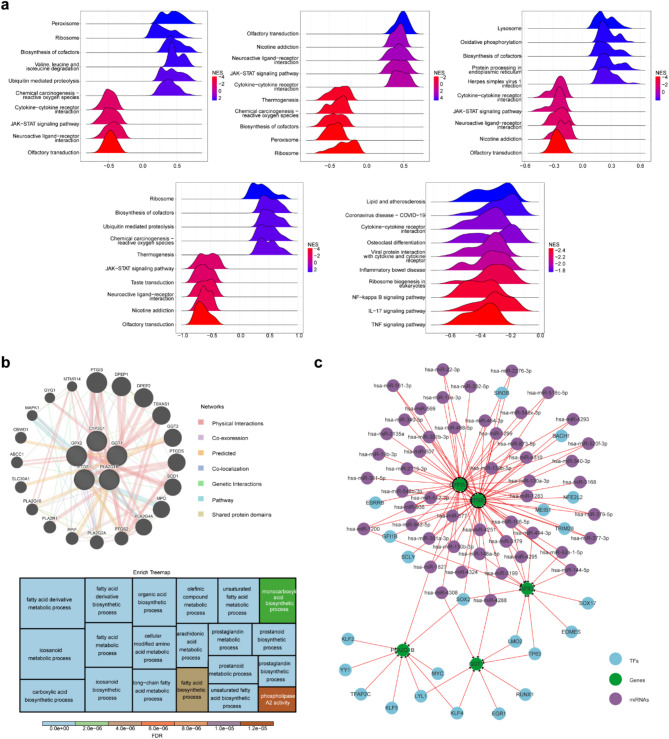
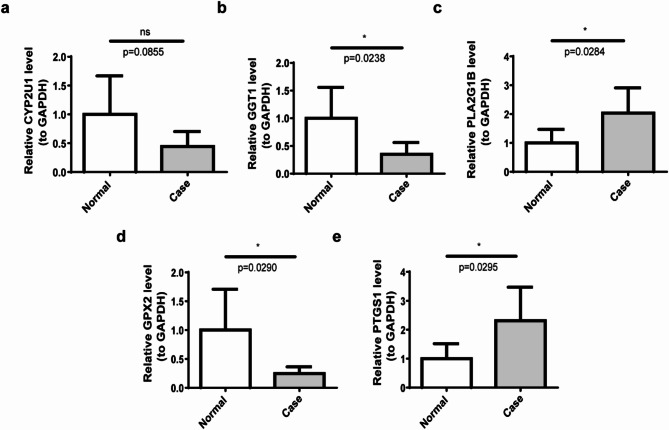
Elevated arachidonic acid metabolism (AAM) has been linked to the progression of non-alcoholic fatty liver disease (NAFLD). However, the specific role of AAM-related genes (AAMRGs) in NAFLD remains poorly understood. To investigate the involvement of AAMRGs in NAFLD, this study analyzed datasets GSE89632 and GSE135251 from the Gene Expression Omnibus (GEO) and Molecular Signatures Database (MSigDB). Differential expression analysis revealed 2256 differentially expressed genes (DEGs) between NAFLD and control liver tissues. Cross-referencing these DEGs with AAMRGs identified nine differentially expressed AAMRGs (DE-AAMRGs). Least absolute shrinkage and selection operator (LASSO) and univariate logistic regression analyses pinpointed five biomarkers-CYP2U1, GGT1, PLA2G1B, GPX2, and PTGS1-demonstrating significant diagnostic potential for NAFLD, as validated by receiver operating characteristic (ROC) analysis. These biomarkers were implicated in pathways related to AAM and arachidonate transport. An upstream regulatory network, involving transcription factors (TFs) and MicroRNAs (miRNAs), was constructed to explore the regulatory mechanisms of these biomarkers. In vivo validation using a NAFLD mouse model revealed liver histopathological changes, and quantitative reverse transcription polymerase chain reaction (qRT-PCR) and western blot (WB) analyses confirmed the upregulation of biomarker expression, particularly PTGS1, in NAFLD. The bioinformatic analysis identified five AAM-related biomarkers, enhancing the understanding of NAFLD pathogenesis and offering potential diagnostic targets.
花生四烯酸代谢(AAM)增强与非酒精性脂肪性肝病(NAFLD)的进展有关。然而,AAM相关基因(AAMRGs)在NAFLD中的具体作用仍知之甚少。为了研究AAMRGs在NAFLD中的作用,本研究分析了来自基因表达综合数据库(GEO)和分子特征数据库(MSigDB)的数据集GSE89632和GSE135251。差异表达分析揭示了NAFLD与对照肝组织之间有2256个差异表达基因(DEGs)。将这些DEGs与AAMRGs进行交叉比对,鉴定出9个差异表达的AAMRGs(DE-AAMRGs)。最小绝对收缩和选择算子(LASSO)及单变量逻辑回归分析确定了5个生物标志物——CYP2U1、GGT1、PLA2G1B、GPX2和PTGS1——对NAFLD具有显著的诊断潜力,这一点通过受试者工作特征(ROC)分析得到了验证。这些生物标志物涉及与AAM和花生四烯酸转运相关的途径。构建了一个涉及转录因子(TFs)和微小RNA(miRNAs)的上游调控网络,以探索这些生物标志物的调控机制。使用NAFLD小鼠模型进行的体内验证揭示了肝脏组织病理学变化,定量逆转录聚合酶链反应(qRT-PCR)和蛋白质免疫印迹(WB)分析证实了NAFLD中生物标志物表达的上调,尤其是PTGS1。生物信息学分析鉴定出5个与AAM相关的生物标志物,加深了对NAFLD发病机制的理解,并提供了潜在的诊断靶点。