
基于放射学腹膜癌指数的CT扫描在晚期卵巢癌最佳肿瘤细胞减灭术后的残留肿瘤:一个真正的预后因素
Residual Tumour at CT Scan Based on Radiologic Peritoneal Carcinomatosis Index After Optimal Cytoreduction in Advanced Ovarian Cancer: A True Prognostic Factor.
作者信息
Trelis Blanes Alexandra, Lago Víctor, Pérez Martínez Rosario, Belloch Ripollés Vicente, Montoliu Guillermina, Padilla-Iserte Pablo, Gurrea Marta, Cárdenas Rebollo Jose Miguel, Domingo Santiago
机构信息
Department of Gynaecologic Oncology, University Hospital La Fe, 46026 Valencia, Spain.
Department of Obstetrics and Gynaecology, Hospital Virgen de los Lirios, 03804 Alcoy, Spain.
出版信息
Cancers (Basel). 2025 Feb 22;17(5):746. doi: 10.3390/cancers17050746.
INTRODUCTION
The maximum residual tumour size after surgery is the most important prognostic factor related to survival in advanced ovarian cancer. This parameter can be subjectively determined by the surgeon at the end of the operation and by a radiologist with a postoperative CT scan. CT scans after optimal cytoreduction can reveal residual/progressive disease in a significant percentage of patients, ranging from 21% to 49%. The aim of this study was to validate the PCI scale for the systematic reading of postoperative CT scans in patients with advanced ovarian cancer and to establish it as a new prognostic marker.
MATERIAL AND METHODS
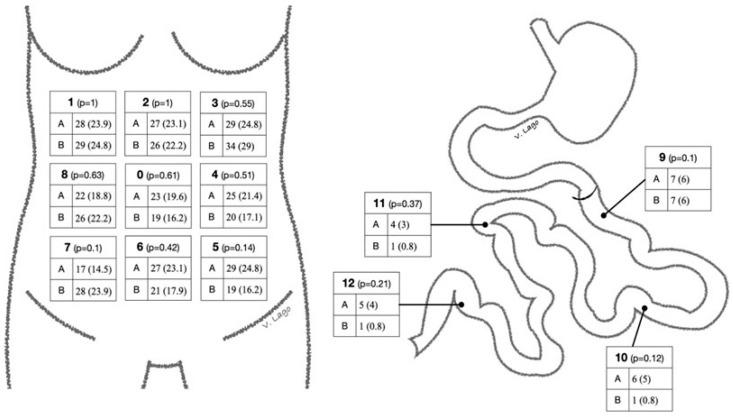
Patients with advanced ovarian cancer (FIGO II-IV), diagnosed between 2007 and 2019 in Hospital La Fe Valencia, in whom cytoreductive surgery was performed (achieving R0 or R1), and in whom a postoperative CT scan was performed between the third and eighth week post-surgery and prior to the start of chemotherapy, were included. Two different radiologists who specialised in gynaecological malignancy performed a blind analysis of the CT scans. They then read the images using the Peritoneal Carcinomatosis Index (PCI) scale, which divides the abdominopelvic cavity into 12 quadrants. Using the Qualitative Assessment (QA) scale, they established the presence or lack of tumour disease in each of these regions, with QA 1-2 being definitely/probably normal, QA 3 indeterminate and QA 4-5 probably/definitely metastatic.
RESULTS
This study included a cohort of 117 patients. The radiological study found measurable tumour disease in up to 49% of patients after optimal primary cytoreduction (R0 or R1). There was "substantial agreement" between the results of the two radiologists according to the Kappa analysis (0.624). Both radiologists' (A and B) findings were related to a significant reduction in both disease-free survival (DFS) and overall survival (OS) in patients with residual disease in the CT scan (QA 4-5) versus those without macroscopic disease (QA 1-3) ( < 0.05).
CONCLUSIONS
The finding of radiological tumour disease on a standardised and systematised postsurgical CT scan prior to the initiation of adjuvant chemotherapy is associated with the prognosis of patients with advanced ovarian cancer.
引言
手术后最大残留肿瘤大小是晚期卵巢癌生存相关的最重要预后因素。该参数可由外科医生在手术结束时主观确定,也可由放射科医生通过术后CT扫描确定。最佳肿瘤细胞减灭术后的CT扫描可在相当比例(21%至49%)的患者中发现残留/进展性疾病。本研究的目的是验证用于系统解读晚期卵巢癌患者术后CT扫描的PCI量表,并将其确立为一种新的预后标志物。
材料与方法
纳入2007年至2019年在瓦伦西亚拉斐医院诊断为晚期卵巢癌(国际妇产科联盟II-IV期)、接受了肿瘤细胞减灭术(达到R0或R1)且在术后第三至八周、化疗开始前进行了术后CT扫描的患者。两名专门从事妇科恶性肿瘤诊断的放射科医生对CT扫描进行了盲法分析。然后他们使用腹膜癌指数(PCI)量表读取图像,该量表将腹腔盆腔分为12个象限。他们使用定性评估(QA)量表确定这些区域中每个区域是否存在肿瘤疾病,QA 1-2表示肯定/可能正常,QA 3表示不确定,QA 4-5表示可能/肯定转移。
结果
本研究纳入了117例患者。影像学研究发现,在最佳初次肿瘤细胞减灭术(R0或R1)后,高达49%的患者存在可测量的肿瘤疾病。根据Kappa分析,两位放射科医生的结果之间存在“实质性一致”(0.624)。两位放射科医生(A和B)的发现均表明,CT扫描显示有残留疾病(QA 4-5)的患者与无肉眼可见疾病(QA 1-3)的患者相比,无病生存期(DFS)和总生存期(OS)均显著缩短(<0.05)。
结论
在辅助化疗开始前,标准化、系统化的术后CT扫描发现放射学肿瘤疾病与晚期卵巢癌患者的预后相关。


 Zotero 插件