
机械系统发育动力学模型并未提供确凿证据表明非鸟类恐龙在最终灭绝之前数量就在减少。
Mechanistic phylodynamic models do not provide conclusive evidence that non-avian dinosaurs were in decline before their final extinction.
作者信息
Allen Bethany J, Volkova Oliveira Maria V, Stadler Tanja, Vaughan Timothy G, Warnock Rachel C M
机构信息
Department of Biosystems Science and Engineering, ETH Zurich, Basel, Switzerland.
Computational Evolution Group, Swiss Institute of Bioinformatics, Lausanne, Switzerland.
出版信息
Camb Prism Extinct. 2024 Apr 16;2:e6. doi: 10.1017/ext.2024.5. eCollection 2024.
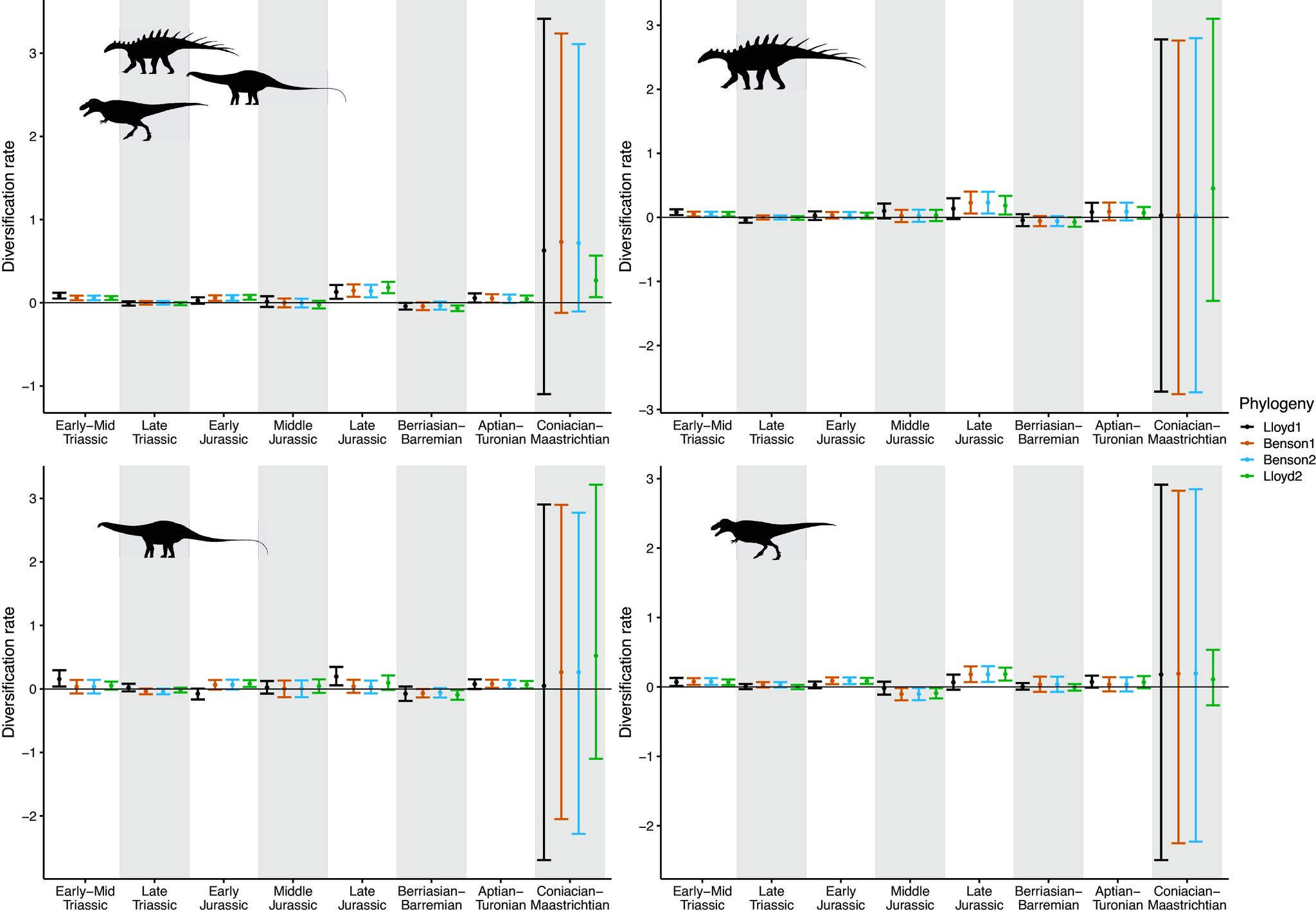
Phylodynamic models can be used to estimate diversification trajectories from time-calibrated phylogenies. Here we apply two such models to phylogenies of non-avian dinosaurs, a clade whose evolutionary history has been widely debated. Although some authors have suggested that the clade experienced a decline in diversity, potentially starting millions of years before the end-Cretaceous mass extinction, others have suggested that the group remained highly diverse right up until the Cretaceous-Paleogene (K-Pg) boundary. Our results show that model assumptions, likely with respect to incomplete sampling, have a large impact on whether dinosaurs appear to have experienced a long-term decline or not. The results are also highly sensitive to the topology and branch lengths of the phylogeny used. Developing comprehensive models of sampling bias, and building larger and more accurate phylogenies, are likely to be necessary steps for us to determine whether dinosaur diversity was or was not in decline before the end-Cretaceous mass extinction.
系统发育动力学模型可用于从时间校准的系统发育树估计物种分化轨迹。在此,我们将两种此类模型应用于非鸟类恐龙的系统发育树,这是一个进化历史一直存在广泛争议的类群。尽管一些作者认为该类群的多样性有所下降,可能在白垩纪末大灭绝前数百万年就已开始,但另一些人则认为该类群在直到白垩纪 - 古近纪(K - Pg)边界时仍保持高度多样性。我们的结果表明,模型假设,可能与采样不完整有关,对恐龙是否似乎经历了长期衰退有很大影响。结果对所用系统发育树的拓扑结构和分支长度也高度敏感。开发全面的采样偏差模型,并构建更大、更准确的系统发育树,可能是我们确定白垩纪末大灭绝前恐龙多样性是否下降的必要步骤。


 Zotero 插件