The Milner Centre for Evolution, Department of Life Sciences, University of Bath, Bath, UK.
Instituto de Biología, Universidad Nacional Autónoma de México, Ciudad de México, Mexico.
Biol Lett. 2023 Sep;19(9):20230314. doi: 10.1098/rsbl.2023.0314. Epub 2023 Sep 13.
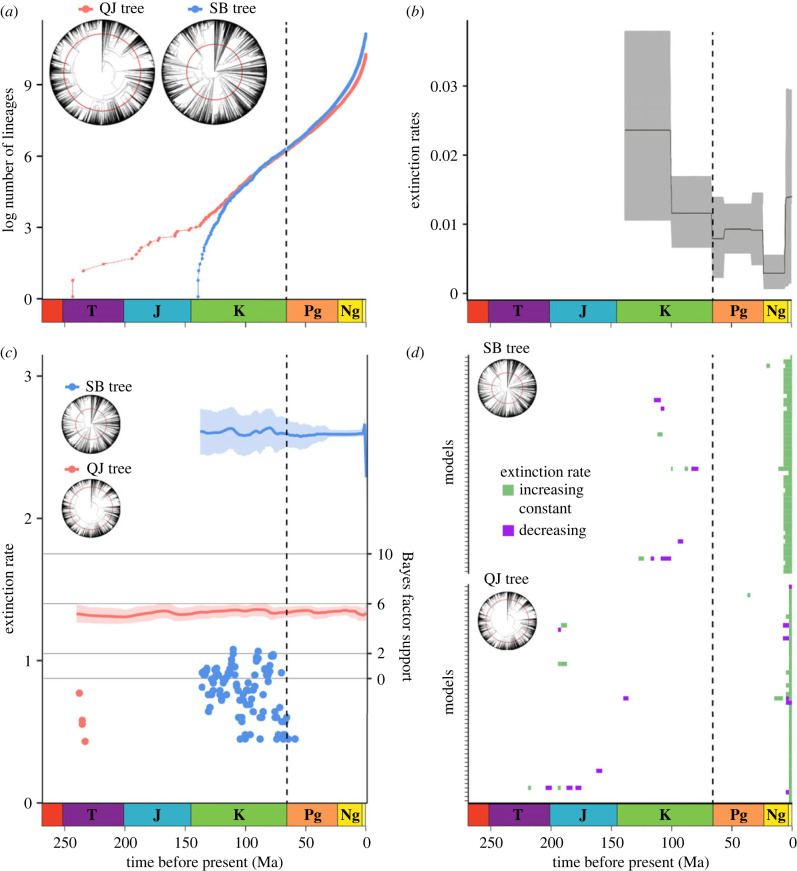
The Cretaceous-Palaeogene mass extinction event (K-Pg) witnessed upwards of 75% of animal species going extinct, most notably among these are the non-avian dinosaurs. A major question in macroevolution is whether this extinction event influenced the rise of flowering plants (angiosperms). The fossil record suggests that the K-Pg event had a strong regional impact on angiosperms with up to 75% species extinctions, but only had a minor impact on the extinction rates of major lineages (families and orders). Phylogenetic evidence for angiosperm extinction dynamics through time remains unexplored. By analysing two angiosperm mega-phylogenies containing approximately 32 000-73 000 extant species, here we show relatively constant extinction rates throughout geological time and no evidence for a mass extinction at the K-Pg boundary. Despite high species-level extinction observed in the fossil record, our results support the macroevolutionary resilience of angiosperms to the K-Pg mass extinction event via survival of higher lineages.
白垩纪-古近纪灭绝事件(K-Pg)见证了超过 75%的动物物种灭绝,其中最显著的是非鸟类恐龙。宏观进化的一个主要问题是,这次灭绝事件是否影响了开花植物(被子植物)的兴起。化石记录表明,K-Pg 事件对被子植物有强烈的区域性影响,多达 75%的物种灭绝,但对主要谱系(科和目)的灭绝率只有较小的影响。通过时间对被子植物灭绝动态的系统发育证据仍未得到探索。通过分析包含大约 32000-73000 个现存物种的两个被子植物 mega 系统发育,我们在这里表明,在地质时间内灭绝率相对稳定,没有证据表明 K-Pg 边界发生了大规模灭绝。尽管在化石记录中观察到了高物种水平的灭绝,但我们的结果支持了被子植物通过较高谱系的生存对 K-Pg 大灭绝事件的宏观进化弹性。