
无知的多样性与对多样性的无知:“隐性多样性”对保护生物学和物种灭绝的起源及影响
The diversity of ignorance and the ignorance of diversity: origins and implications of "shadow diversity" for conservation biology and extinction.
作者信息
Turton-Hughes Serena, Holmes George, Hassall Christopher
机构信息
School of Earth and Environment, Faculty of Environment, University of Leeds, Leeds, UK.
School of Biology, Faculty of Biological Sciences, University of Leeds, Leeds, UK.
出版信息
Camb Prism Extinct. 2024 Nov 22;2:e18. doi: 10.1017/ext.2024.21. eCollection 2024.
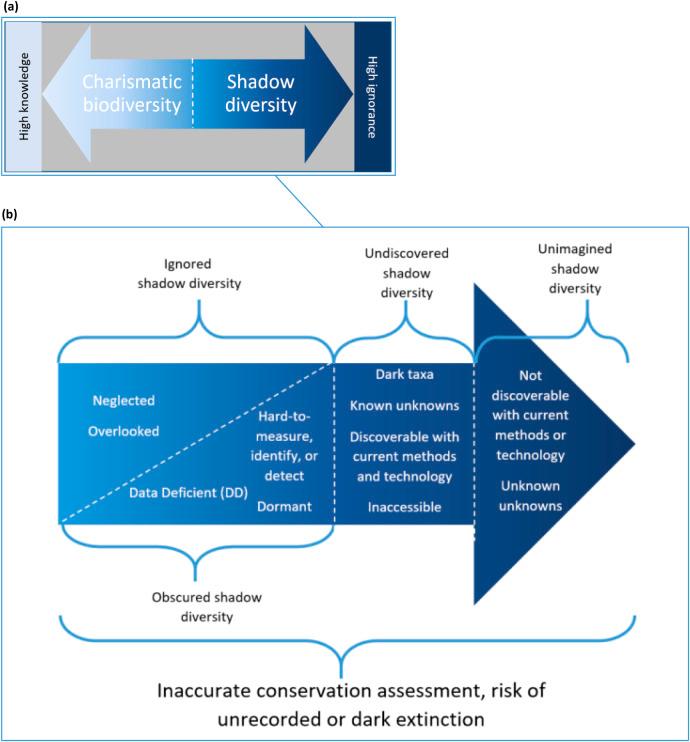
Biodiversity shortfalls and taxonomic bias can lead to inaccurate assessment of conservation priorities. Previous literature has begun to explore practical reasons why some species are discovered sooner or are better researched than others. However, the deeper socio-cultural causes for undiscovered and neglected biodiversity, and the value of collectively analysing species at risk of unrecorded, or "dark", extinction, are yet to be fully examined. Here, we argue that a new label (we propose "shadow diversity") is needed to shift our perspective from biodiversity shortfalls to living, albeit unknown, species. We suggest this linguistic shift imparts intrinsic value to these species, beyond scientific gaze and cultural systems. We review research on undiscovered, undetected and hidden biodiversity in the fields of conservation biology, macroecology and genetics. Drawing on philosophy, geography, history and sociology, we demonstrate that a range of socio-cultural factors (funding, education and historical bias) combine with traditional, practical impediments to limit species discovery and detection. We propose using a spectrum of shadow diversity which enables a complex, non-binary and comprehensive approach to biodiversity unknowns. Shadow diversity holds exciting potential as a tool to increase awareness, appreciation and support for the conservation of traditionally less studied wildlife species and sites, from soil microbes to less charismatic habitat fragments. We advocate for a shift in how the conservation community and wider public see biodiversity and an increase in popular support for conserving a wider range of life forms. Most importantly, shadow diversity provides appropriate language and conceptual frameworks to discuss species absent from conservation assessment and at potential risk of dark extinction.
生物多样性不足和分类学偏差可能导致对保护重点的评估不准确。以往的文献已经开始探讨一些物种比其他物种更早被发现或研究得更好的实际原因。然而,未被发现和被忽视的生物多样性的深层社会文化原因,以及对面临未记录或“暗”灭绝风险的物种进行综合分析的价值,仍有待充分研究。在此,我们认为需要一个新的标签(我们提议为“影子多样性”)来将我们的视角从生物多样性不足转向那些虽不为人知但仍存活的物种。我们认为这种语言上的转变赋予了这些物种内在价值,超越了科学审视和文化体系。我们回顾了保护生物学、宏观生态学和遗传学领域中关于未被发现、未被检测到和隐藏的生物多样性的研究。借鉴哲学、地理学、历史学和社会学,我们证明了一系列社会文化因素(资金、教育和历史偏见)与传统的实际障碍相结合,限制了物种的发现和检测。我们提议使用一系列影子多样性,它能够对未知的生物多样性采取一种复杂、非二元且全面的方法。影子多样性作为一种工具,具有激发人们对保护传统上较少研究的野生动物物种和栖息地(从土壤微生物到缺乏魅力的栖息地片段)的认识、欣赏和支持的令人兴奋的潜力。我们主张保护界和广大公众对生物多样性的看法发生转变,并增加对保护更广泛生命形式的公众支持。最重要的是,影子多样性提供了适当的语言和概念框架来讨论保护评估中缺失且面临暗灭绝潜在风险的物种。



 Zotero 插件