Chen Yanyu, Luo Daya, Gao Renzhuo, Wu Jinjing, Qiu Xingpeng, Zou Yang, Jian Yingchao, Zhang Shuhua
Jiangxi Cardiovascular Research Institute, Jiangxi Provincial People's Hospital, The First Affiliated Hospital of Nanchang Medical College, Nanchang, China.
Tongji Hospital, Tongji Medical College, Huazhong University of Science and Technology, Wuhan, China.
Front Immunol. 2025 Feb 26;16:1428978. doi: 10.3389/fimmu.2025.1428978. eCollection 2025.
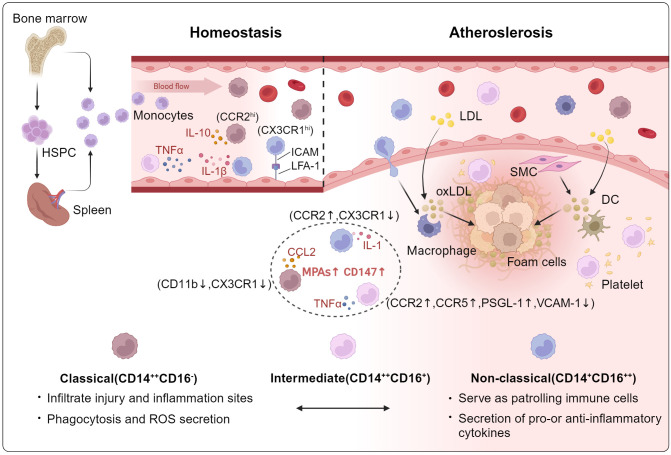
Monocytes are heterogeneous immune cells that play a crucial role in the inflammatory response during atherosclerosis, influencing the progression and outcome of the disease. In the pathogenesis of atherosclerotic diseases, such as coronary artery disease (CAD), monocytes not only serve as the initial sensors of endogenous and exogenous pathogenic factors, but also function as intermediators that bridge the circulatory system and localized lesions. In the bloodstream, heterogeneous monocytes, acting as sentinels, are rapidly recruited to atherosclerotic lesions, where they exhibit a heightened capacity to respond to various pathological stimuli upon detecting signals from damaged vascular endothelial cells. Clinical studies have demonstrated that the heterogeneity of monocytes in CAD patients presents both diversity and complexity, varying across different disease subtypes and pathological stages. This review explores the heterogeneity of monocytes in CAD, focusing on alterations in monocyte subset numbers, proportions, and the expression of functional receptors, as well as their correlations with clinical features. Additionally, we propose strategies to enhance the clinical utility value of monocyte heterogeneity and outline future research directions in the field of CAD. With the widespread application of high-parameter flow cytometry and single-cell sequencing technologies, it is anticipated that a comprehensive understanding of monocyte heterogeneity in CAD will be achieved, enabling the identification of disease-specific monocyte subtypes. This could offer new opportunities for improving the diagnosis and treatment of CAD.
单核细胞是异质性免疫细胞,在动脉粥样硬化的炎症反应中起关键作用,影响疾病的进展和转归。在动脉粥样硬化性疾病如冠心病(CAD)的发病机制中,单核细胞不仅作为内源性和外源性致病因素的初始感受器,还作为连接循环系统和局部病变的中介物。在血液中,异质性单核细胞作为哨兵,被迅速招募到动脉粥样硬化病变处,在那里它们在检测到受损血管内皮细胞发出的信号后,表现出对各种病理刺激的更强反应能力。临床研究表明,CAD患者单核细胞的异质性呈现出多样性和复杂性,在不同疾病亚型和病理阶段有所不同。本综述探讨了CAD中单核细胞的异质性,重点关注单核细胞亚群数量、比例和功能受体表达的变化,以及它们与临床特征的相关性。此外,我们提出了提高单核细胞异质性临床应用价值的策略,并概述了CAD领域未来的研究方向。随着高参数流式细胞术和单细胞测序技术的广泛应用,预计将全面了解CAD中单核细胞的异质性,从而能够识别疾病特异性的单核细胞亚型。这可能为改善CAD的诊断和治疗提供新的机会。