• 文献检索
  • 文档翻译
  • 深度研究
  • 学术资讯
  • Suppr Zotero 插件Zotero 插件
  • 邀请有礼
  • 套餐&价格
  • 历史记录
应用&插件
Suppr Zotero 插件Zotero 插件浏览器插件Mac 客户端Windows 客户端微信小程序
定价
高级版会员购买积分包购买API积分包
服务
文献检索文档翻译深度研究API 文档MCP 服务
关于我们
关于 Suppr公司介绍联系我们用户协议隐私条款
关注我们

Suppr 超能文献

核心技术专利:CN118964589B侵权必究
粤ICP备2023148730 号-1Suppr @ 2026

文献检索

告别复杂PubMed语法,用中文像聊天一样搜索,搜遍4000万医学文献。AI智能推荐,让科研检索更轻松。

立即免费搜索

文件翻译

保留排版,准确专业,支持PDF/Word/PPT等文件格式,支持 12+语言互译。

免费翻译文档

深度研究

AI帮你快速写综述,25分钟生成高质量综述,智能提取关键信息,辅助科研写作。

立即免费体验

高剂量与低剂量维生素D₃补充剂对患有慢性抽动障碍儿童的疗效:一项随机对照试验。

Efficacy of high-dose vs. low-dose vitamin D₃ supplementation in children with chronic tic disorders: a randomized controlled trial.

作者信息

Mohamed Zakaria Ahmed, Bai Miaoshui, Dong Hanyu, Xue Yang, Jia Feiyong, Feng Junyan

机构信息

Department of Developmental and Behavioral Pediatrics, Children's Medical Center, The First Hospital of Jilin University, Jilin University, Changchun, China.

The Child Health Clinical Research Center of Jilin Province, Changchun, China.

出版信息

Nutr J. 2025 Mar 17;24(1):44. doi: 10.1186/s12937-025-01112-w.

DOI:10.1186/s12937-025-01112-w
PMID:40091021
原文链接:https://pmc.ncbi.nlm.nih.gov/articles/PMC11912708/
Abstract

BACKGROUND

Vitamin D₃ has emerged as a potential therapeutic agent for alleviating tic symptoms in children with chronic tic disorders (CTDs). This study aims to evaluate the comparative efficacy of high-dose and low-dose vitamin D₃ supplementation on tic severity and serum 25-hydroxyvitamin D 25(OH)D levels in children with CTDs.

METHODS

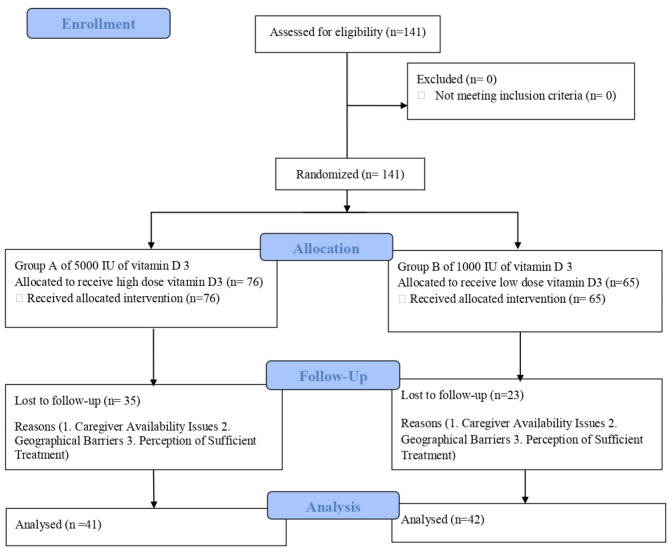
A randomized controlled trial was conducted with 83 children aged 4 to 15 years diagnosed with CTDs. Participants were randomly assigned to receive either high-dose vitamin D₃ (5,000 IU/day) or low-dose vitamin D₃ (1,000 IU/day) for three months. The primary outcome was tic severity, assessed using the Yale Global Tic Severity Scale (YGTSS), while secondary outcomes included changes in serum 25(OH)D and calcium levels. Tic severity and biochemical markers were measured at baseline and after the intervention to assess the effects of vitamin D₃ supplementation.

RESULTS

Both the high-dose and low-dose groups showed significant improvements in tic severity and increases in serum 25(OH)D levels (𝑝 < 0.05). The high-dose group exhibited a significantly greater reduction in tic severity and a more substantial increase in serum 25(OH)D levels compared to the low-dose group (𝑝 < 0.05). No significant differences were observed in serum calcium levels between the group (𝑝 > 0.05). Furthermore, multivariate linear regression analysis revealed a significant negative association between increases in serum 25(OH)D levels and reductions in tic severity (𝑡 = -2.816, 𝑝 < 0.05).

CONCLUSION

High-dose vitamin D₃ supplementation is more effective than low-dose supplementation in reducing tic severity and increasing serum 25(OH)D levels in children with CTDs. These findings suggest that high-dose vitamin D₃ may serve as a valuable adjunctive therapy for managing CTDs.

摘要

背景

维生素D₃已成为缓解慢性抽动障碍(CTD)患儿抽动症状的一种潜在治疗药物。本研究旨在评估高剂量和低剂量补充维生素D₃对CTD患儿抽动严重程度和血清25-羟基维生素D[25(OH)D]水平的比较疗效。

方法

对83名4至15岁被诊断为CTD的儿童进行了一项随机对照试验。参与者被随机分配接受高剂量维生素D₃(5000国际单位/天)或低剂量维生素D₃(1000国际单位/天),为期三个月。主要结局是抽动严重程度,使用耶鲁全球抽动严重程度量表(YGTSS)进行评估,次要结局包括血清25(OH)D和钙水平的变化。在基线和干预后测量抽动严重程度和生化指标,以评估补充维生素D₃的效果。

结果

高剂量组和低剂量组的抽动严重程度均有显著改善,血清25(OH)D水平均升高(p<0.05)。与低剂量组相比,高剂量组的抽动严重程度显著降低,血清25(OH)D水平显著升高(p<0.05)。两组之间的血清钙水平未观察到显著差异(p>0.05)。此外,多变量线性回归分析显示血清25(OH)D水平升高与抽动严重程度降低之间存在显著负相关(t=-2.816, p<0.05)。

结论

在降低CTD患儿的抽动严重程度和提高血清25(OH)D水平方面,高剂量补充维生素D₃比低剂量补充更有效。这些发现表明,高剂量维生素D₃可能是治疗CTD的一种有价值的辅助疗法。
https://cdn.ncbi.nlm.nih.gov/pmc/blobs/00f3/11912708/104180f2815e/12937_2025_1112_Fig1_HTML.jpg

相似文献

1
Efficacy of high-dose vs. low-dose vitamin D₃ supplementation in children with chronic tic disorders: a randomized controlled trial.高剂量与低剂量维生素D₃补充剂对患有慢性抽动障碍儿童的疗效:一项随机对照试验。
Nutr J. 2025 Mar 17;24(1):44. doi: 10.1186/s12937-025-01112-w.
2
A Prospective Study to Evaluate the Possible Role of Cholecalciferol Supplementation on Autoimmunity in Hashimoto's Thyroiditis.一项评估胆钙化醇补充对桥本甲状腺炎自身免疫可能作用的前瞻性研究。
J Assoc Physicians India. 2023 Jan;71(1):1.
3
Clinical improvement following vitamin D3 supplementation in children with chronic tic disorders.补充维生素D3对患有慢性抽动障碍儿童的临床改善情况。
Neuropsychiatr Dis Treat. 2019 Aug 26;15:2443-2450. doi: 10.2147/NDT.S212322. eCollection 2019.
4
Serum 25-hyroxyvitamin D levels and tic severity in Chinese children with tic disorders.血清 25-羟维生素 D 水平与中国抽动障碍儿童抽动严重程度的关系。
Psychiatry Res. 2018 Sep;267:80-84. doi: 10.1016/j.psychres.2018.05.066. Epub 2018 May 31.
5
Effect of high-dose cholecalciferol (vitamin D) on bone and body composition in children and young adults with HIV infection: a randomized, double-blind, placebo-controlled trial.大剂量胆钙化醇(维生素D)对感染HIV的儿童和青年的骨骼及身体成分的影响:一项随机、双盲、安慰剂对照试验。
Osteoporos Int. 2017 Jan;28(1):201-209. doi: 10.1007/s00198-016-3826-x. Epub 2016 Nov 11.
6
Comparison of two vitamin D supplementation strategies in children with sickle cell disease: a randomized controlled trial.两种维生素 D 补充策略在镰状细胞病患儿中的比较:一项随机对照试验。
Br J Haematol. 2021 Jan;192(2):385-394. doi: 10.1111/bjh.17119. Epub 2020 Nov 10.
7
Weekly Vitamin D Supplementation to Prevent Acute Respiratory Infections in Young Children at Different Latitudes: A Randomized Controlled Trial.不同纬度地区补充维生素 D 预防幼儿急性呼吸道感染的随机对照试验。
J Pediatr. 2024 Dec;275:114249. doi: 10.1016/j.jpeds.2024.114249. Epub 2024 Aug 22.
8
Effect of vitamin D3 seasonal supplementation with 1500 IU/day in north Italian children (DINOS study).北意大利儿童(DINOS 研究)每天补充 1500IU 维生素 D3 的季节性影响。
Ital J Pediatr. 2019 Jan 28;45(1):18. doi: 10.1186/s13052-018-0590-x.
9
Vitamin D supplementation for sickle cell disease.镰状细胞病的维生素D补充治疗
Cochrane Database Syst Rev. 2020 May 28;5(5):CD010858. doi: 10.1002/14651858.CD010858.pub3.
10
Effectiveness and safety of vitamin D in relation to bone health.维生素D对骨骼健康的有效性与安全性。
Evid Rep Technol Assess (Full Rep). 2007 Aug(158):1-235.

本文引用的文献

1
Sex Differences in Youth with Chronic Tic Disorder and Tourette Syndrome: Evaluation of Tic Severity, Psychological Profiles, and Quality of Life.患有慢性抽动障碍和妥瑞氏综合征青少年的性别差异:抽动严重程度、心理特征及生活质量评估
J Clin Med. 2024 Apr 24;13(9):2477. doi: 10.3390/jcm13092477.
2
The Relationship Between Vitamin D Intake and Serum 25-hydroxyvitamin D in Young Children: A Meta-Regression to Inform WHO/FAO Vitamin D Intake Recommendations.儿童维生素 D 摄入量与血清 25-羟维生素 D 水平的关系:为 WHO/FAO 维生素 D 摄入量建议提供元回归分析依据。
J Nutr. 2024 Jun;154(6):1827-1841. doi: 10.1016/j.tjnut.2024.04.031. Epub 2024 Apr 28.
3
Vitamin D3 improves iminodipropionitrile-induced tic-like behavior in rats through regulation of GDNF/c-Ret signaling activity.
维生素 D3 通过调节 GDNF/c-Ret 信号活性改善亚精胺诱导的大鼠抽动样行为。
Eur Child Adolesc Psychiatry. 2024 Sep;33(9):3189-3201. doi: 10.1007/s00787-024-02376-z. Epub 2024 Feb 23.
4
Vitamin D as a Modulator of Neuroinflammation: Implications for Brain Health.维生素 D 作为神经炎症的调节剂:对大脑健康的影响。
Curr Pharm Des. 2024;30(5):323-332. doi: 10.2174/0113816128281314231219113942.
5
Efficacy of differential reinforcement of other behaviors therapy for tic disorder: a meta-analysis.差异强化其他行为疗法治疗抽动障碍的疗效:一项荟萃分析。
BMC Neurol. 2024 Jan 2;24(1):3. doi: 10.1186/s12883-023-03501-2.
6
Cytokine levels reflect tic symptoms more prominently during mild phases.细胞因子水平在轻度阶段更能明显反映出抽动症状。
BMC Neurosci. 2023 Oct 31;24(1):57. doi: 10.1186/s12868-023-00830-3.
7
Vitamin D and Child Neurodevelopment-A Post Hoc Analysis.维生素 D 与儿童神经发育:一项事后分析。
Nutrients. 2023 Oct 3;15(19):4250. doi: 10.3390/nu15194250.
8
Omega-3 polyunsaturated fatty acids and/or vitamin D in autism spectrum disorders: a systematic review.自闭症谱系障碍中的Omega-3多不饱和脂肪酸和/或维生素D:一项系统评价
Front Psychiatry. 2023 Aug 16;14:1238973. doi: 10.3389/fpsyt.2023.1238973. eCollection 2023.
9
Vitamin D status and tic disorder: a systematic review and meta-analysis of observational studies.维生素D状态与抽动障碍:观察性研究的系统评价和荟萃分析
Front Pediatr. 2023 May 30;11:1173741. doi: 10.3389/fped.2023.1173741. eCollection 2023.
10
Behavioral Interventions for Children and Adults with Tic Disorder.抽动障碍儿童和成人的行为干预。
Annu Rev Clin Psychol. 2023 May 9;19:233-260. doi: 10.1146/annurev-clinpsy-080921-074307.