Lin Yi-Hsuan, Wang Yi-Hsun, Peng Yi-Jen, Liu Feng-Cheng, Sytwu Huey-Kang, Cheng Chia-Pi
Department and Graduate institute of Biology and Anatomy, National Defense Medical Center, Taipei, Taiwan.
Graduate Institute of Life Sciences, National Defense Medical Center, Taipei, Taiwan.
Int J Med Sci. 2025 Feb 26;22(7):1504-1515. doi: 10.7150/ijms.102967. eCollection 2025.
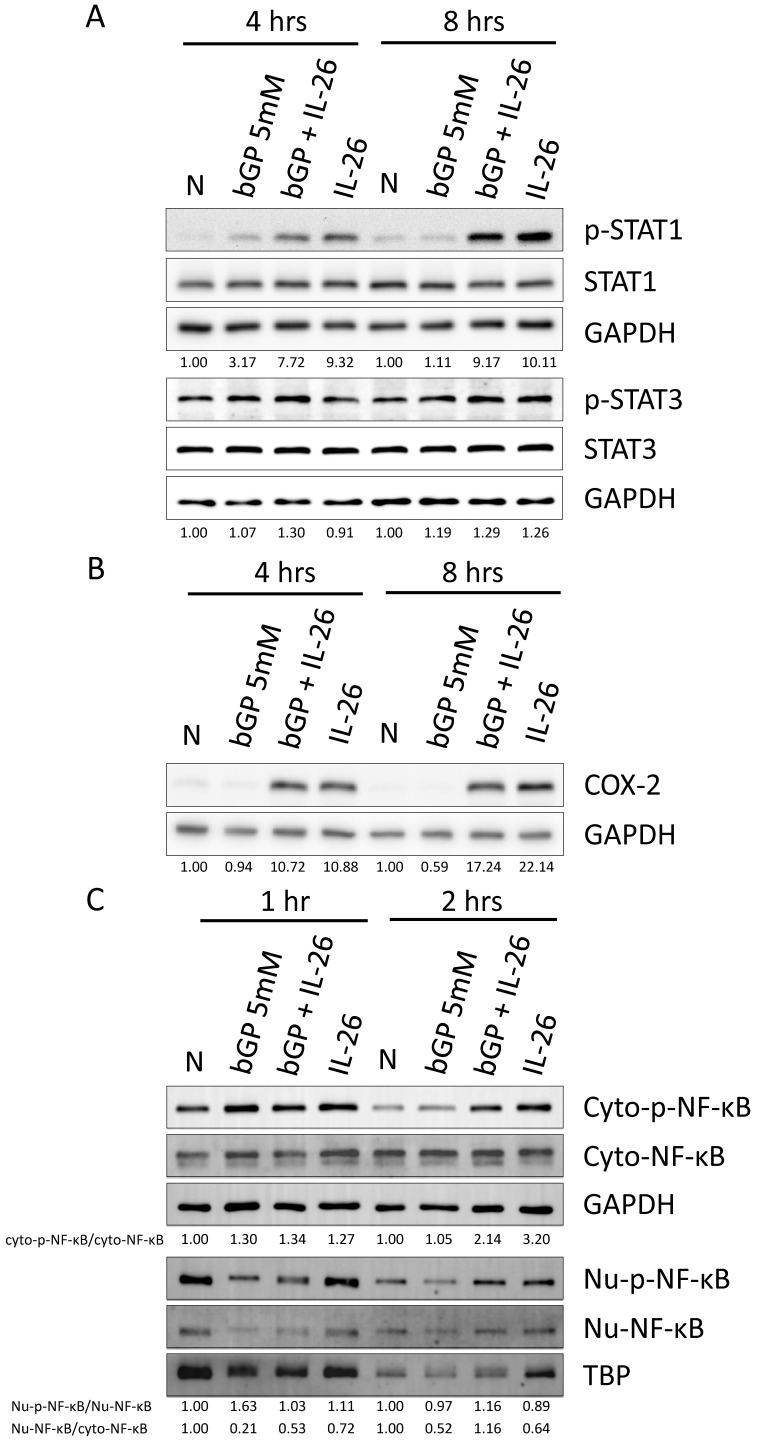
Osteoarthritis (OA) represents the prevailing form of degenerative joint pathology. Recent investigations have revealed a heightened expression of interleukin 26 (IL-26) in various inflammatory arthritic conditions, including OA. However, the specific impacts and functions of IL-26 on osteoblasts (OBs) within the context of OA remain inadequately elucidated. This study aims to clarify the effects and underlying mechanisms of IL-26 by examining its influence on osteoblasts isolated from OA patients and a murine osteoblast cell line. Human primary osteoblasts and mouse pre-osteoblast cells were subjected to treatment with β-glycerophosphate or concurrent treatment with IL-26 to observe the effects on osteoblast differentiation. The differentiation of osteoblasts was assessed through the expression of relevant genes using reverse transcription-polymerase chain reaction (RT-PCR). Key molecular mechanisms of downstream signaling pathways were examined through immunoblotting assays. Our results reveal that IL-26 mitigates osteoblast differentiation and reduces the expression of the marker alkaline phosphatase. Furthermore, the NF-κB downstream OB proliferated marker iNOS and inhibition OB differentiated marker LCN2 messenger RNA are up-regulated in IL-26 treated group. Also, phosphorylation and nuclear translocation of NF-κB p65 occur following IL-26 stimulation. Additionally, IL-26 enhances the downstream transcription factor cyclooxygenase-2 (COX2), a major player associated with iNOS. STAT1, the canonical receptor signaling pathway of IL-26 is activated. In summary, our findings substantiate the role of IL-26 in osteoarthritis and identify it as a potential therapeutic target for intervention in osteoarthritic pathology.
骨关节炎(OA)是退行性关节病变的主要形式。最近的研究表明,白细胞介素26(IL-26)在包括OA在内的各种炎性关节炎病症中表达上调。然而,在OA背景下,IL-26对成骨细胞(OBs)的具体影响和功能仍未得到充分阐明。本研究旨在通过检测IL-26对从OA患者分离的成骨细胞和小鼠成骨细胞系的影响,阐明其作用及潜在机制。用人原代成骨细胞和小鼠前成骨细胞分别用β-甘油磷酸处理或同时用IL-26处理,以观察对成骨细胞分化的影响。通过逆转录聚合酶链反应(RT-PCR)检测相关基因的表达来评估成骨细胞的分化。通过免疫印迹分析检测下游信号通路的关键分子机制。我们的结果显示,IL-26减轻成骨细胞分化并降低标志物碱性磷酸酶的表达。此外,在IL-26处理组中,NF-κB下游OB增殖标志物iNOS和抑制OB分化标志物LCN2信使RNA上调。而且,IL-26刺激后发生NF-κB p65的磷酸化和核转位。此外,IL-26增强下游转录因子环氧化酶-2(COX2),COX2是与iNOS相关的主要因子。IL-26的经典受体信号通路STAT1被激活。总之,我们的研究结果证实了IL-26在骨关节炎中的作用,并将其确定为干预骨关节炎病理的潜在治疗靶点。