Park Jin-Ho, Kwon Ohsang, Choi Jae Heouk, Yeom Jin S, Park Sang-Min, Kim Cheol Hyun, Kim Ho-Joong
Department of Orthopedic Surgery, Kangdong Sacred Heart Hospital, Hallym University College of Medicine, Seoul, Republic of Korea.
Department of Orthopedic Surgery, Armed Forces Capital Hospital, Seongnam, Gyeonggi-Do, Republic of Korea.
Osteoporos Int. 2025 May;36(5):833-843. doi: 10.1007/s00198-025-07449-6. Epub 2025 Mar 18.
We conducted a randomized controlled trial to assess the preventive effect of perioperative teriparatide on proximal junctional kyphosis and proximal junctional failure (PJF) in osteoporosis patients undergoing adult spinal deformity surgery. Teriparatide (experimental group) and denosumab (active control) were administered. The teriparatide group demonstrated significantly better PJF incidence and VAS for back pain, EQ-5D than the control group.
This randomized controlled trial is aimed at investigating and comparing the effects of perioperative teriparatide and denosumab as an active control for preventing proximal junctional kyphosis (PJK) and proximal junctional failure (PJF) in patients with osteoporosis after adult spinal deformity (ASD) surgery.
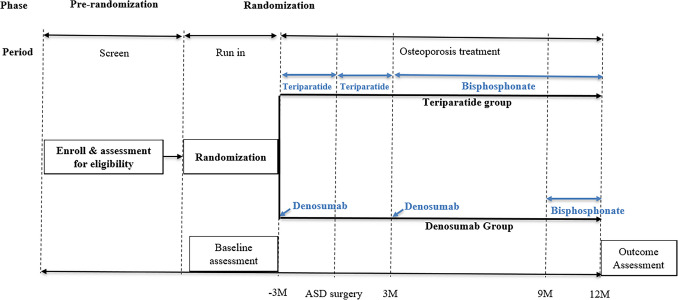
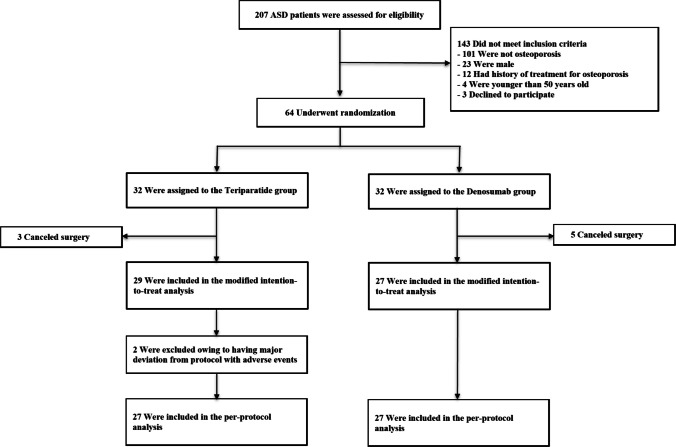
A total of 64 patients with osteoporosis, who planned to undergo ASD surgery, were randomly assigned to the teriparatide and denosumab groups. Treatment with teriparatide or denosumab in both groups was conducted from 3 months preoperatively to 3 months postoperatively based on the standard regimen for each medication. The primary outcome was PJK and PJF incidence within 1 year after ASD surgery. The secondary outcomes were patient-reported outcomes (PROs), bone mineral density (BMD), and dual-energy X-ray absorptiometry (DEXA) t-score of the hip.
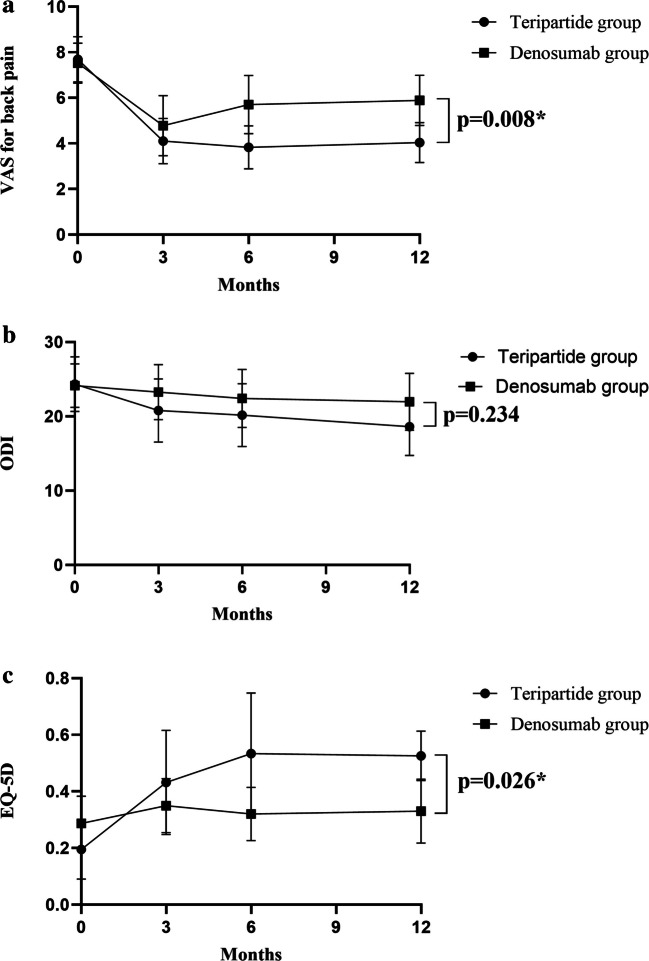
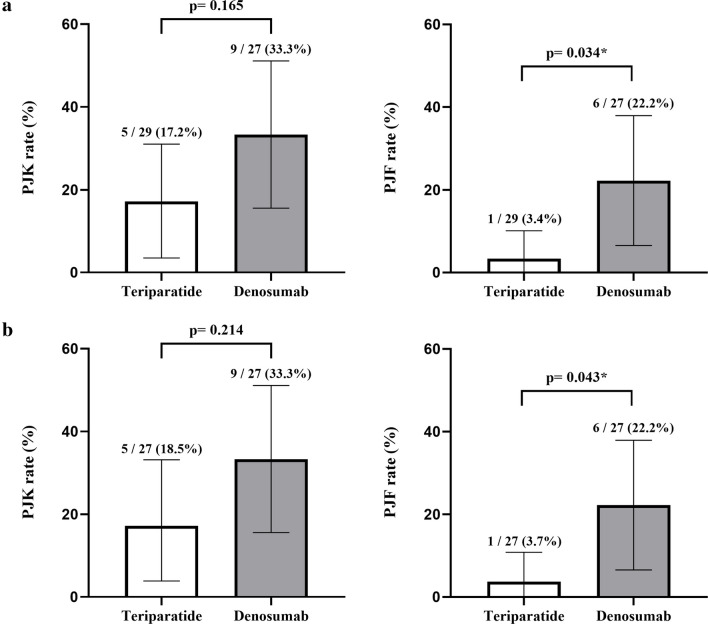
The teriparatide group showed a lower incidence of PJK than the denosumab group (17.2% vs. 33.3%), although this difference was not statistically significant (p = 0.165 in a modified intention-to-treat (mITT) analysis). Furthermore, the teriparatide group exhibited a significantly lower incidence of PJF than the denosumab group (3.4% vs. 22.2%; p = 0.034 in the mITT analysis). As for the secondary outcomes, no significant differences in BMD of the hip were observed between the two groups at the 1-year follow-up. The teriparatide group showed significantly improved postoperative VAS for back pain and EQ-5D score.
Perioperative teriparatide treatment of patients with osteoporosis after ASD surgery effectively reduced PJF incidence and postoperative back pain.
我们进行了一项随机对照试验,以评估围手术期使用特立帕肽对接受成人脊柱畸形手术的骨质疏松症患者近端交界性后凸和近端交界性失败(PJF)的预防效果。给予特立帕肽(实验组)和地诺单抗(活性对照)。特立帕肽组在PJF发生率、背痛视觉模拟评分(VAS)、EQ-5D方面均显著优于对照组。
本随机对照试验旨在研究和比较围手术期使用特立帕肽和作为活性对照的地诺单抗对成人脊柱畸形(ASD)手术后骨质疏松症患者预防近端交界性后凸(PJK)和近端交界性失败(PJF)的效果。
共有64例计划接受ASD手术的骨质疏松症患者被随机分配到特立帕肽组和地诺单抗组。两组均根据每种药物的标准方案,从术前3个月至术后3个月给予特立帕肽或地诺单抗治疗。主要结局是ASD手术后1年内PJK和PJF的发生率。次要结局是患者报告结局(PROs)、骨密度(BMD)和髋部双能X线吸收法(DEXA)t值。
特立帕肽组的PJK发生率低于地诺单抗组(17.2%对33.3%),尽管这一差异无统计学意义(改良意向性分析(mITT)中p = 0.165)。此外,特立帕肽组的PJF发生率显著低于地诺单抗组(3.4%对22.2%;mITT分析中p = 0.034)。关于次要结局,两组在1年随访时髋部BMD无显著差异。特立帕肽组术后背痛VAS和EQ-5D评分显著改善。
围手术期对ASD手术后骨质疏松症患者使用特立帕肽治疗可有效降低PJF发生率和术后背痛。