Cotter Elizabeth W, Dunford Ashley, Gilchrist Kirsten, Yan Tong, Deyton Lawrence, Essel Kofi
Department of Health Studies, American University, Washington, DC, 20016, USA.
Department of Psychiatry, Massachusetts General Hospital, Boston, MA, USA.
J Eat Disord. 2025 Mar 18;13(1):50. doi: 10.1186/s40337-025-01231-z.
Most healthcare providers exhibit weight bias (i.e., negative assumptions, beliefs, or discriminatory acts toward someone based on their weight/body size) in their interactions with patients with obesity. Such bias can be exacerbated in medical training and may lead to reduced healthcare utilization and worsened patient outcomes. This study explored reflections of pre-clinical medical students on formative experiences they perceived to be related to their newly identified implicit weight bias.
Seven hundred and sixteen second-year medical students completed the Weight Implicit Association Test (IAT) between April 2019-April 2022 and were instructed to write a reflective response based on their results. Of this sample, 212 students described experiences from childhood in their reflections, and these participant quotes were pulled for analysis. Inductive coding techniques were used to identify themes that were generated from medical students' reflections on formative experiences using the software program Dedoose Version 8.3.35.
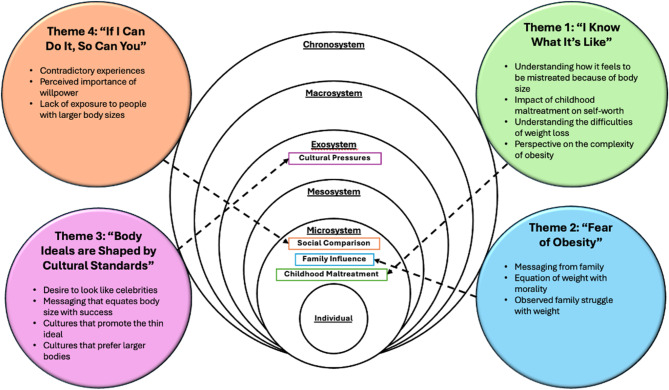
The identified themes highlighted medical students' own struggles with weight management and body dissatisfaction in childhood, a fear of having obesity, the prioritization of a "healthy" (i.e., thin) body and the stigmatization of larger bodies, and the influence of culture of origin on thin-ideal internalization. Results recognize the manifold experiences that these medical students have before entering their formalized medical training.
Despite the proven negative impact on patient care caused by clinician weight bias there is a paucity of medical training programs that address weight bias. This research highlights the need for a more intentional educational curriculum to counteract the deeply rooted implicit weight bias existent in some future healthcare providers.
大多数医疗服务提供者在与肥胖患者互动时表现出体重偏见(即基于患者体重/体型对其产生负面假设、信念或歧视行为)。这种偏见在医学培训中可能会加剧,并可能导致医疗服务利用率降低和患者预后恶化。本研究探讨了临床前医学生对他们认为与新发现的隐性体重偏见相关的形成性经历的反思。
716名二年级医学生在2019年4月至2022年4月期间完成了体重内隐联想测验(IAT),并被要求根据测验结果撰写反思性回应。在这个样本中,212名学生在反思中描述了童年经历,这些参与者的引述被提取出来进行分析。采用归纳编码技术,使用Dedoose 8.3.35软件程序,从医学生对形成性经历的反思中识别出主题。
确定的主题突出了医学生自身在童年时期体重管理和身体不满方面的挣扎、对患肥胖症的恐惧、对“健康”(即瘦)身体的优先重视和对较大体型的污名化,以及原生文化对瘦理想内化的影响。结果认识到这些医学生在进入正式医学培训之前所经历的多方面经历。
尽管临床医生的体重偏见对患者护理已被证明有负面影响,但解决体重偏见的医学培训项目却很少。这项研究强调需要一个更有针对性的教育课程,以抵消一些未来医疗服务提供者中存在的根深蒂固的隐性体重偏见。