Park SoJung, Yi Jaehun, Lee Nam Ki
Department of Chemistry, Seoul National University 08826 Seoul Republic of Korea
Chem Sci. 2025 Mar 10;16(15):6443-6449. doi: 10.1039/d5sc00749f. eCollection 2025 Apr 9.
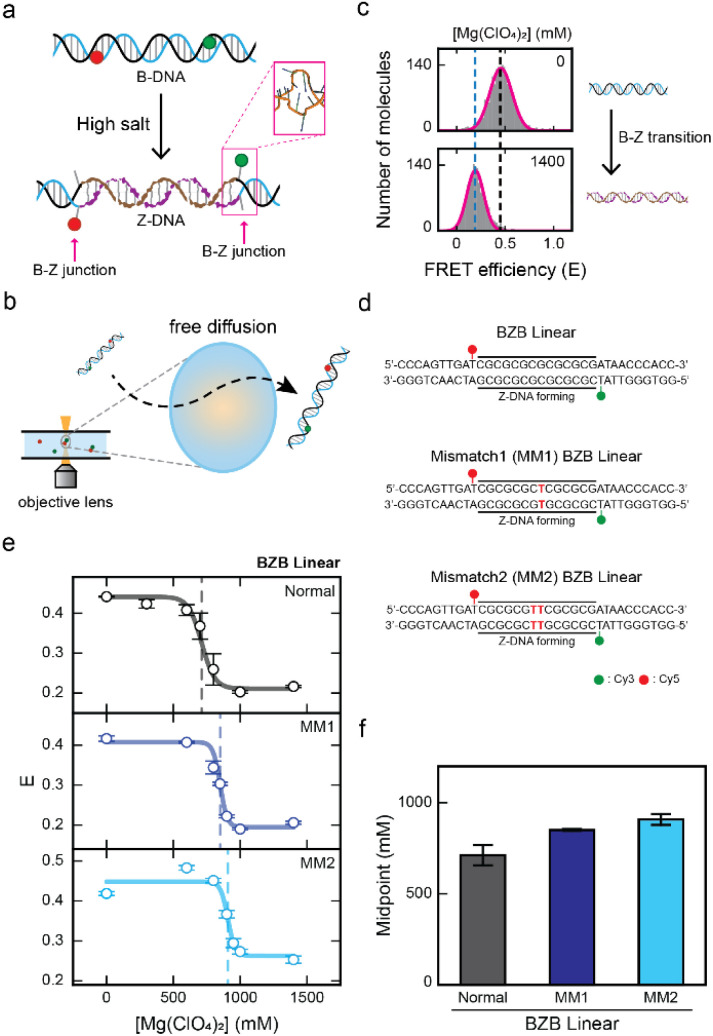
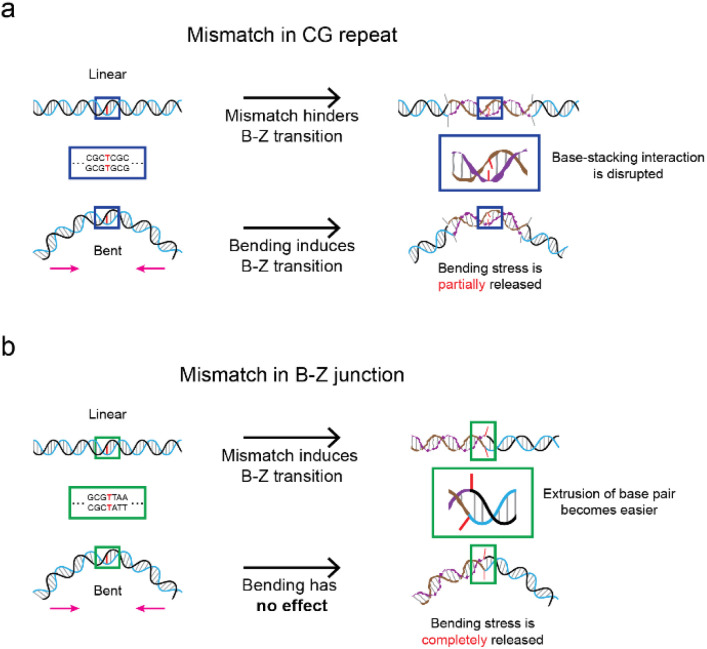
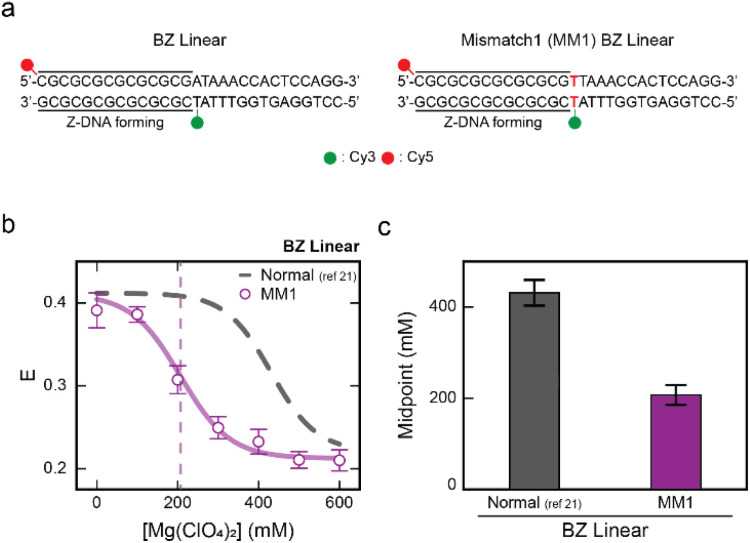
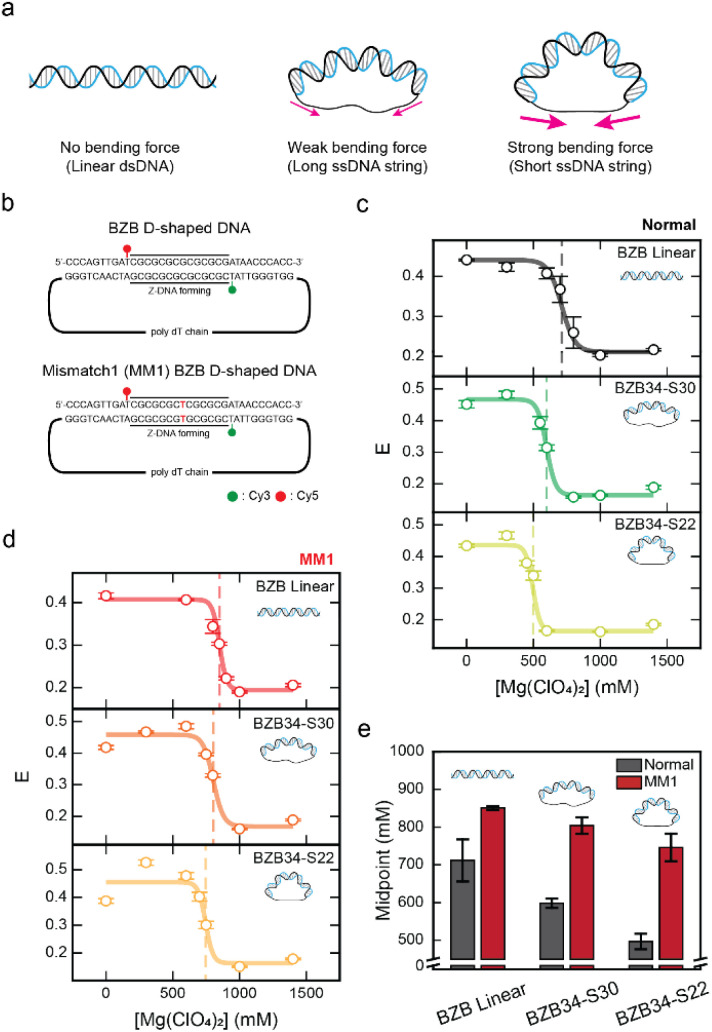
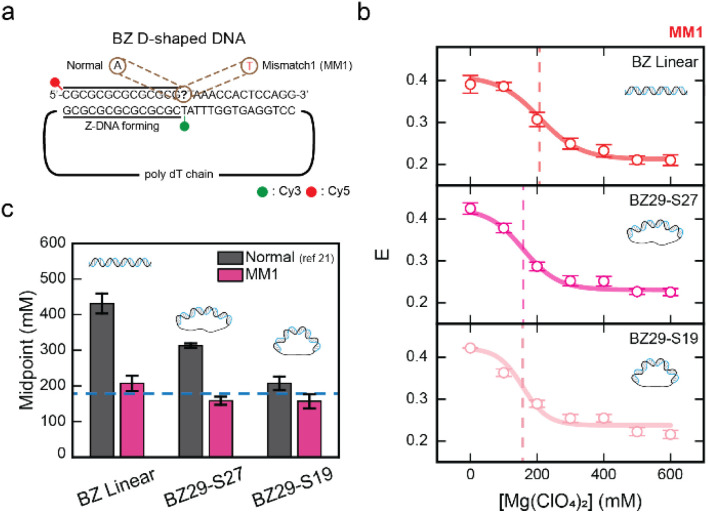
Z-DNA is a non-canonical, left-handed helical structure that plays crucial roles in various cellular processes. DNA mismatches, which involve the incorporation of incorrect Watson-Crick base pairs, are present in all living organisms and contribute to the mechanism of Z-DNA formation. However, the impact of mismatches on Z-DNA formation remains poorly understood. Moreover, the combined effect of DNA mismatches and bending, a common biological phenomenon observed , has not yet been explored due to technological limitations. Here, using single-molecule FRET, we show that a mismatch inside the Z-DNA region, , the CG repeat region, hinders Z-DNA formation. In stark contrast, however, a mismatch in the B-Z junction facilitates Z-DNA formation. When the bending force is applied on double stranded DNA, a mismatch in the B-Z junction releases the bending stress more effectively than one in the CG repeat region. These findings provide mechanical insights into the role of DNA mismatches and bending forces in regulating Z-DNA formation, whether promoting or inhibiting it in biological environments.
Z-DNA是一种非规范的左手螺旋结构,在各种细胞过程中发挥着关键作用。DNA错配涉及不正确的沃森-克里克碱基对的掺入,存在于所有生物体中,并有助于Z-DNA的形成机制。然而,错配对Z-DNA形成的影响仍知之甚少。此外,由于技术限制,尚未探索DNA错配和弯曲(一种常见的生物学现象)的综合作用。在这里,我们使用单分子荧光共振能量转移技术表明,Z-DNA区域(即CG重复区域)内的错配会阻碍Z-DNA的形成。然而,与之形成鲜明对比的是,B-Z交界处的错配促进了Z-DNA的形成。当对双链DNA施加弯曲力时,B-Z交界处的错配比CG重复区域的错配更有效地释放弯曲应力。这些发现为DNA错配和弯曲力在调节Z-DNA形成中的作用提供了力学见解,无论是在生物环境中促进还是抑制Z-DNA的形成。