
对东南亚岛屿山羊的母系和父系谱系分析揭示了其通过印度洋的大陆传播路线和基因渗入情况。
Maternal and paternal lineage analysis of Island Southeast Asian goats reveals continental propagation routes and introgression through the Indian ocean.
作者信息
Masuko Ryo, Masaoka Maho, Kawaguchi Fuki, Sasazaki Shinji, Dagong Muhammad I A, Bugiwati Sri R A, Masangkay Joseph S, Yonezawa Takahiro, Mannen Hideyuki
机构信息
Laboratory of Animal Breeding and Genetics, Graduates School of Agricultural Science, Kobe University, Kobe, Japan.
Faculty of Animal Science, Hasanuddin University, Makassar, South Sulawesi, 90245, Indonesia.
出版信息
Sci Rep. 2025 Mar 19;15(1):9411. doi: 10.1038/s41598-025-93651-9.
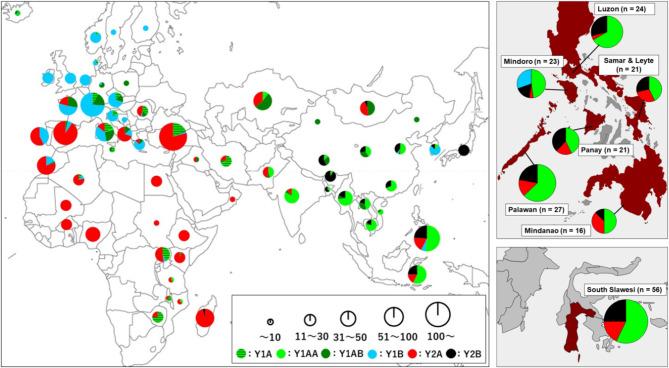
The Philippines and Indonesia, located at the crossroads of historical human migrations in the Asia-Pacific region, lie in the southeasternmost part of Mainland Southeast Asia. Both countries are recognized as mega-diverse nations, hosting a wide variety of species. However, the history of goat propagation in Island Southeast Asia remains unclear due to limited molecular studies and the absence of archaeological evidence in this region. This study conducted phylogeographic analyses of mtDNA hypervariable region 1 and SRY 3'UTR sequences of goats from the Philippines and Indonesia, comparing them with Old World domestic goats. Philippine goat mtDNA haplotypes were classified into haplogroups B (152/206, 73.8%) and A (54/206, 26.2%), whereas all Indonesian goat mtDNA haplotypes belonged to haplogroup B (72/72, 100%). The distribution of mtDNA haplogroup B and regional differences suggest two propagation routes: one from China/Taiwan to the Philippines and another from Mainland Southeast Asia to Indonesia. The distribution of five SRY haplotypes demonstrated that haplotype Y2A, absent in Mainland Southeast Asia, was present in Island Southeast Asia, indicating gene introgression through the Indian Ocean from the African continent and/or southern Europe. This introgression may have been driven by human activities, such as European migrations between the 16th and 19th centuries.
菲律宾和印度尼西亚位于亚太地区历史上人类迁徙的十字路口,地处东南亚大陆的最东南部。这两个国家均被视为生物多样性大国,拥有各种各样的物种。然而,由于该地区分子研究有限且缺乏考古证据,东南亚岛屿地区山羊的繁殖历史仍不明确。本研究对来自菲律宾和印度尼西亚的山羊的线粒体DNA高变区1和SRY 3'非翻译区序列进行了系统地理学分析,并将它们与东半球的家养山羊进行比较。菲律宾山羊的线粒体DNA单倍型被分为B单倍群(152/206,73.8%)和A单倍群(54/206,26.2%),而所有印度尼西亚山羊的线粒体DNA单倍型均属于B单倍群(72/72,100%)。线粒体DNA B单倍群的分布和区域差异表明存在两条传播路线:一条是从中国/台湾到菲律宾,另一条是从东南亚大陆到印度尼西亚。五种SRY单倍型的分布表明,东南亚大陆不存在的Y2A单倍型在东南亚岛屿地区存在,这表明存在从非洲大陆和/或南欧通过印度洋的基因渗入。这种基因渗入可能是由人类活动驱动的,比如16至19世纪的欧洲移民。


 Zotero 插件