Janni W, Rack B, Friedl T W P, Hartkopf A D, Wiesmüller L, Pfister K, Mergel F, Fink A, Braun T, Mehmeti F, Uhl N, De Gregorio A, Huober J, Fehm T, Müller V, Rich T A, Dustin D J, Zhang S, Huesmann S T
Department of Obstetrics and Gynecology, University Hospital Ulm, Ulm, Germany.
Department of Obstetrics and Gynecology, University Hospital Ulm, Ulm, Germany; Department of Obstetrics and Gynecology, University Hospital Tübingen, Tübingen, Germany.
ESMO Open. 2025 Apr;10(4):104296. doi: 10.1016/j.esmoop.2025.104296. Epub 2025 Mar 22.
Detection of minimal residual disease (MRD) in early breast cancer (EBC) after curative-intent treatment may identify patients at risk for recurrence. Most circulating tumor DNA (ctDNA)-based MRD assays require knowledge of genomic alterations from tumor tissue. However, tissue availability may be limited in some patients. Here, we evaluated sensitivity and specificity for recurrence detection, using a plasma-only ctDNA MRD assay.
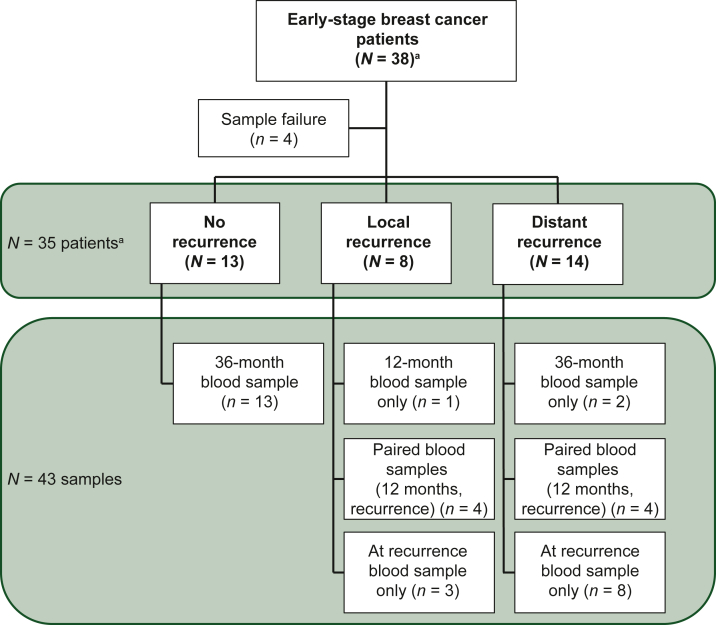
For this pilot study, 47 plasma samples from 38 EBC patients were collected at 12 or 36 months post-diagnosis or at clinical recurrence. ctDNA presence was determined by a custom bioinformatics classifier that identifies tumor-derived somatic variants and methylation profiles specific to individual cancer types using a 5-Mb next-generation sequencing panel.
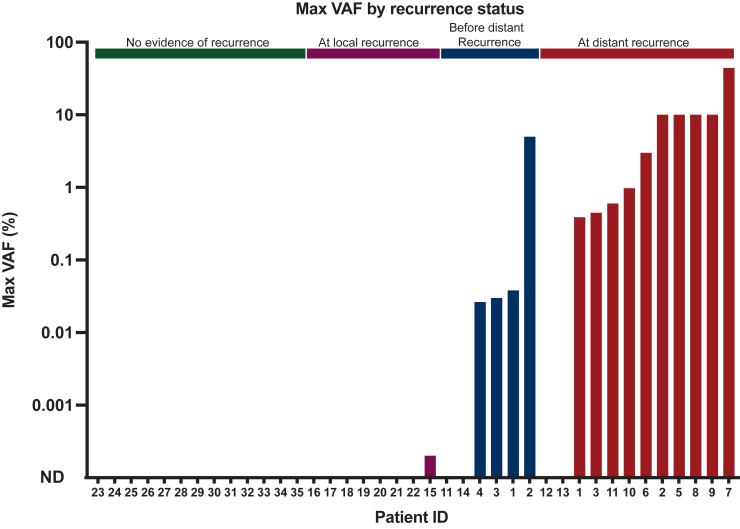
ctDNA was detected at or before distant recurrence in 11/14 (79%) patients [sensitivity was 85% (11/13) among samples collected within 2 years from recurrence]. Lead time was evaluable in 4/6 (67%) samples collected before distant recurrence with detectable ctDNA and ranged from 3.4 to 18.5 months. ctDNA was not detected in samples from patients without recurrence (n = 13).
This study demonstrates the feasibility of MRD detection in EBC using a plasma-only multiomic ctDNA-based approach. Larger studies are ongoing to further validate the clinical performance of the assay and demonstrate its applications.
在早期乳腺癌(EBC)进行根治性治疗后检测微小残留病(MRD),可能识别出有复发风险的患者。大多数基于循环肿瘤DNA(ctDNA)的MRD检测需要了解肿瘤组织的基因组改变。然而,在一些患者中组织获取可能受限。在此,我们使用仅基于血浆的ctDNA MRD检测方法评估了复发检测的敏感性和特异性。
在本前瞻性研究中,收集了38例EBC患者在诊断后12个月或36个月、或临床复发时的47份血浆样本。使用定制的生物信息学分类器确定ctDNA的存在,该分类器使用5兆碱基的新一代测序面板识别特定于个体癌症类型的肿瘤衍生体细胞变异和甲基化谱。
在14例患者中有11例(79%)在远处复发时或之前检测到ctDNA[在复发后2年内采集的样本中敏感性为85%(11/13)]。在远处复发前采集的6份可检测到ctDNA的样本中有4份(67%)可评估提前期,范围为3.4至18.5个月。在无复发患者的样本中未检测到ctDNA(n = 13)。
本研究证明了使用仅基于血浆的多组学ctDNA方法在EBC中检测MRD的可行性。正在进行更大规模的研究以进一步验证该检测方法的临床性能并展示其应用。