Lin Shin-Yi, Liu Yen-Bing, Ho Li-Ting, Kuo Ching-Hua, Peng Yu-Fong, Huang Chih-Fen, Tang Sung-Chun, Jeng Jiann-Shing
Department of Pharmacy, National Taiwan University Hospital, Taipei, Taiwan.
School of Pharmacy, National Taiwan University, Taipei, Taiwan.
Clin Pharmacol Ther. 2025 Jul;118(1):156-163. doi: 10.1002/cpt.3654. Epub 2025 Mar 25.
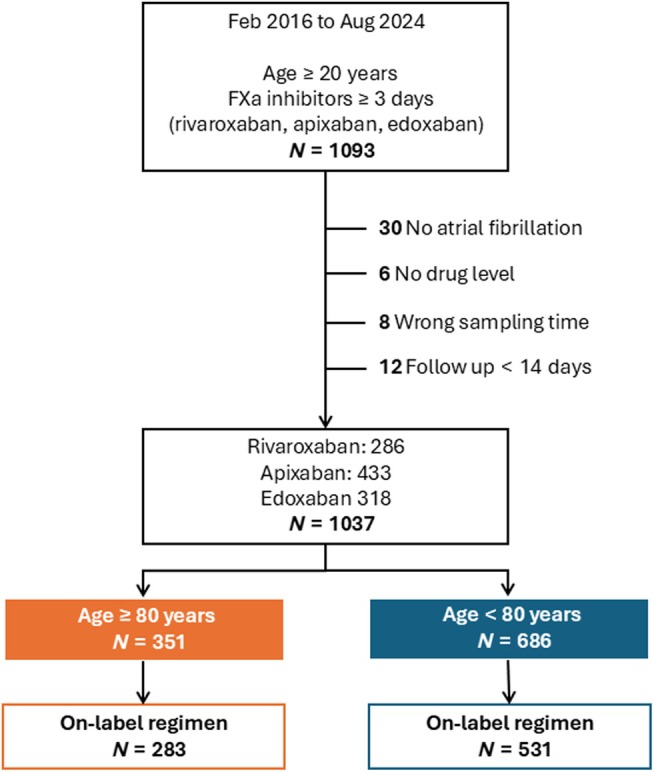
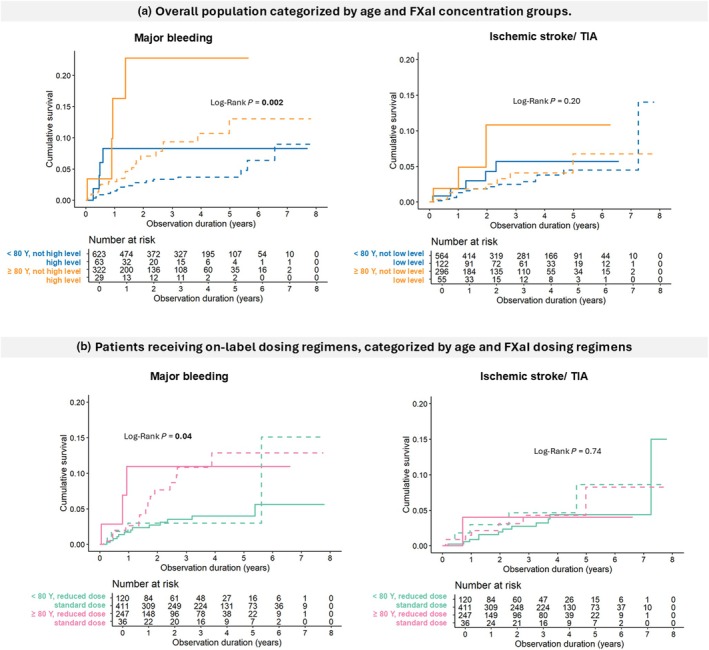
This study aimed to analyze differences in the exposure-response relationship for factor Xa inhibitors (FXaI) between patients aged ≥ 80 and < 80 years. Patients with atrial fibrillation (AF) taking rivaroxaban, apixaban, or edoxaban were enrolled, and a single steady-state trough concentration was measured. FXaI concentrations were compared with the expected range reported in clinical trials to define high or low drug levels. The primary outcome was major bleeding, and the secondary outcome was ischemic stroke or transient ischemic attack (IS/TIA). From 2016 to 2023, 1,037 patients aged from 30 to 105 years were enrolled (average, 75.4 ± 10.0 years; 33.8% were aged ≥ 80 years). During a median follow-up of 2.35 years, 48 major bleeding events and 32 IS/TIA events were observed. Although drug concentrations were similar between the two age groups, those aged ≥ 80 years with high FXaI levels experienced a greater increase in major bleeding risk compared to those aged < 80 years with high levels (aHR 6.47 [2.07, 20.28] vs. 3.45 [1.15, 10.30]). Additionally, patients aged ≥ 80 years without elevated FXaI levels also had a higher risk of major bleeding compared to those aged < 80 years without elevated levels (aHR 2.39 [1.20, 4.76]). While low FXaI concentrations were associated with IS/TIA, the risk was not significantly different across age groups. In conclusion, despite similar FXaI concentrations, patients aged ≥ 80 years have a higher baseline risk of major bleeding and experience a greater increase in bleeding risk at high drug levels compared to those aged < 80 years.
本研究旨在分析年龄≥80岁和<80岁患者之间,凝血因子Xa抑制剂(FXaI)暴露-反应关系的差异。纳入服用利伐沙班、阿哌沙班或依度沙班的房颤(AF)患者,并测量单一稳态谷浓度。将FXaI浓度与临床试验报告的预期范围进行比较,以定义药物水平的高或低。主要结局为大出血,次要结局为缺血性卒中或短暂性脑缺血发作(IS/TIA)。2016年至2023年,纳入了1037例年龄在30至105岁之间的患者(平均年龄75.4±10.0岁;33.8%的患者年龄≥80岁)。在中位随访2.35年期间,观察到48例大出血事件和32例IS/TIA事件。尽管两个年龄组的药物浓度相似,但与FXaI水平高的<80岁患者相比,FXaI水平高的≥80岁患者大出血风险增加更大(调整后风险比[aHR]为6.47[2.07,20.28] vs. 3.45[1.15,10.30])。此外,与FXaI水平未升高的<80岁患者相比,FXaI水平未升高的≥80岁患者大出血风险也更高(aHR 2.39[1.20,4.76])。虽然低FXaI浓度与IS/TIA相关,但各年龄组的风险无显著差异。总之,尽管FXaI浓度相似,但与<80岁的患者相比,≥80岁的患者大出血的基线风险更高,且在药物水平高时出血风险增加更大。