Alhaddad Fedae, Abu-Dieyeh Mohammed, Jaoua Samir, Al-Ghouti Mohammad A, Al-Thani Roda, Ahmed Talaat
Biological Science Program, Department of Biological and Environmental Sciences, College of Arts and Sciences Qatar University Doha Qatar.
Environmental Science Program, Department of Biological and Environmental Sciences, College of Arts and Sciences Qatar University Doha Qatar.
Plant Direct. 2025 Mar 24;9(3):e70026. doi: 10.1002/pld3.70026. eCollection 2025 Mar.
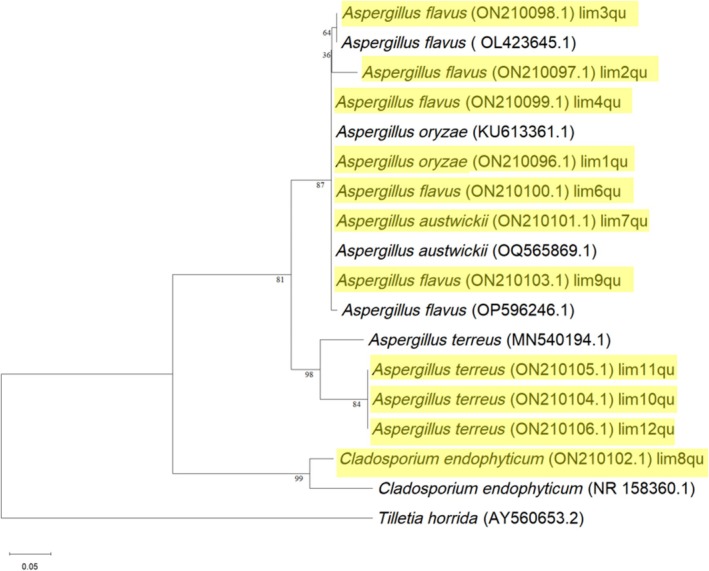
Halophytes, plants that thrive in high-salinity environments, host unique microbial communities, including fungal endophytes, which contribute to plant growth and pathogen resistance. This study aimed to isolate, identify, and evaluate the antagonistic potential of fungal endophytes from the halophytic plant , collected from both inland and coastal habitats. Fungal endophytes were isolated, identified via molecular techniques, and tested for antagonistic activity against phytopathogenic fungi using dual-culture assays. The results showed a diverse range of fungal endophytes, with and being the dominant genera. A total of 152 endophytic fungi were isolated from both locations, with 95 isolates coming from coastal plants and 57 from inland species. The isolates exhibited varying degrees of antagonistic activity against phytopathogens, highlighting their potential role in plant protection. Further research is needed to clarify these interactions' mechanisms and investigate their practical applications in agriculture. An endophytic isolate of strain ((AL10) lim10qu) (ON210104.1) exhibited potent in vitro antifungal activity against , a pathogenic fungus affecting tomato plants. Greenhouse experiments demonstrated that the fungus significantly increased both the length of tomato seedlings and the overall plant biomass. Both laboratory-based (in vitro) and field-based (in vivo) evaluations of the strain ((AL10) lim10qu) () against suggest the promising role of endophytes as effective biological control agents. Analysis using Gas Chromatography-Mass Spectrometry of the fungal extract detected around 100 compounds (secondary metabolites). In addition to gradually reducing the need for chemical fungicides, bio-products can also contribute to sustainable agriculture.
盐生植物是能在高盐环境中茁壮成长的植物,它们拥有独特的微生物群落,包括真菌内生菌,这些内生菌有助于植物生长和抵御病原体。本研究旨在从内陆和沿海栖息地采集的盐生植物中分离、鉴定并评估真菌内生菌的拮抗潜力。分离出真菌内生菌,通过分子技术进行鉴定,并使用双培养试验测试其对植物致病真菌的拮抗活性。结果显示真菌内生菌种类多样,其中[具体属名1]和[具体属名2]为优势属。从这两个地点共分离出152株内生真菌,其中95株分离自沿海植物,57株分离自内陆植物。这些分离株对植物病原体表现出不同程度的拮抗活性,突出了它们在植物保护中的潜在作用。需要进一步研究以阐明这些相互作用的机制,并研究它们在农业中的实际应用。一种[具体菌株名]的内生分离株((AL10) lim10qu) (ON210104.1)对[具体病原菌名]表现出强大的体外抗真菌活性,[具体病原菌名]是一种影响番茄植株的致病真菌。温室试验表明,该真菌显著增加了番茄幼苗的长度和整株植物的生物量。对((AL10) lim10qu) ()菌株进行的基于实验室(体外)和田间(体内)的评估均表明内生菌作为有效的生物防治剂具有广阔前景。使用气相色谱 - 质谱联用仪对真菌提取物进行分析,检测到约100种化合物(次生代谢产物)。除了逐渐减少对化学杀菌剂的需求外,生物制品还可促进可持续农业发展。